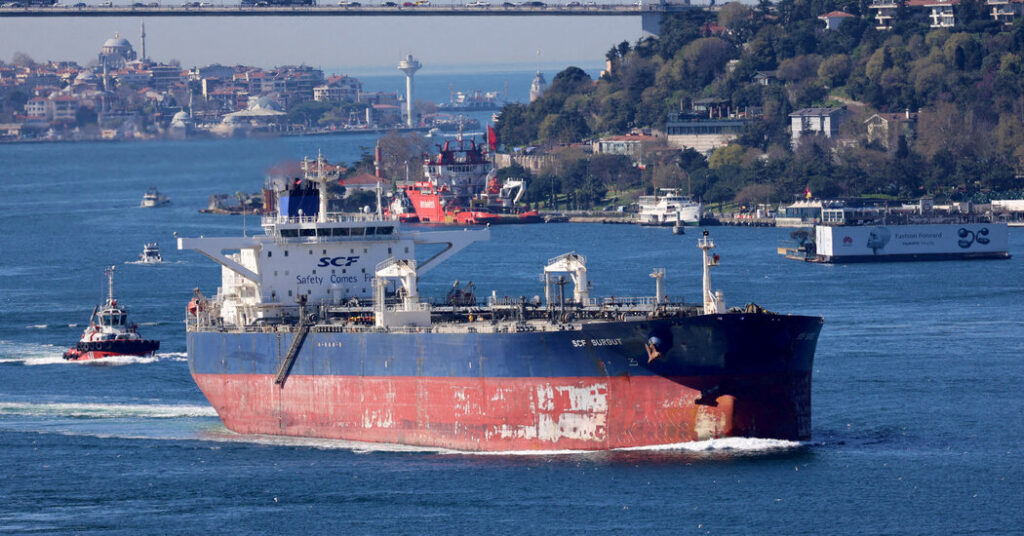
Indian officials spent six months in agony after President Trump decided last summer to punish the country for buying crude oil from Russia, as they struggled to negotiate around his demand. Mr. Trump exerted pressure by placing sanctions on some Indian refiners and imposing a punishing 50 percent tariff on Indian goods to cut into revenue for what he called Moscow’s “war machine.”
This week, after joining Israel to launch a war against Iran, Mr. Trump made it nearly impossible for India to get oil from its alternative suppliers, which are mostly in the Persian Gulf, with supplies from the region cut off by the fighting that has escalated since it began on Saturday. That leaves India with few options to feed its growing economy’s need for fuel, 90 percent of which it imports. Russia looks like the obvious solution.
Sumit Ritolia, a research analyst at Kpler, which tracks international shipping, said that “we may see increased sourcing” of Indian supplies from Russian tankers. But it’s not visible yet. It takes nearly a month for tankers loaded in Russia to reach Indian ports.
Rajeev Lala, a director at S&P Global Energy who follows India’s state-owned oil companies, said India’s recent experience buying and refining large quantities of seaborne crude from Russia proved that it could do without buying very much from the Gulf. It is well positioned to pick up where it left off when, in recent months, it started tapering its Russian purchases.
“India is better placed to restart the Russia supply chain, whereas others will need to work harder — if Gulf supplies are to stay shut for long,” Mr. Lala said.
India’s refineries are already rigged to process Russian supplies, and its shipping and insurance agents have their Russian contacts at the ready. It could ramp up imports of Russian oil.
On Thursday, Scott Bessent, the U.S. Treasury Secretary, said in a social media post that the Trump administration would grant India a limited, 30-day waiver to buy sanctioned Russian oil currently stranded at sea to keep oil “flowing into the global market.”
Four weeks ago, India and the United States settled their trade war. In the bargain, India agreed to quit buying oil from Russia, according to the official American account.
That meant that Indian buyers would forgo the discounts that had saved billions of dollars since the start of the war in Ukraine. They had been buying Russian crude on the cheap, refining it and selling those products on to Europe, which has sharply curtailed its trade with Russia.
Barely a week later, the Supreme Court invalidated the tariffs that Mr. Trump had used to force India into that deal. There are other ways that the Trump administration can compel India to buy less Russian oil, for instance by threatening penalties on companies that buy from its biggest oil firms, or by finding some new legal basis for tariffs.
There are not many other places for India to turn for oil right now. Its main suppliers used to be Iraq and Saudi Arabia, and Kuwait and Oman were expected to make up much of the balance. But the Strait of Hormuz, a narrow waterway on Iran’s southern border that carries much of the Gulf’s energy exports, is all but closed by a barrage of drones and missile fire.
Russian oil, by contrast, sails to India by several routes. From Russia’s western ports, oil can be shipped through the Mediterranean, the Suez Canal and the Red Sea to reach India’s west coast. Some has been shipped from the Russian Far East, too, though that may be diverted to buyers in East Asia who are also seeking alternatives to Persian Gulf supplies.
Shipments from Russia are slower to reach India than tankers from the Gulf, which take less than a week. But a large amount of Russian oil is sitting in tankers on the open sea — Mr. Ritolia of Kpler estimated more than 30 million barrels this week, or enough to fulfill six days of India’s demand.
Mr. Lala of S&P Global Energy noted that in recent years India had become comfortable simply buying crude oil, without investing in exploration or drilling projects of its own, in the Gulf or elsewhere. “The idea was, ‘Keep calm, and keep on buying,’” he said. But with supplies being pinched in Russia and the Gulf, that may need to change.
Alan Rappeport contributed reporting from Washington.
Alex Travelli is a correspondent based in New Delhi, writing about business and economic developments in India and the rest of South Asia.
The post War in the Gulf Could Turn India Back Onto Russian Oil appeared first on New York Times.