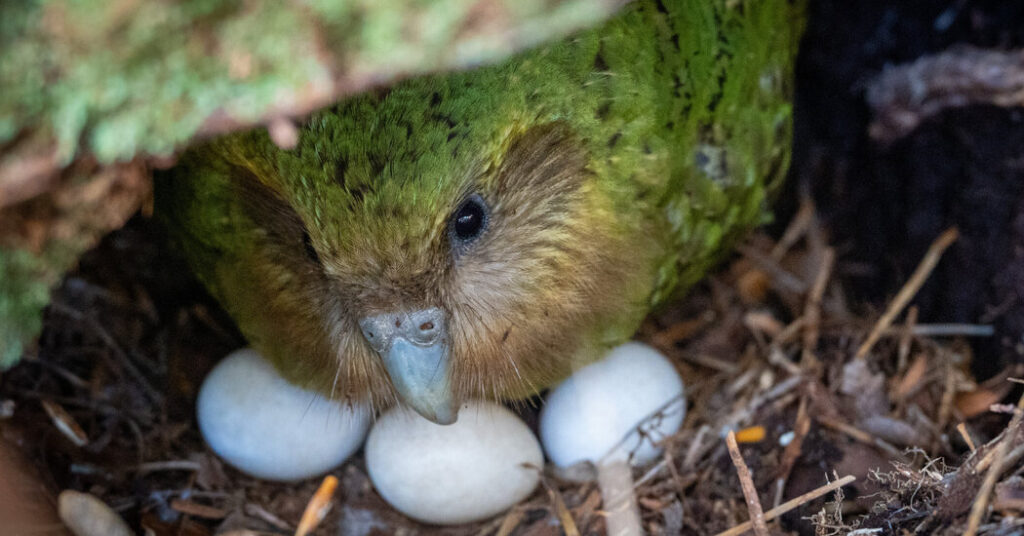
Not all superfoods are indeed super, but one just might help save a critically endangered parrot species that can be found only in New Zealand: the kakapo.
The peculiar birds are mating at a record pace this year, making the most of one of the best bumper crops in decades of the fruit from coniferous rimu trees, according to scientists.
The fruit, which resembles bright red berries, is rich in calcium and vitamin D, providing what researchers described as critical nourishment to chicks.
So far this year, 52 chicks have hatched on several sanctuary islands off the country’s South Island, said Andrew Digby, a scientist and kakapo specialist at New Zealand’s Department of Conservation.
Not all are expected to survive, but Dr. Digby said the number was likely to surpass the 73 chicks that hatched in 2019, a record for the reclusive and flightless parrot species that currently counts 236 adults. Three decades ago, he said, there were 51 adults.
“Maybe in the next five, 10 years, we might have got them to the next step away from extinction,” Dr. Digby said in an interview on Thursday.
Kakapo is a combination of the Maori words for parrot (kaka) and night (po). The overwhelming majority of people have never seen one of the nocturnal parrots in person, according to scientists, who brought three to a sanctuary on New Zealand’s North Island and use helicopters to relocate the birds.
The average life span of the parrots is about 60 years, with some living as long as humans, said Dr. Digby, who was monitoring the mating frenzy on Anchor Island, a small refuge off New Zealand’s southwestern coastline that is known for lacking of the kind of predators that threaten the parrots. Among them are cats, dogs, stoats and weasels.
Each adult kakapo wears a transmitter that Dr. Digby and his colleagues use to the track the birds, which use their chartreuse color as camouflage.
“They wear them like a backpack,” he said. “They’re a little bit like a Fitbit. We can see if they’re nesting. We can even see who has mated and who they’ve mated with and how long they’ve mated for.”
As of Thursday, 245 eggs had been laid this year, 139 of which were fertile, Dr. Digby said.
Marlene Zuk, an evolutionary biologist at the University of Minnesota, said many plants experience boom-or-bust cycles in the way that the rimu trees were yielding an abundance of fruit for the kakapo.
“Maybe a good analogy is a lot of people are familiar with oak trees having what are called mast years, meaning that there are some years where the ground is just strewn with acorns, and lots and lots of animals, say wild turkeys, will benefit from that,” Dr. Zuk said.
Even though they don’t fly, the parrots will climb to great heights, sometimes 100 feet into the tree canopy, to pick the fruit, according to Dr. Digby, who said adults can weigh up to nine pounds. Their faces are owlish.
“I’ve stood two meters away from a kakapo and, literally, could not see it because it’s so well camouflaged,” he said.
But Dr. Digby said he knew it was nearby because of its distinctive sweet, musty smell.
Alexander Boast, a paleoecologist at the Bioeconomy Science Institute in New Zealand, said it was important to understand what other plants could sustain the kakapo species because rimu trees were slow-growing and had been decimated by logging.
“Despite claims that the birds are somehow ‘designed to go extinct,’ this all really shows they are beautifully adapted to their natural habitat, and their quirky breeding system is a brilliant solution to ensuring that their chicks have a rich source of food,” he said via email.
The male kakapo is known for its low-frequency mating call, known as a boom — think of a bassoon, only deeper.
And some guys, it seems, have all the luck. Take a male kakapo named Blades, who had at least 22 chicks, prompting scientists to remove him from the breeding system.
“He’s been banished to a male-only island, unfortunately for him,” Dr. Digby said.
The more genetic diversity that the species can achieve, scientists said, the better its chances of thriving and building up resistance to diseases.
“I think this showcases how hard it is to bring species back from the brink, especially when they are, as these birds are, highly specialized, long lived, large bodied,” Dr. Zuk said. “It’s not like breeding up cockroaches. You really, really need to do a lot to help an animal like this. We’re all rooting for them.”
Neil Vigdor covers breaking news for The Times, with a focus on politics.
The post Superfood Fuels Mating Frenzy for a Critically Endangered Parrot appeared first on New York Times.