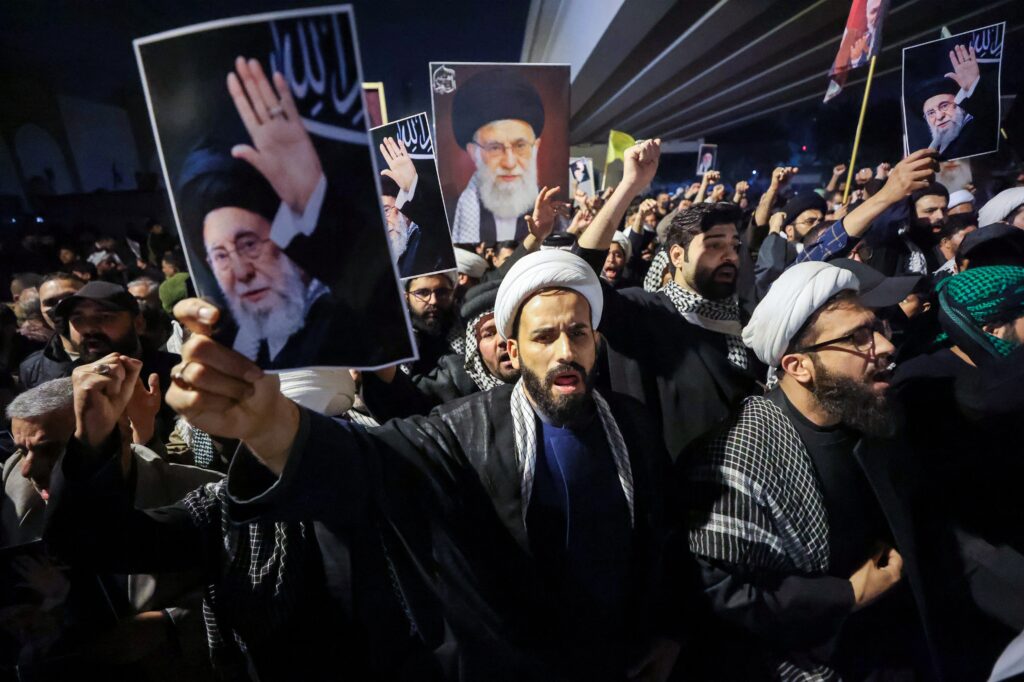
President Donald Trump said about the airstrike that killed Iranian Supreme Leader Ali Khamenei a week ago: “I got him before he got me.” Iran had plotted to assassinate Trump, he explained. “Well, I got him first.”
Few people outside of Iran will mourn Khamenei, who devoted himself to a decades-long campaign to kill Americans, Israelis and his own dissidents. But Trump’s comment indicates how targeted killing — assassination, in blunt terms — has become normalized in modern warfare. Gangland terms like “getting him” and “taking him out” are now commonplace.
“Decapitation” is emerging as the American way of war, after two frustrating decades of unsuccessful “nation building” in Iraq and Afghanistan. A week into the Iran campaign with Israel, the United States’ goal seems to be destruction of Iran’s leadership and military infrastructure — with an ill-defined hope that a better regime will rise from the rubble.
It’s the strategic equivalent of a “fire and forget” missile. The goal is to destroy the Iranian regime’s leadership and structure of repression. Building a new Iran is an afterthought. “Maybe we’ll get lucky,” one key member of Congress mused to me. But U.S. intelligence analysts have assessed that this campaign has a low likelihood of creating a stable, modernizing government, according to people who have read the intelligence reports.
Trump, in one of his stream-of-consciousness soliloquies last week, explained the difficulty with his decapitation strategy. Asked who the United States would negotiate with when the bombing campaign ends, Trump answered: “Most of the people we had in mind are dead. … Pretty soon, we’re not going to know anybody.”
Secretary of State Marco Rubio told members of Congress this week that the United States would finish its demolition of the regime — and then gauge the prospects for political reconstruction. That strikes me as a triumph of tactics over strategy — knock it down and then think about how to rebuild. It didn’t help when Trump proclaimed Thursday that he should be involved in choosing Iran’s next leader.
Rather than risking American “boots on the ground” to help build a new Iran, Trump is offering support for Iranian opposition groups, including air cover for Kurdish militias. That kind of approach has been considered by U.S. and Israeli officials ever since the 1979 Iranian Revolution — but was abandoned because it risks producing a fragmented and chaotic Iran that compounds the region’s instability.
“The regime is a fabric, and Trump has yet to unravel that weave,” cautions one of the CIA’s most experienced Iran experts. “The fabric of the regime must be changed if we are going to change its approach to decision-making.”
America’s new enthusiasm for assassination may compound the problem. Here’s how Jonny Gannon, a recently retired CIA officer with extensive Iran experience, weighs the balance:
“Assassination can help you remove a node and disrupt a larger network. It can signal resolve without mass mobilization. It can help you avoid a larger war by applying selective violence, and, maybe, if fortune favors you, help shape succession in your favor,” he texted me. “But it comes with risks — martyrdom effects; hard-liner succession; erosion of norms; and intelligence degradation (because dead men don’t talk).”
Israel for decades has used assassination and decapitation strategies against its adversaries in Gaza, the West Bank, Lebanon, Syria and Iran. “Since World War II, Israel has assassinated more people than any other country in the Western world,” writes Ronen Bergman in his detailed history of these operations, “Rise and Kill First: The Secret History of Israel’s Targeted Assassinations.”
Israel showed “impressive operational capabilities,” Bergman writes, but paid a “high moral price.” These tactics may have been necessary, given Israel’s unrelenting terrorist enemies. But it’s hard to argue that they’ve been successful, given the recurring cycles of violence that Israeli officials came to describe as “mowing the grass.”
Assassination is forbidden for the United States. Executive Order 12333, signed by President Ronald Reagan in 1981, states: “No person employed by or acting on behalf of the United States Government shall engage in or conspire to engage in assassination.”
The original order, issued by President Gerald Ford after the Church Committee investigation of the CIA in 1976, banned only “political assassination” and didn’t extend to those “acting on behalf of” the United States. But the rule was tightened by President Jimmy Carter in 1978 and reaffirmed by Reagan.
Despite the 1981 ban, “Reagan and every president since then have arguably either violated the order on its face or expressed an intent to do so,” writes Stephen Knoepfler in an extensive law review article. Targets included Col. Moammar Gaddafi’s compound in Libya, Saddam Hussein’s presidential palace in Baghdad and Osama bin Laden’s training camp in Afghanistan.
“Targeted killing in the War on Terror was a gateway drug to what we have now,” a former top national security official told me. According to Bergman’s book, U.S. targeted killings of alleged terrorists rose from 48 under President George W. Bush to 353 under President Barack Obama.
Targeted killing has become much easier thanks to exquisite intelligence that can locate people and precision munitions that can destroy them. Technology is seductive: The long slog of conventional war can seem like a waste of time and lives when you can vaporize an enemy’s leaders in a moment.
But these tools will be available to adversaries, too. Mustafa Suleyman, one of the pioneers of artificial intelligence, wrote about the “Hezbollahization” of technology in his 2023 book, “The Coming Wave.” He warned of “a splintered, tribalized world where everyone has access to the latest technologies.” Gannon, the former CIA officer, asks: “Are we ready for our ambassadors and other officials overseas to more commonly become targets?”
President Trump is right to seek the end of the cruel regime in Iran. But he needs to think more carefully about how to create a stable Iran after the war is over. And we all need a serious debate about how to avoid creating a global shooting gallery and a perpetual high-tech gang war.
The post The dangerous rise of decapitation warfare appeared first on Washington Post.