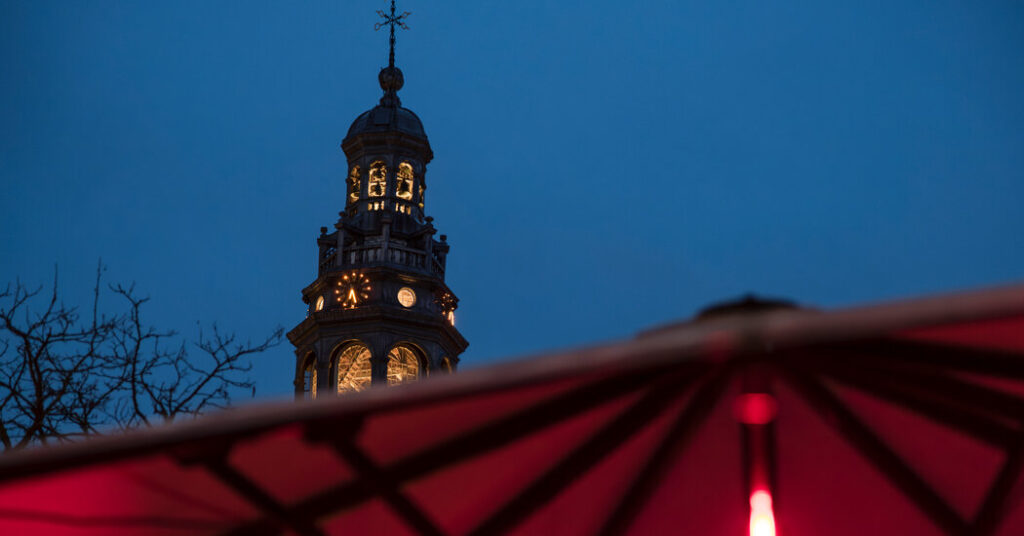
People who live in Maastricht like to say that theirs is the most French of Dutch cities.
It is a place of outdoor cafes, small boutiques, cobblestone streets, and restaurants and hotels that carry French names like Petit Bonheur and Au Quartier.
Unlike Amsterdam, with its many tourists and more bicycles than residents, Maastricht is a place of calm. Residents of a certain age dress up to go to the market and walk arm in arm in the pedestrian-only city center, where cycling is banned when shops are open.
“When my friends come from Amsterdam, they feel a little like they are on a French vacation,” said Isabel Mesterom, a young accountant who was working part-time at the Café Charlemagne. “And we dress more fine and less baggy than in Amsterdam. We’re more chic.”
Camille Oostwegel Sr., a retired owner of a string of luxury hotels, added, “We like to say that Maastricht is a tiny Paris.”
For nearly two decades, Oostwegel, who counts Charlemagne as one of his ancestors, served as the French government’s honorary consul. He has hosted presidents, prime ministers and kings at his signature hotel, the Château Neercanne, which was used for meetings and meals during negotiations for the Maastricht Treaty that created the European Union in 1992. According to Oostwegel’s autobiography, President François Mitterrand was so moved by the baroque gardens of the château during a visit the previous year that he exclaimed, “Monsieur, this is France here.”
Visitors to the European Fine Art Foundation fair in Maastricht, which runs March 14-19, will see signs of the French connection wherever they go, as it is deeply rooted in geography, history, language and gastronomy.
A strategic fortress city since ancient Roman times, it is part of the province of Limburg, a misshapen, illogical panhandle that juts deep into Belgium and Germany. Maastricht, the southernmost city in the Netherlands, sits on the border with French- and Flemish-speaking Belgium.
French has long dominated the culture of the city. The dialect still spoken by many families in Maastricht has a soft French feel that sounds different from standard Dutch with its hard guttural consonants. French words like“coiffeur” and “bougie” (candle) season the dialect.
French was the language of education, commerce and the bourgeoisie in the 18th and 19th centuries. A French-language newspaper was once published and read in Maastricht, and schoolchildren once learned French as their second language.
Then there is history. France captured and occupied Maastricht several times.
The most dramatic siege came in 1673 when the 34-year-old Louis XIV was here to lead the victory over Maastricht. The siege was so important a propaganda tool and a celebration of the king’s glory that it was immortalized in paintings in Versailles’s Hall of Mirrors.
Architectural remnants of that siege remain. The Fort Sint Pieter was built on a hill outside the city to defend the valleys below after the French breached the fortifications in 1673. Remains of walls and ramparts, some of which defended against French sieges, survive in parks and the city center.
Most important for stamping Frenchness into Maastricht was Napoleon. The people of Maastricht historically opposed both Dutch rule and its austere way of life and embraced Napoleon, who brought a new vision and legal structure.
In 1794, the region in and around Maastricht was seized by France and became part of the First Republic, removing ties to feudal society, instituting the Napoleonic Code, and making the area with Maastricht as its capital one of France’s administrative “départements.”
Napoleon is still beloved here. A marble bust of the French emperor along with tapestries and an imposing marble fireplace adorn City Hall’s Chamber of the Princes. “He looks very nice here,” said Vicky Maesen, the chief of protocol. “He was a handsome guy.”
The Maastricht Museum displays skeletons of horses killed during Louis XIV’s siege, a vast scale model of the city commissioned by Louis XV after he conquered the city in 1748 and an authentic guillotine used from 1798 on under Napoleonic rule.
“Can I tell you something: We didn’t like the Dutch,” said Jos Welie, a tour guide. “We were Catholics and the Dutch were Calvinists, terrible people. I ask tourists all the time whether they think Napoleon was a dictator — and they all say yes. And I tell them that before he became a dictator, he was faithful to the ideas of the French Revolution and equality for all.”
In the city archives for Maastricht, Truus Roks, one of its administrators, enjoys showing off vestiges of the Napoleonic era: a formal decree signed by Napoleon that reinstated a title to an aristocratic family and a handwritten document registering the first act of divorce in the Netherlands under the Napoleonic Code.
She is proudest of an even more personal tribute to Napoleon’s rule. “May I show you my babies?” she asked. Laid out on a table covered in black fabric was an array of tiny possessions that could have been used to identify foundlings housed in a home created in 1803. They included a tangle of orange wool, a piece of braided yarn, half of a playing card, and part of a page torn from a book. “One part was left with the child; the other was kept by the poor mother,” she said. “You don’t get any closer to history than this. We have many blessings here thanks to Napoleon. It gives me goose bumps.”
Maastricht also was immortalized in French literature. This is where Louis XIV’s commander and most famous Musketeer, Charles de Batz de Castelmore d’Artagnan, died a hero in his early 60s when a musket ball tore into his throat in the 1763 siege. Alexandre Dumas made d’Artagnan famous in transforming his life story into gripping fictional adventures of bravery, camaraderie, loyalty, and yes, sex, in the “D’Artagnan romances,” which comprise “The Three Musketeers” and its two sequels.
Maastricht celebrates his memory. In Aldenhofpark, a bronze statue of d’Artagnan erected in 2003 stands near the spot where the Musketeer lost his life. D’Artagnan, depicted as a young man, holds his sword in his right hand; a glove sits at his feet. His most famous words, “One for all, all for one,” are etched in French into the base.
A mosaic commemorating him decorates a brick building nearby. A D’Artagnan Route has been created for equestrians, pedestrians and bikers. The main Maastricht theater has named a room after him. Château Neercanne and the Maastricht beer brewer Zuyd Craft have created a d’Artagnan beer.
D’Artagnan’s body was never found and some d’Artagnan lovers believe he was buried below Saint Peter and Paul Church in the district of Wolder. Louis XIV set up his headquarters there and attended mass in the church every day.
“A personage like d’Artagnan had to be buried near the church,” said Oostwegel, who is pressing for a full-scale investigation. “If we find the body, I’m sure the president of France would bury him in the Pantheon.”
Finally comes a more important but less tangible quality: the feel of the place. Maastricht’s unofficial nickname is “the city of good taste,” a spirit dating back to the Middle Ages when Burgundian dukes controlled eastern France and much of Belgium and the Netherlands.
Residents speak of the “Burgundian” lifestyle marked by the area’s attachment to the rituals and rites of Catholicism (compared to austere Dutch Protestantism) and an appreciation for fine food and good wine.
France inspired such popular dishes as boeuf bourguignon (a “sour meat” version), tête de veau and stewed rabbit. The Mes Amis restaurant offers only a multicourse dinner menu (no fewer than five courses), each paired with a different wine.
“The Dutch say ‘Don’t stand out, don’t exaggerate,’” said Marnix van Wijk, project manager of culture and heritage at Maastricht Marketing. “Here, we like to enjoy ourselves, to dress up, to eat well, to take our time — as if we were in Paris.”
The outdoor food market sells products like bottled French fish soup and lobster bisque. Mitchel Sauer, the owner of a small cheese-making enterprise who sells in the market, takes pride in the mature cheeses he sells alongside giant rounds of sweet-smelling young Gouda.
“The tastes and smells in the south are different from the north,” he said. “Because of the French influence, we appreciate stinky cheeses.”
Elaine Sciolino, a contributing writer and former Paris bureau chief for The Times, is the author most recently of “Adventures in the Louvre: How to Fall in Love with the World’s Greatest Museum,” published in paperback in March.
Elaine Sciolino is a former Paris bureau chief for The Times and the author, most recently, of “Adventures in the Louvre: How to Fall in Love with the World’s Greatest Museum.”
The post Welcome to Maastricht, Where All Things French Flourish appeared first on New York Times.