For the last 12 years, Nicolas Edelman has been changing the clothes of a little boy who never gets older, and who never stops peeing.
That boy, the small bronze fountain at a corner in Brussels known as Manneken Pis, is feted like a local celebrity and visited by millions of tourists each year.
The Manneken Pis — meaning little urinating man — is a beloved symbol of the Belgian capital, synonymous with the city’s mischievous sense of humor (known as “zwanze” humor), its rebellious spirit and its folkloric roots.
Visitors to the art fair TEFAF, this year taking place March 14-19, often stop in Brussels on their way to or from Maastricht, which is about an hour and a half away by car. The little boy is a key attraction, but his fancy wardrobe is not to be missed.
Edelman is the official dresser of the child, and he helps him with a selection of more than 1,190 outfits. The little boy receives 20 to 30 new costumes as gifts each year, often for ceremonial events at the fountain. In 2025 alone, he had 213 outfit changes.
“It’s a job that’s unique in the world,” Edelman said in a video interview. “And I’m very proud to do it.”
Edelman, an administrative assistant for the city of Brussels, said the responsibility of dressing the Manneken Pis, coordinating his schedule and planning his events, was just part of his work as a civil servant for the city’s department of culture. He is one of many official dressers who have served the Manneken Pis since 1755.
“You can’t apply for this job,” explained Marc Boutsen, who works with Edelman as an assistant dresser. “You have to be asked, and that’s why it feels like an honor. When they ask you, it means that you have a big heart for this city, that you embrace all its traditions.”
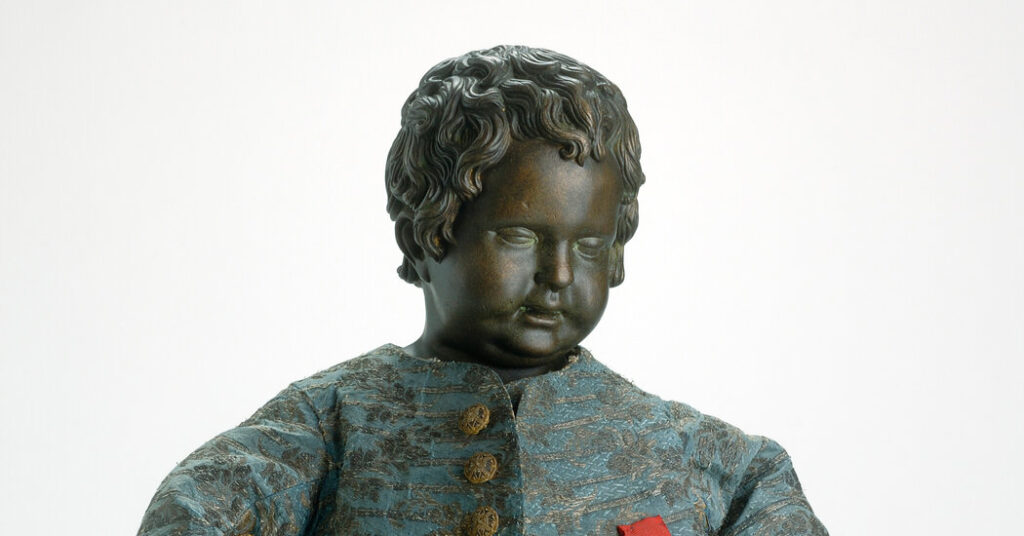
Manneken Pis’s outfits include a ceremonial costume, which he received from the French King Louis XV in 1747, a Superman suit and an Elvis Presley costume. He has a Santa’s beard, a butcher’s belt and equestrian gear, though he does not do much riding. (An official calendar of his costume changes is published monthly and is on display at the fountain.)
Edelman’s personal favorite is an haute couture piece that the French fashion designer Jean Paul Gaultier made for the 20th anniversary of the first gay pride celebration in Brussels in 2015, which Gaultier insisted on presenting in person.
The origins of the statue “are not really well known,” said Marieke de Baerdemaeker, curator at the Brussels City Museum who works with the Manneken Pis and his collection of costumes.
“We know that in the mid-15th century there are already archival sources that mention a manneken” that urinated, she said. “Then the first visual representations are from the late 16th century, like a map of Brussels in which there was a mention of the fountain, but it wasn’t drawn, so you can’t see what it looked like,” she added.
What is clear is that the boy originated as a legend. Some say he was the son of a Brussels merchant who went missing, and was later discovered peeing into a fountain. Others tell of a little boy who saved the city from a bomb blast by dousing the ignited fuse. Another version has him putting out a fire with his urine. Yet another legend suggests that the boy urinated on a witch’s doorstep, so she cursed him to stand forever in that unseemly pose.
The first fountain was made of stone and nicknamed Petit Julien or Little Julian. The first known depiction was in a cityscape that was painted in 1616 by the Flemish artist Denis van Alsloot.
The Manneken Pis that we all know today, de Baerdemaeker said, is a bronze sculpture that was created in 1619, by the Flemish architect and sculptor Jérôme Duquesnoy the Elder. It is a small fountain for a national monument, standing just 22 inches tall and weighing about 44 pounds.
“It’s often said that he represents the quirky, not-too-serious Brussels attitude,” de Baerdemaeker said. “We like to laugh a lot and we’re not pretentious. Our symbol isn’t the Eiffel Tower, it’s a small peeing boy.”
Although many people get joy from the fountain, across the centuries he was frequently attacked, tagged with graffiti and stolen, said Géraldine Patigny, a researcher at the Royal Institute for Cultural Heritage in Brussels, and a leading expert on Manneken Pis.
In 1965, the statue was torn from its pedestal, leaving only its bronze feet behind. An anonymous tip led to its retrieval from the Brussels Canal, and the two parts were stored in a safe in the Brussels City Museum. It was finally reconstructed in 2003, and put on display in the museum, where it remains. A separate museum space displays his “Garderobe,” a select group of about 150 of his costumes.
A bronze replica was made from a mold for the outdoor fountain. That’s where most people visit him today.
Rumors circulate around the Manneken Pis, including one that suggested that the fountain is hooked up to a keg, and the boy urinates beer on special occasions. This is not true, de Baerdemaeker said.
“That’s only when there are student pranks,” she said. “It’s always water but sometimes people add color. Sometimes people put soap in the water so it gets all bubbly, too.”
Contemporary artists have been inspired by the little boy to create other micturating monuments. In 1987, a little peeing girl, “Jeanneke Pis” was added to the city’s private art landscape, and some years later, a bronze dog, “Zinneke Pis,” by the Brussels artist Tom Frantzen, raised his hind leg near a city baluster. Thousands of tinkling trinkets are also popular Brussels souvenirs.
Costume changes always attract a crowd. Edelman said he usually arrives in the morning about 10 minutes before 9 a.m. to slip on the new costume. He comes back to undress the Manneken Pis just before 6 p.m., so that his outfits are not stolen at night. “He refuses to wear pajamas,” Boutsen said.
For Edelman, Manneken Pis is much more than just a static fountain. “He’s a statue who meets people,” he said. “Every folkloric event in Brussels begins in front of Manneken Pis, or finishes in front of Manneken Pis, with beer, with bands, with music. It’s very special.”
Boutsen added, “He’s a little guy who brings everyone together. The key factor of Manneken Pis is only joy.”
The post This Small Statue in Brussels Has a Large Bladder and Lots of Outfits appeared first on New York Times.