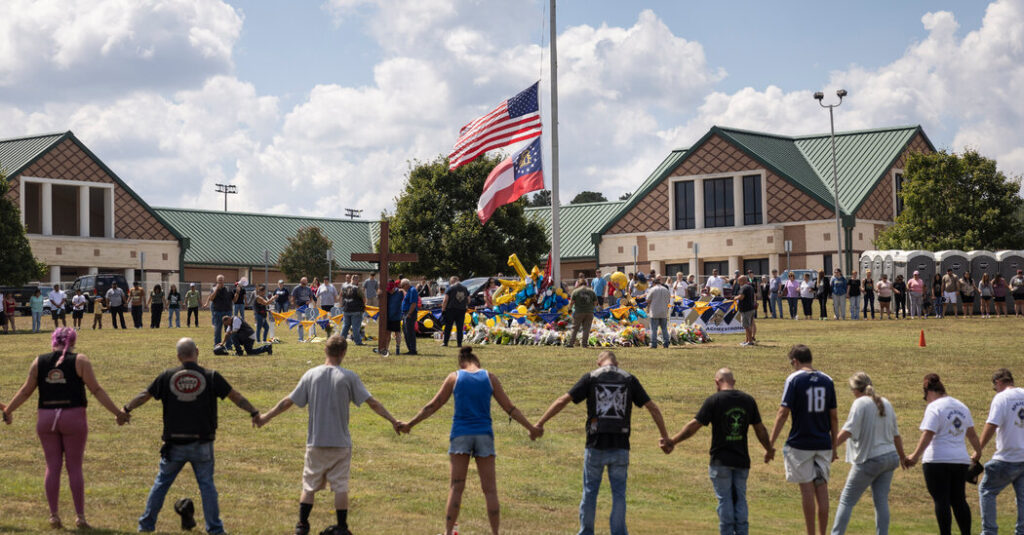
Audrey Lanni, a paramedic in Winder, Ga., was dispatched to Apalachee High School soon after a 14-year-old gunman opened fire there in 2024. She saw the bloodshed and anguish. It haunts her still.
She closely followed the recent trial of the boy’s father, Colin Gray, who had given his troubled son an assault-style rifle months before the attack.
The jury found Mr. Gray, 55, guilty of murder and manslaughter on Tuesday, after deliberating for less than two hours. He could face life in prison. In Ms. Lanni’s view, it made total sense.
“Somebody has to be held responsible for allowing these children to become the way they are,” she said, sipping an iced latte at a coffee shop in Winder soon after the verdict. “It was so apparent that he could have done something, and he didn’t.”
After years of mass shootings at schools, churches, theaters, grocery stores and community gatherings, the country is casting an ever wider net in its search for accountability.
Punishing the parents of the perpetrators, whether through criminal prosecutions or civil litigation, has been an emerging front in that effort. And the verdict in Georgia — which came before the teenage suspect, Colt Gray, had gone to trial himself — is the latest evidence that it can yield results, when so many other tactics have largely led to frustration and disappointment.
Law enforcement officers prosecuted after flawed responses to school shootings in Parkland, Fla., and Uvalde, Texas, were acquitted. Lawsuits against gun manufacturers typically run into a federal shield from litigation that is nearly impenetrable. And the grief and outrage incited by individual shootings have not translated into political will to overhaul the nation’s gun laws.
“That leaves the parents of the shooters,” said John F. Acevedo, a law professor at Emory University in Atlanta. “It is the last attempt to hold someone accountable who can stop it.”
Still, other legal experts see the prosecution of the elder Mr. Gray, who was convicted of second-degree murder and involuntary manslaughter, as an overreach. They say that prosecutors don’t have all the legal tools they need in cases like these, and are left to decide between charging parents with serious offenses, like murder, or not at all.
“What we need is a middle-ground solution that acknowledges that some people can contribute to other people’s wrongdoing in ways that might be blameworthy,” said Ben McJunkin, an associate professor of law at Arizona State University, “but that aren’t the same as having committed the crime themselves.”
Cases like Mr. Gray’s have coincided with a wave of state and local statutes in recent years that place more of an onus on parents, even when a child’s misdeeds are minor. Depending on what state they live in, parents might be prosecuted for failing to prevent a child from committing truancy, for example, or fined for a child’s curfew violations, or jailed if a child is involved in a public disturbance.
Some legal scholars warned of the imbalances that can arise when parents are held liable, with those who have the most burdens and fewest resources facing the biggest risk.
“Putting this responsibility on parents is beneficial to the state, because then they can just say, Well, we’ve done something about this,” said Nila Bala, a law professor at the University of California, Davis, who studies parental liability. “They don’t have to address all the other structural issues that cause this to happen.”
Mr. Gray’s case followed a similar one in Michigan, where a 15-year-old shot and killed four people at a high school in 2021. The shooter’s parents, James and Jennifer Crumbley, were convicted of involuntary manslaughter in 2024 after prosecutors cited their failure to safely store a gun in their home and to adequately address their son’s deteriorating mental health.
After a 21-year-old opened fire on a crowd gathered for a Fourth of July parade outside Chicago in 2022, the gunman’s father pleaded guilty to misdemeanor charges and was sentenced to 60 days in jail for helping his son obtain a gun license despite being aware of his son’s mental health issues.
And last year, prosecutors in Wisconsin criminally charged the father of a 15-year-old girl who shot and killed a student and teacher at her private Christian school before killing herself.
Some experts are skeptical that these high-profile examples will deter mass shootings — or lead to a surge in prosecutions of parents. Mr. Gray’s actions, they said, were egregious enough to be in a category of their own.
Prosecutors portrayed Mr. Gray as blowing past repeated warning signs: His son, Colt, attracted the attention of school officials and law enforcement officials after he used a school-issued computer to search “how to kill your dad” online and when the F.B.I. traced anonymous threats of a school shooting posted on social media to his family’s home. He had violent outbursts, and had hung what prosecutors described as a shrine to the perpetrator of the Parkland massacre in his bedroom.
“These are more than warning signs,” said Nick Suplina, the senior vice president for law and policy at Everytown for Gun Safety, a violence prevention organization. “This is strong evidence of intent, and the idea that against that backdrop and more you would hand an AR-15 to a child going through that kind of mental health crisis is beyond the pale.”
Mr. Gray argued that he had not ignored his son’s troubles and wanted to help him, even if hindsight showed his efforts were insufficient and misguided.
Matt Bogar, a tow-truck driver who had stopped by an auto-parts store in Winder on the day of the verdict, was among those who were uneasy about the severity of the charges.
“If the father knew there was a problem, sure, let’s nail him to the wall,” he said. “But murder? To me, it’s too much.”
Advocates for preventing gun violence said that other avenues for accountability might be frustratingly slow and incremental, but have not been entirely ineffective.
In 2022, a month after 19 students and two teachers were killed at an elementary school in Uvalde, Texas, President Joseph R. Biden Jr. signed legislation intended to prevent dangerous people from accessing firearms and increase investments in the nation’s mental health system. Critics cast it as a weak compromise compared with the original proposal, yet even skeptics acknowledged that breaking a 30-year stalemate, as the deal did, was no small feat.
And it took an obscure strategy and a protracted legal battle that reached the Supreme Court, but families of victims in the 2012 massacre at Sandy Hook Elementary School in Connecticut reached a $73 million settlement in 2022 with the maker of the rifle used in the attack.
In Michigan, as the case against the Crumbleys unfolded, lawmakers approved a red-flag law that added more expansive background checks and a requirement to safely store guns in homes where a child is present.
In Georgia, Mr. Bogar, 54, said he was uncomfortable with how blame had been apportioned in the case. Colt Gray, now 16, deserved most of it, he believed. The father deserved some, too, but so did others. He noted the boy’s past brushes with law enforcement and social services and interactions with other adults in his life. His mother, who did not have custody of her son but had a relationship with him, was not charged.
“There’s so many red flags that I think everybody should be accountable,” Mr. Bogar said. “It’s the society that we live in, and I hate it.”
Rick Rojas is the Atlanta bureau chief for The Times, leading coverage of the South.
The post America is Weary of School Shootings. Can Prosecuting Parents Help? appeared first on New York Times.