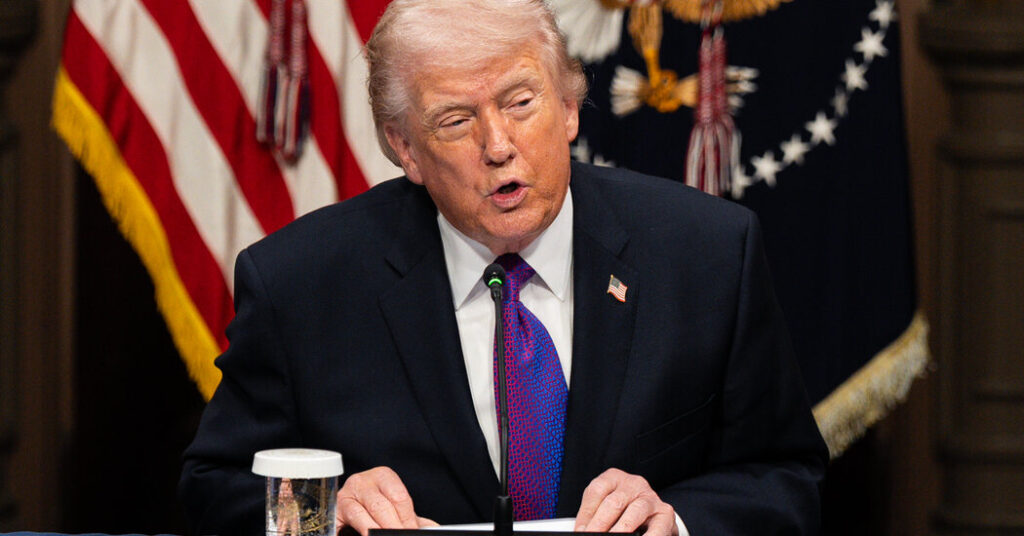
President Trump on Thursday said he should have a role in choosing Iran’s new leader, and that Mojtaba Khamenei, a son of the former leader Ayatollah Ali Khamenei who appeared to be the leading candidate to succeed his father, was an “unacceptable” choice.
Mr. Trump’s comments, in interviews with Reuters and Axios, were the most explicit he has been yet about his vision of an American role in creating a new government in Tehran. They made clear that Mr. Trump’s model for Iran, as he told The New York Times in an interview on Sunday, was to replicate the installation of a new president in Venezuela after a Delta team seized Nicolas Maduro and sent him to a federal prison in Brooklyn, where he is awaiting trial.
Many analysts have noted that there are huge differences between Iran, a country of 92 million people run by a complex mix of clerics and the Islamic Revolutionary Guard Corps, and Venezuela. But Mr. Trump has continued to cite the example, including in conversations with world leaders and members of Congress.
Mr. Trump’s statement is the also latest in a series of contradictory claims about Washington’s war aims.
On Saturday, as the attacks began, he called on the Iranian people to rise up and overthrow the existing regime. On Sunday, he told The New York Times that he had three candidates for supreme leader in mind, though he later told ABC that he believed all three had been killed in days of U.S. and Israeli airstrikes.
His comments to Axios, and then to Reuters, are bound to remind Iranians of a period in their history taught in the country’s schools: the 1953 coup, run by the C.I.A., that overthrew Iran’s democratically elected prime minister, Mohammad Mossadegh, to assure that Britain had access to Iranian oil.
That coup ultimately led to the installation of Mohammed Reza Pahlavi as the shah of Iran. He was overthrown in the 1979 Iranian revolution that ushered in a half-century of theocratic rule.
President Barack Obama acknowledged the C.I.A.’s role in the Iranian coup in a 2009 speech in Cairo, admitting that “the United States played a significant role in the overthrow of a democratically elected Iranian government.” He was criticized by Republicans at the time for seeming to apologize for America’s past interventions in Iranian politics.
David E. Sanger covers the Trump administration and a range of national security issues. He has been a Times journalist for more than four decades and has written four books on foreign policy and national security challenges.
The post Trump Says He Should Have Role in Picking Iran’s Leader appeared first on New York Times.