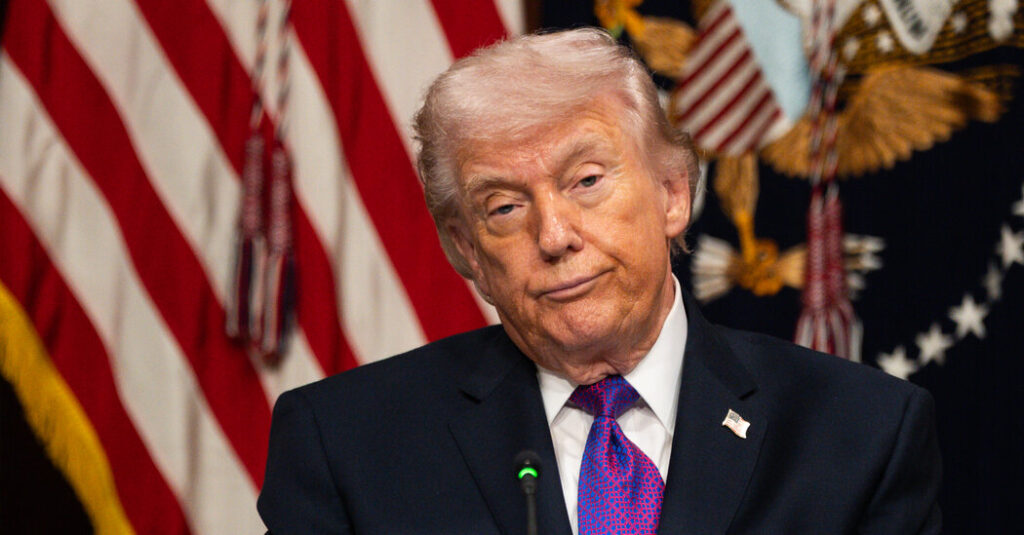
A coalition of two dozen states sued President Trump on Thursday over the new 10 percent tariff that he has imposed on imports from around the world, a move that will send the administration back to court to defend the legality of its punishing trade war.
The lawsuit, led by the Democratic attorneys general from Oregon, New York, California and Arizona, claimed that Mr. Trump did not have the power to impose that tax and “sidestep” the Supreme Court, which delivered the administration a stunning blow last month that struck down the president’s original slate of withering duties.
The legal challenge marked the latest twist in a saga that has engulfed Mr. Trump’s second-term economic agenda, which hinges on the unfettered use of tariffs to reorient global trade, bolster domestic manufacturing, project geopolitical influence and raise billions of dollars in revenue. That money, totaling more than $100 billion, has been the subject of a separate bout of legal warfare, as a rapidly widening roster of businesses clamor for refunds that the administration has been unwilling to provide.
But Mr. Trump and his top aides have remained unfazed despite intensifying opposition. Even after the Supreme Court choked off their primary tool to wage trade war last month, the administration insisted it would simply turn to a stable of other authorities to forge ahead with its wide-ranging ambitions.
”The President has made clear that he is going to impose worldwide tariffs by any means necessary,” the states charged in their lawsuit, as they faulted Mr. Trump for what they described as “an exercise of completely unrestrained executive power.”
The White House did not immediately respond to a request for comment.
Initially, the president had relied on decades-old economic emergency law to impose country-by-country tariffs without the approval of Congress, until a majority of the justices invalidated that approach. Now, Mr. Trump has turned to another little-known law, Section 122 of the Trade Act of 1974, which allows him to institute tariffs of up to 15 percent for 150 days.
The rate is currently set at 10 percent, though the president has said he intends to raise it to the maximum of 15 percent as soon as this week.
Until Mr. Trump, no president had ever invoked Section 122, a provision that Congress enacted to address issues with the nation’s “balance of payments,” or the record of all goods, services, money and other assets that flow in and out of the country. But Mr. Trump justified his novel action in late February by pointing partly to another metric, the nation’s trade deficit, saying that the persistent gap between U.S. exports and imports warranted an immediate response.
As a result, state officials sued the Trump administration in the U.S. Court of International Trade, arguing on Thursday that local residents and businesses were harmed by policies imposed by the president without proper justification. They charged that the president’s actions threatened to “upend the constitutional order and bring chaos to the global economy.”
That same panel of judges had previously sided with Oregon and other states when they sued over Mr. Trump’s original roster of duties. This time, the states said that Mr. Trump had not met the criteria for using Section 122. They pointed to the administration’s own previous comments, which had acknowledged that a balance-of-payments problem is different from one involving the nation’s trade deficit. And they accused the White House of “cherry picking” its data in order to conform its tariffs to the requirements under the law.
Many economists agree that the United States does not have an imbalance in payments, a primary concern in the long-abandoned days when the U.S. dollar was tied to gold. Such a problem would occur only if the country could not afford to pay its foreign creditors — the kind of problem the United States nearly faced in the early 1970s, shortly before the law was written.
In their lawsuit, the states took further issue with the fact that Mr. Trump had moved to spare a long list of products, and even some countries, from his new 10 percent tax on imports. They said the law does not allow for these exceptions, which the president first put in place last year in a tacit recognition that his earlier tariffs could cause consumer prices to rise.
“The focus right now should be on paying people back, not doubling down on illegal tariffs,” said Dan Rayfield, the Democratic attorney general of Oregon, in a statement. “People are already making hard choices about what to put in their shopping cart. Prices on basics like groceries, clothing and other essentials have all been skyrocketing. At some point, the bills become unmanageable.”
If Mr. Trump were to lose the case, it could force the administration to refund money collected under the new tariff. The 10 percent tax on imports, if it is maintained for the full 150 days, could generate about $35 billion in revenue, according to the Committee for a Responsible Federal Budget, which supports deficit reduction.
But the fight is still likely to look much different from the recent legal wrangling over Mr. Trump’s previous strategy, which relied on the International Emergency Economic Powers Act. That law did not even mention tariffs, and no president before Mr. Trump had ever used it to impose them, creating a host of novel legal issues for the courts to resolve. With Section 122, the law clearly allows for tariffs, but it is the president’s justification that is subject to dispute.
As a result, many legal experts remain torn on whether judges would afford Mr. Trump discretion to determine the economic conditions that might justify his duties.
Still, the Trump administration has openly described its across-the-board tariffs as a temporary fix, which would buy time for the government to pursue more lasting duties under another provision of trade law known as Section 301. That power permits the president to tax imports from countries that engage in unfair trade practices, but only after the government completes a lengthy investigation.
Mr. Trump has used this power, which is more legally settled, to impose tariffs on China dating back to his first term. Many similar inquiries are now underway, leading Scott Bessent, the Treasury secretary, to conclude this week that the administration is on track to recapture the size and scope of the duties that the Supreme Court recently deemed illegal.
“It’s my strong belief that the tariff rates will be back to their old rate within five months,” Mr. Bessent told CNBC.
Ana Swanson contributed reporting.
Tony Romm is a reporter covering economic policy and the Trump administration for The Times, based in Washington.
The post States Sue to Stop Trump From Reviving Steep Tariffs appeared first on New York Times.