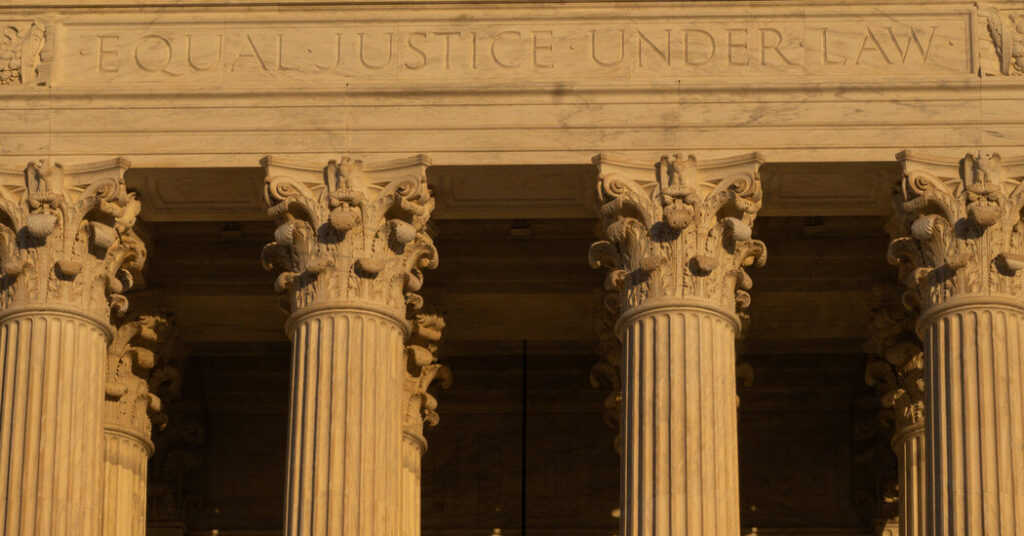
When the Supreme Court issued an emergency order this week that protected the congressional district of a New York Republican, it intervened in a voting rights dispute, pre-empting the state’s highest court before it had a chance to act.
Since President Trump returned to the White House, the Supreme Court’s conservative majority has shown a willingness to short-circuit lower-court proceedings with a slew of emergency rulings in federal cases. But this was a rare instance in which the justices leapfrogged the state courts, too — a sign, legal experts said, that despite intense scrutiny of how the Supreme Court has been using its emergency docket, the conservative justices appear to be expanding its use rather than constraining it.
Unlike the court’s traditional “merits” cases, which arrive after months or years of lower-court consideration, emergency requests are fast-tracked with limited briefing and almost always without oral argument. The emergency docket has exploded in recent years, particularly in the second Trump administration, with the filings accounting for a significant part of the justices’ workload. While the quick-turn orders are technically place holders, they can effectively settle significant issues while litigation plays out in the lower courts.
The order in the New York case was unsigned and included no reasoning, as is typical. The three liberal justices joined in a 13-page dissent to assert that the majority had interfered with New York court proceedings in an inappropriate and unorthodox manner that could have far-reaching consequences for expanding the justices’ power.
The majority was grabbing “newfound authority,” wrote Justice Sonia Sotomayor, warning that the action could put the Supreme Court at the center of deciding every election-law dispute, even as states seek to redraw voting maps before midterm elections in November. The move also usurped state power, she observed, a violation of principles of federalism that conservatives promote in other instances.
“If this court’s grasping reach extends even to a nonfinal decision of a state trial court,” Justice Sotomayor wrote, “then every decision from any court is now fair game.”
The New York order was issued Monday evening, when the court also released a second emergency ruling in which it blocked California policies that limit what public schools can tell parents about their children’s gender transition at school. In that case, the conservative majority pre-empted a federal appeals court. Without full briefing or oral argument, the majority seemed to expand the reach of a decision it issued last term to find the state’s rules likely to be unconstitutional.
Taken together, the two nighttime orders were a reminder of the majority’s willingness to flex its power through the emergency docket, making substantive — if technically temporary — decisions over the sharp objections of the liberal justices.
Stephen I. Vladeck, a Georgetown University law professor and the author of a book called “The Shadow Docket,” said the emergency orders this week made the court “look like what so many regularly accuse it of being: a font of partisan political power.” The justices, he added, had gotten into a “bad habit” of granting relief before litigants had gone through the process in the lower courts.
“The court is intervening because it (thinks it) can, and because, for whatever reason, it doesn’t want to wait — in these cases, anyway — for the ordinary processes that would bring these issues to the court in due course,” he wrote in his newsletter.
At issue in the California case were state rules that generally restrict public schools from informing parents about their child’s social transitioning unless the child has consented. In one instance cited in the case, parents learned of their middle-school child’s gender transitioning at school after the child attempted suicide and was hospitalized.
Justice Amy Coney Barrett said the majority was not being impatient but was compelled to act by the court’s precedents to ensure parents have critical information about their children’s mental health. A group of Christian teachers and parents challenged California’s policies.
Religious liberty groups hailed the outcome as a groundbreaking victory for parental rights and praised the court for not waiting on the lower courts. But proponents of L.G.B.T.Q. rights denounced the court for failing to fully explore the potential harms to students or even litigate the contested question of what California’s policy actually requires — issues that lower courts would normally fully dissect before the Supreme Court took action.
In dissent, Justice Elena Kagan suggested that the majority could turn out to be right on what she called “thorny” legal questions. But skipping ahead of the U.S. Court of Appeals for the Ninth Circuit, she said, was out of line with how the Supreme Court would have handled a similar case just a decade ago. She noted that the court could wait and consider any one of 40 other cases testing similar issues that were making their way through the legal system on its normal timelines.
“Our processes are, in short, the hallmark of judicial probity, and alike its guarantor,” she wrote. “There was no reason to abandon them here.”
In the New York case, the majority blocked an order from a state court trial judge who had concluded that a New York congressional map, approved in 2024, violated the state Constitution by diluting the power of Black and Latino voters. The congresswoman, Nicole Malliotakis, had asked the justices to block the ruling and to preserve her district, the only one in New York City held by a Republican.
Under federal law, the Supreme Court does not have jurisdiction to hear appeals from state courts until a state’s highest court has ruled and issued final “judgments or decrees.” In the past, when the justices have provided emergency relief from a state-court decision, the top state court had either denied the request first or failed to act promptly.
That was not the case in the New York matter, where Ms. Malliotakis simultaneously appealed to the state’s intermediate and highest appeals courts. The top court transferred the matter, saying it must first be reviewed by the intermediate court, which eventually denied the congresswoman’s request. Ordinarily, the case could then return to the state’s Court of Appeals, but her request to the Supreme Court was already pending by then.
Stephanie Barclay, a constitutional law scholar at Georgetown, noted that the justices had recently cleared the way for Texas and California to use new voting maps in November that had been adopted by their legislatures and challenged in court. She said she saw the majority as following a similar approach in New York, declaring “neither state nor federal courts can interfere with election maps too close to the election.”
More broadly, she pushed back on criticism of the court’s handling of the emergency docket.
“The thing that is novel here is the critique,” said Professor Barclay, who was a law clerk to Justice Neil M. Gorsuch. “It is not the practice.”
Indeed, Justice Samuel A. Alito Jr., writing separately for himself, said it was imperative for the court to act because Ms. Malliotakis had “nowhere else to turn.”
Had the justices not intervened, he wrote, the clock was likely to have run out before they could review the matter. That would have allowed the “use of an unconstitutional district in the November election and the election of a member of the House of Representatives whose entitlement to the office would be tainted.”
Justice Sotomayor countered that the court’s action was an “astonishing, unexplained step,” acting before the state’s top court “had a chance to weigh in.”
Richard L. Hasen, an election law expert at U.C.L.A. Law School, said the court might have been responding to what appeared to be a novel approach to redistricting in New York, prompting a possible one-off move by the justices that did not “portend the Supreme Court regularly interfering with ongoing state election-law decisions.”
Still, Mr. Hasen said, he could not think of another time in an elections context when the justices had intervened on an emergency basis before a state’s highest court had acted.
Justice Alito, he said, “seems to have bent the jurisdictional rules.”
Ann E. Marimow covers the Supreme Court for The Times from Washington.
The post An Assertive Supreme Court Turns to Curbing State Courts appeared first on New York Times.