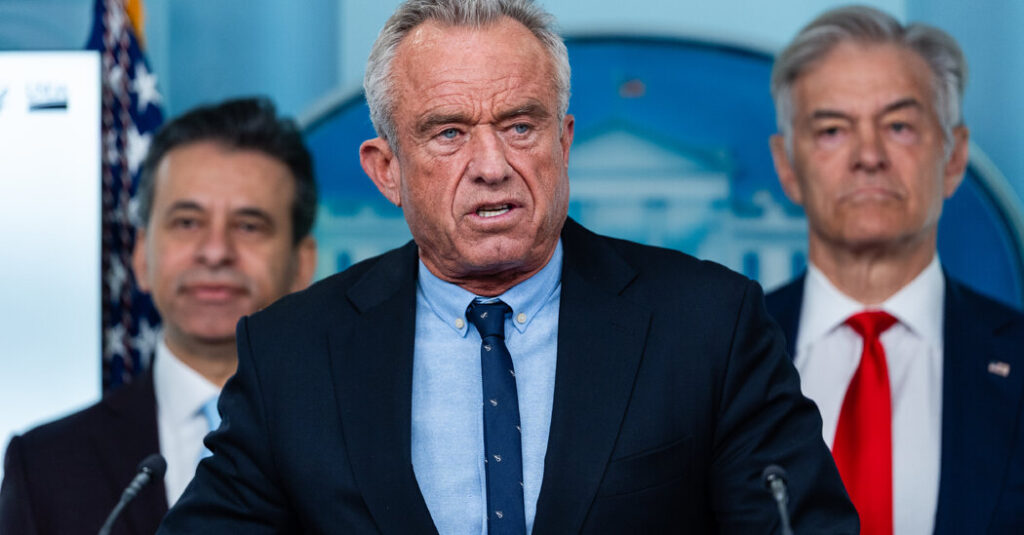
Health Secretary Robert F. Kennedy Jr. said Thursday that more than 50 medical schools would embrace a federal framework for nutrition education, after a monthslong campaign to pressure universities into accepting the government’s curriculum recommendations.
Thursday’s announcement gave Mr. Kennedy’s Make America Healthy Again agenda a stronger foothold in a medical community that has often criticized the secretary’s ideas, especially on vaccination, as conspiratorial and unscientific. The announcement also reinforced how the Trump administration is seeking to infuse American colleges and universities with its ideology, a departure from the country’s tradition of academic independence.
“This is how we implement the MAHA agenda,” Mr. Kennedy said as he debuted what he called “a transformative breakthrough in medical education that will reshape the way we train doctors in our country.”
Mr. Kennedy’s appearance in Washington on Thursday alongside Education Secretary Linda McMahon came one day after The New York Times detailed the federal government’s effort to secure support from medical schools. The Health and Human Services Department used a blend of approaches, including the threat of funding cuts and the prospect of public praise, to entice schools to sign on.
None of the elite universities that previously reached funding-related settlements with the Trump administration — including Brown, Columbia, Cornell and Northwestern — agreed to back Mr. Kennedy’s plan, even though they have some of the nation’s best-regarded medical schools.
But Mr. Kennedy attracted a range of other institutions. Many are public schools in conservative states, including the University of Alabama at Birmingham, the University of Florida, the University of Kentucky, the University of Oklahoma and Texas Tech. Others are in more left-leaning areas: the University of California, Irvine; George Washington University; New York University; and Tufts University.
Mr. Kennedy said on Thursday that part of the process had been “school-led” and that Thursday’s announcement did not represent “the Trump administration dictating” curriculum.
“We respect the independence of medical schools and accrediting bodies, and the Department of Education will never mandate curriculum — that’s not our job,” Ms. McMahon said on Thursday. “But we can and will spotlight promising, evidence-based models; convene leaders who are improving health outcomes; and celebrate institution-driven curricular reforms.”
Officials from some of the schools that declined to endorse Mr. Kennedy’s plan said they had been concerned by the possibility of ongoing federal interference. Others said they believed their nutrition curriculums were already sufficient.
“Nutrition has been robustly integrated into multiple required courses and clerkships in the four-year curriculum for Harvard medical students for many years, providing them with repeated exposure and depth to this critical topic,” the medical school said in a statement.
Harvard added that it “continues to champion nutrition education” and said it “remains committed to ongoing review, revision and improvement of educational programming in nutrition and other important areas.”
Doctors have debated for decades about how much time to spend on nutrition in medical school. In 1962, for example, the American Medical Association held a conference after a report by the group concluded that there was “inadequate recognition, support and attention given to this subject in medical schools.”
Little changed in subsequent decades, though the deliberations did not end. In 2022, for example, the Biden administration and a bipartisan resolution in the House urged medical schools and other health training programs to expand nutrition education.
The framework that Mr. Kennedy rolled out Thursday is not mandatory, but it recommends 71 “competencies” that medical schools can use to include at least 40 hours of nutrition education for every medical student.
Some of the competencies align closely with a 2024 set of recommendations from experts, like understanding nutrient deficiencies and food allergies. But others are on shakier scientific ground, including the promotion of dietary supplements and “wearable” devices.” One proposed that medical students study “soil sampling, composting and crop rotation.”
Mr. Kennedy’s framework also does not explicitly emphasize teaching doctors how to screen for food insecurity, or whether people have access to enough nutritious and safe food, which the 2024 report viewed as a top priority.
Some critics want to see more nutrition education, but balk at the idea of the federal government sketching out curriculums.
Asked in an interview last week whether the Department of Health and Human Services should be trying to shape curriculums, Dr. Louis Sullivan, who led the department during George Bush’s presidency, replied, “No.”
“Medical schools and academic institutions generally value their autonomy and their freedom because the ideal is to have a culture that seeks truth and knowledge to improve the lives of people,” added Dr. Sullivan, who steered a revamping of nutrition labeling as health secretary and was also president of the Morehouse School of Medicine in Atlanta.
Mr. Kennedy acknowledged in a speech last week that he had also put pressure on the groups behind the U.S. Medical Licensing Examination. Mr. Kennedy argued that medical schools had been reluctant to devote much time to nutrition because the exam included few questions about the topic.
The Federation of State Medical Boards, one of the exam’s sponsors, said this week that program officials were “actively planning further nutrition-related enhancements to the exam.”
Alan Blinder is a national correspondent for The Times, covering education.
The post Dozens of Medical Schools Back Kennedy Plan on Nutrition After Pressure appeared first on New York Times.