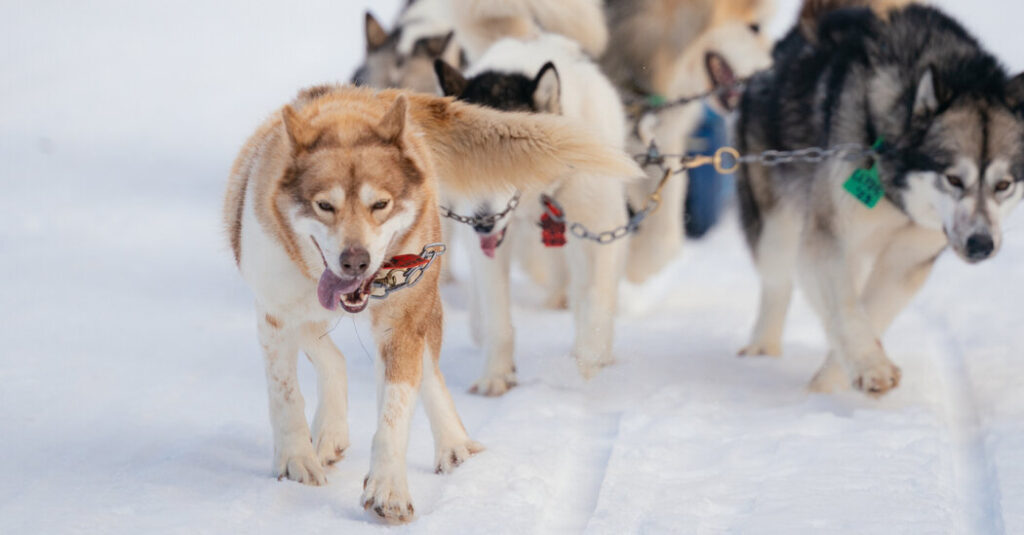
Eben, the leader, keeps to herself. Silus is strong but easily distracted. Small but peppy Alatna outpaces him at times.
These three Canadian Inuit dogs comprised my team on a three-night January trip. Transportation meets adventure in mushing, another term for dog-sledding, at Wintergreen Dogsled Lodge on the edge of the frosty Boundary Waters Canoe Area in Ely, Minn.
I enjoy the thrill of downhill skiing, the exertion of cross-country skiing and, in both, the beauty of the snow-covered landscape. Dog-sledding offered thrills, scenery and a unique attraction: canine charisma.
“Ready,” I shouted on the first morning, giving the dogs the cue to stand, and nudging Silus to get his head out of the snowbank. “Hike!” and they jolted into a run.
“Whoa!” I later commanded to get them to stop while jamming on the foot brake, a metal hook behind the sled that I could press into the snow.
In between, the dogs and I traversed a snowy region of lakes and wetlands interspersed with rollicking forest episodes, including downhills when I hung on for dear life, crashing into shrubs and bending around saplings.
“People are often surprised with how physical the dog-sledding is here,” said Nick Sander, one of two guides leading our group of seven people running four sleds. “You’re getting off the sled, you’re pushing, you’re moving, you’re petting dogs. It’s a lot of work.”
Mostly, of course, for the dogs.
“The dogs are stoked,” said Henry Arana, our second Wintergreen guide, who explained that the cold-adapted dogs run only in winter. “This is what they do.”
Born to Run
A fresh foot of snow blanketed the area in early January when I rolled into Ely, about a two-hour drive north of Duluth, finding my way to the Timber Trail Lodge & Resort near Wintergreen. Because the Wintergreen kennel can accommodate more dogs than its on-site lodge, which sleeps 12 guests, the business rents off-site cabins in peak season.
For two nights, I shared a no-frills four-bedroom, two-bathroom cabin with six other Midwestern mushers, including two couples and a pair of sisters-in-law. On the third day, a plumbing problem forced an upgrade to a neighboring cabin with a fieldstone fireplace and cozier beds. In both, a spacious kitchen was stocked with food for do-it-yourself breakfasts. Lunches were served on the trails, and a chef catered dinner to the cabin nightly. (The three-night trip cost $1,275, including meals and lodgings).
For more than 40 years, Paul Schurke, who owns Wintergreen with his wife, Susan Schurke, has been offering dog-sledding excursions, originally as the winter alternative to leading summer canoe trips in the Boundary Waters for people with disabilities.
His introduction to dog-sledding led Mr. Schurke to polar exploration beginning in 1986, when he, the Arctic explorer Will Steger and their team completed the first-confirmed trek to the North Pole without resupplying. His numerous polar trips have included retracing the Antarctic explorer Ernest Shackleton’s 1916 expedition across South Georgia Island. Mr. Schurke is known to regale Wintergreen guests with tales of Arctic exploration.
In many dog-sled operations professionals drive the dogs while visitors ride in the sled. At Wintergreen, the guests pilot their own sleds, which exposes them to all the chaos that comes with harnessing teams in a rambunctious 50-dog kennel and the exhilaration of learning to command them.
“We attract dog lovers in a big way,” said Mr. Shurke, who runs about 100 trips that regularly sell out each winter. “It’s a winning combination to have such accommodating dogs and the forest to enjoy them in.”
Also known as the Canadian Eskimo dog, the Canadian Inuit, he explained, is an ancient breed used for transportation and hunting that “made Arctic life possible.”
“They won’t set ground-speed records,” he added. “They’re the Sherman tank of the mushing world, built for power, not speed.”
Big, burly and with a double-thick coat, the dogs come in a range of colors and are remarkably friendly.
“They’re not the drones of the hybrid-dog world,” said Mr. Schurke. “They have a lot of personality.”
From Harness to Trail
The hands-on experience began in the kennel on the first full day, when we were tasked with finding, harnessing and walking the dogs to their assigned sleds. Most of us worked in teams to thread a sturdy harness, which covers a dog’s back and rib cage, over its head and fold its front legs gently into place.
Once we’d won this wrestling match, we walked the powerful dogs to the waiting sleds, often on their two hind legs for more control. The guides clipped them into central gang lines that would pull the sleds.
Dog-sledding couples drove sleds harnessed to five or six dogs — wheel dogs at the rear, team dogs in the middle and leaders up front — with a platform to stand on behind the sled basket, used to carry extra gear, tools and water bottles. Because I was alone, I stood directly on the runners at the rear of the sled powered by my three dogs.
On cross-country skis, one guide headed up the line of sled teams and another brought up the rear.
“When we put on the skis, you see the dog’s energy shift,” said Mr. Sander.
From the kennel, we shot off across snowy White Iron Lake getting the feel for the ride and learning how to moderate speed on flat land. Direction commands such as “gee” for right and “haw” for left were superfluous as the dogs clearly followed the lead guide.
“The dogs like smooth,” explained Mr. Sander. “If you’re doing a lot of jerking or the lead dog’s chains aren’t tight, you have dogs bunch up, and when dogs bunch up we get dog balls, we get fights, we get tangles, we get issues.”
Over the initial two-hour test run, our most important job, beyond maintaining a steady pace, was to keep the animals stationary when we stopped, by standing on the brake and holding on.
“They will know if you’re not on the handlebar and they will try to go without you,” said the guide.
Advanced Sledding
Breaking at the lodge for lunch — vegetable bean soup, ham and cheese in phyllo dough, broccoli salad and chocolate chip cookies — we had a chance to adjust our clothing. The detailed packing list had called for extensive layering, including insulated pants over base layers as well as anoraks over parkas and wool gloves inside of roomy, waterproof mittens.
In the afternoon, sledding on forest trails was more physically challenging as the guides instructed us to run up hills, pushing the sleds to make it easier on the dogs, and then jumping on to descend. I found that feathering the brakes controlled the descents on trails that were often just wide enough. I threw my weight in the opposite direction of turns and kept my hands and knees firmly behind the sled.
By the second day, our group approached the dogs more confidently, getting them harnessed without help. We set out on a longer and equally exhilarating route — roughly 10 miles — interspersing tranquil rides over pine-edged lakes and frozen wetlands, where we could see beaver holes and otter slides, with rolling trails through hardwood forests.
Returning the dogs to their individual houses in the kennel, we hiked into the woods to forage for wood and made bratwurst and quesadillas over an open fire for lunch. A retired sled dog, Fraser, who freely roamed the property, came around for leftovers.
It was the end of the sledding but not of the adventure. A few of us strapped on cross-country skis for a spin on the lake, followed by a session in the wood-fired sauna that sent us running through the snow to plunge in an ice hole in the lake.
On the final day, it was hard to say goodbye to our teams.
“I loved the challenge and physicality of it and just the connection with the dogs,” said Marianne Flynn Statz, a retired police detective from Eagle River, Wis., and my sauna mate. “We were relying on them for the experience, but they were relying on us to be part of the team.”
Follow New York Times Travel on Instagram and sign up for our Travel Dispatch newsletter to get expert tips on traveling smarter and inspiration for your next vacation. Dreaming up a future getaway or just armchair traveling? Check out our 52 Places to Go in 2026.
Elaine Glusac is The Times’s Frugal Traveler columnist, focusing on budget-friendly tips and journeys.
The post Feel the Canine Charisma: Dog-Sledding in Northern Minnesota appeared first on New York Times.