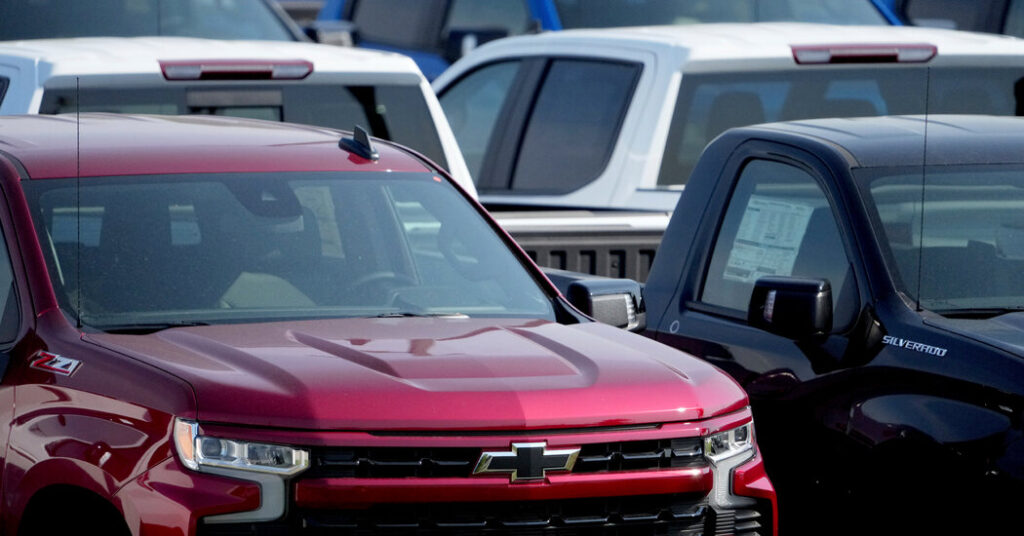
Buying a new car has become unaffordable for a growing number of Americans — and that is starting to become a problem for automakers.
Sales at many car companies are trending down or rising only a little, and analysts and car dealers say they don’t expect things to get better soon. Car prices, interest rates on auto loans and insurance costs have all climbed in recent years, putting new vehicles out of reach for many people.
So far this year, auto sales have been mixed. Sales rose modestly in January, but fell by more than 3 percent in February. Most analysts expect total U.S. sales to fall to about 16 million vehicles this year, from 16.3 million in 2025.
“It’s not an exaggeration to say this is a crisis,” said Taz Harvey, the owner of Honda, Mazda and Chevrolet dealerships in central California.
Consider Joe Opsahl. He has been thinking about replacing his 2020 Ford F-150 pickup truck, but says he can’t justify making a switch given the rise in interest rates and car prices.
“I’m looking at the monthly payment, and interest rates are everything,” said Mr. Opsahl, who helps run a family-owned commercial construction company near Ann Arbor, Mich. “The last time I bought, I got 0.9 percent, so if it’s 5 this time, it’s a no.”
The average interest rate on a 60-month new car loan from banks was 7.22 percent in November, according to the Federal Reserve. While that is down a little from early 2025, it is still much higher than in 2021 when the rate averaged 4.8 percent. Add to that the average price of new cars has reached nearly $50,000, up from $38,400 in 2019, according to Cox Automotive, a research firm.
Convincing people like Mr. Opsahl to buy a new car is not the only challenge the auto industry is facing. President Trump’s tariffs on new cars and car parts have raised costs and forced manufacturers to rejig their supply chains. While many automakers are investing less in electric vehicles they are still putting money into other technologies like gasoline-electric hybrids and self-driving systems.
The auto industry outlook has also been clouded by the U.S. and Israeli war with Iran, which has sent oil and gasoline prices up. The conflict could lead to higher inflation and more economic uncertainty, which could hurt car sales over time.
Ford Motor on Wednesday said its sales fell by 5.5 percent in February compared with a year ago. But Toyota, Hyundai and Honda reported higher sales for the month.
One reason auto sales have not weakened significantly is that affluent consumers are still buying cars at a brisk pace. But many in the industry fear that the industry’s affordability problem could become a bigger headache soon.
“We believe as you get into May, June, July, August, you’re going to start feeling it, as new-car prices have nowhere to go but up,” Jeff Dyke, president of Sonic Automotive, which owns 100 car franchises across the country, said in a conference call last month.
Automakers have taken some steps to try to put a lid on prices. In the past year, they’ve cut costs and moved some production to U.S. factories to mitigate the impact of Mr. Trump’s tariffs. Companies have also generally avoided passing on the entire increased cost from tariffs to dealers and car buyers.
But making those changes has cut into company profits, Mr. Dyke noted. General Motors recently said tariffs added $3.1 billion to its costs last year. Ford Motor said they added $2 billion.
“The tariffs are too high,” Mr. Dyke said, adding that he expected the carmakers to eventually pass on more of the cost of tariffs to dealers and car buyers.
One way manufacturers may already be doing so is by increasing destination charges, which are fees that are supposed to account for the cost of delivering cars from factories to dealerships. Ford, for example, now adds $2,595 in shipping fees on the F-150 and other large trucks. In 2023, the fee was $1,795.
Automakers and their finance arms are also offering longer loans so they can offer lower monthly payments, though that tactic can significantly increase the total amount paid over the term of the loan. More than 20 percent of auto loans made in 2025 were for 84 months — seven years — or longer, according to Edmunds, an auto research firm.
Even so, monthly new-car payments have been rising. The average monthly payment in the final three months of 2025 was $774, up from $636 at the end of 2021, according to Edmunds.
“For a lot of people, that’s out of reach,” said Jessica Caldwell, a vice president of insights at Edmunds. “It’s almost like having a second mortgage.”
Car prices started rising rapidly during the Covid pandemic when a shortage of computer chips limited production. With factories shipping vehicles in fits and starts, demand quickly outstripped supply. That enabled automakers to offer fewer and less generous discounts.
Other factors have also kept prices high. Since the end of the pandemic, automakers have restricted production, leaving fewer cars on dealer lots waiting to be sold. G.M. had 486,000 vehicles in U.S. dealer inventories at the end of 2025. Years ago, it typically had twice that many in stock.
At the same time, many automakers have stopped making affordable sedans that appealed to people who were buying their first new cars. G.M., Ford and Stellantis have eliminated many entry-level and inexpensive base models.
The cheapest 2026 model-year car is the Hyundai Venue, which starts at $22,150 including its destination fee, according to Cars.com.
New electronic systems, touch screens and driver-assistance systems have also made cars more expensive. Many new models come with parking sensors, forward-looking radar and cameras, and blind-spot monitoring.
While those devices make driving safer, they also raise the cost of repairing cars. A front-end fender-bender can now cost several thousand dollars if sensors and other computerized components need to be replaced. Higher repair costs, in turn, have pushed up insurance rates.
Doug Freeman, an insurance executive in Amesbury, Mass., said higher car prices have pushed him to think differently about buying new vehicles. He usually purchases his vehicles, but last year he leased a Kia Sportage for his wife in order to secure a reasonable monthly payment and avoid a hefty down payment.
Recently, he was shopping for a car for his son, and found he’d likely have to spend more than $30,000. So, he bought a used Subaru Impreza for about $18,000.
“I didn’t want a third car payment,” he said. “Buying new just wasn’t in the budget.”
Neal E. Boudette, a Michigan-based reporter for The Times, has been covering the auto industry for more than two decades.
The post How $800 Monthly Car Payments Are Hurting Car Sales appeared first on New York Times.