Hating on the Whitney Museum of American Art’s Biennial has been an art world sport since the early 1970s, and you could feel like a dupe if you didn’t join in. Back then, when the art world was small and confined to Manhattan, Biennial criticism was an insider game: Why was this artist picked and not that one? Why do the same few galleries have a lock on the show?
With the rise of what was called “multiculturalism” in the 1990s, the complaining continued but the focus began to change. In some quarters, the Biennial was accused — accurately — of being too white, too male, too market-tethered, and of representing, like its namesake institution, too narrow a version of “America.”
Gradually some of these problems have undergone degrees of correction, a development that has itself inspired some critical pushback. (For the record, of the 56 artists, duos and collectives in this year’s edition, more than half the participants identify as female, and a large number were born in countries that have been historically subject to United States intervention or occupation: Afghanistan, Iraq, Japan, the Philippines, Vietnam and now Iran.)
The result is a Biennial that stands as neither a star-making showcase nor a focused political statement. It’s something broader and looser — one big institutional group show among many across the planet, and one that, in the hands of inventive curators, warrants neither quick dismissal nor easy embrace.
The 2026 Whitney Biennial has two such inventive curators in Marcela Guerrero and Drew Sawyer, both on the museum’s staff. They’ve produced a spare-looking but textured show without an overarching theme but shaped by references to forces now ever-present in the cultural air: climate disaster, border policing, technological dominance, and the moral anxieties and mortal realities those anxieties create.
And they bind these elements together with a simple formal device: a kind of ambient, floor-through sound bath, one composed of voices, music, terrestrial pulsations and electronic plinks and drones generated by the art on view. You hear much of the art on the museum’s fifth and sixth floors, where most of the show is installed, before you see it, and you never quite leave any of it behind while you’re there.
The show is short on visual spectacle, but where there is some, it’s strong. A black-box video installation titled “Pandemonium” by Michelle Lopez on the sixth floor, with its cyclonically swirling image of American flags, newspaper pages and trash projected on the gallery ceiling, catches the unmoored psychic metabolism of this U.S. Semiquincentennial year.
On the fifth floor, a inflatable sculpture, by the veteran New York prankster-activist Pat Oleszko, of what looks like the head of a Brobdingnagian clown blowing a flaming trumpet, dates from 1995 but would look right at home in a No Kings protest now. (An Oleszko survey is on view at the Sculpture Center in Long Island City, Queens, through April 27.)
And there’s a different order of monstrosity to be found in Zach Blas’s installation, “CULTUS,” in the Whitney’s lobby gallery, an immersive takeoff on Silicon Valley-promoted religiosity, with a version of the Great OZ, animated by artificial intelligence, trying to bring us under his seductive spell. A second A.I.-related piece, this one by Cooper Jacoby, is cringe-y in a different way: It resurrects the dead by mining their surviving social media posts and lets them invent new personal histories.
Overall, though, futuristic and post-human is not the direction this Biennial takes. Its focus is on the fragilities of the present, and on the ceaseless movement of present into past.
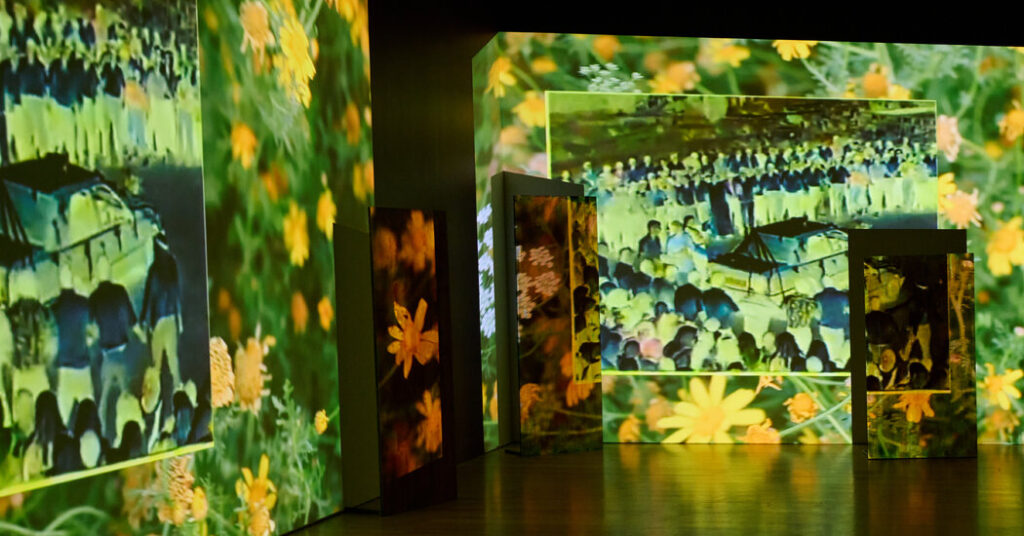
Past and present merge in a luminous three-channel video called “Until We Became Fire and Fire Us” by Basel Abbas and Ruanne Abou-Rahme, artists who live and work in New York and Palestine. Begun in 2023 and still in progress, it combines vintage images of traditional local celebrations with others filmed more recently, and shots of drawings made by Abou-Rahme’s father in Jerusalem in the 1970s and ’80s, with others of wild plants growing in Palestine today.
Evidence of vegetal life is everywhere in the show. It’s there in bouquet-like collages by Enzo Camacho and Ami Lien made from (among many other things) dried sugar cane, seaweed and primrose petals; in ceramic vessels in the shape of thistles and sunflowers by Erin Jane Nelson that function as pinhole cameras; in floral paintings by the Native American artist Kimowan Metchewais, who died at 47 in 2011 and left his work to the Smithsonian’s National Museum of the American Indian as a kind of self-memorial
The idea of all nature having sentience is in the air here. A fiber sculpture by Malcolm Peacock in the form of a giant redwood tree trunk is embedded with recordings of the artist talking to family and friends. Another artist, Ash Arder, has buried sound recordings in a planting bed in the gallery to encourage seeds to grow.
Interviewed in the catalog, Arder said that, for her, gardening symbolizes community. And the notion of community, which is at the heart of this Biennial, takes many forms here. It’ means the population of an entire embattled country in the work of Abbas and Abou-Rahme; and a single city in an audio project by the Filipino composer José Maceda (1917-2004), who persuaded dozens of radio stations in his hometown, Manila, to simultaneously send a musical piece over the airwaves on New Year’s Day in 1974. (You can hear it playing through a choir of portable radios arranged by the artist Aki Onada .)
Community means a company of fellow travelersin the bounteous assemblages of the New York artist Agosto Machado, which document, through hundreds of hoarded and treasured objects, the life and times of a now all-but-vanished creative counterculture in 1960s, ’70s and ’80s Manhattan.
Community also means family: parent and child in a display of crisp, high-color figurative paintings by the Puerto Rican-born artist Carmen de Monteflores paired with hand-molded wax sculptures of sleeping toddlers made in 2024 by her daughter, the contemporary conceptual artist Andrea Fraser.
Family can stretch across time and space, as it does in the 2024 film called “Songbook,” by the Los Angeles-based artist Mariah Garnett, which records her organization of the first-ever performance of an opera, “The Diadem of Stars,” written by her great-great-aunt Ruth Lynda Deyo, who died in 1960 in Egypt, where she had lived half her life.
And it stretches across species in the formally unalike but comparably exquisite work of two artists, Jasmin Sian and Emilie Louise Gossiaux, both of whom have created tributes to cherished nonhuman companions, a parrot named Fennel in the case of Sian’s elaborately detailed drawn landscapes, cut from discarded deli-paper, and a guide dog name London in the ceramic structures and ballpoint pen-and-ink drawings of Gossiaux.
Finally, a homage to creatural connection takes near-monumental form in Oswaldo Maciá’s “Requiem for the Insects,” a chapel-like installation in which towering paintings of a grasshopper and a moth, looking as stately as Renaissance saints, are accompanied by the sounds of chirping and buzzing and shattering glass.
The show has a fair share of impressively scaled objects, including, along with t Oleszko’s sculpture, others by Kelly Akashi, Nani Chason, Raven Halfmoon and Anna Tsouhlarakis. But much of what’s here is modest in size, personal in feeling and projects a kind of crafts-intensive D.I.Y. vibe.
Such is the case with a single piece by Precious Okoyomon: a stuffed fabric doll fitted with taxidermied bird wings and hanging by a noose from a wall. (As of March 25, a flock of such beings will be alighting on the museum’s eighth floor under the title “Everything Wants to Kill You and You Should Be Afraid.”)
Certain objects conceived as protest art are just inches tall, including doorstops made by Kainoa Gruspe from chunks of stone, wood and cement that the artist scavenged from properties in Hawaii that he describes as being “currently occupied by those who might have helped cause or are currently upholding extractive and imperialistic dominion, including military bases, golf courses and hotel resorts.”
Even some digital works fit the small/intimate-/working-at-home model, as in the case of the Palestinian artist Samia Halaby. Her 1980s series of “kinetic paintings,” were originally programmed by the artist on a personal computer that she taught herself to use at time when digital technology, still new, seemed to have a bright populist potential as a medium for carrying art beyond the museum’s walls and into the world.
“Optimism is the banner I follow,” Halaby, now 89, says in a wise catalog interview. It’s a banner that can feel tattered and out of reach right now. This Biennial — materially spare, ideologically non-exhortative, conceptually sometimes arcane —- neither pumps optimism up nor shuts it down. It does suggest, though, that it is in loving communities of all sizes, species, and persuasions that access to it may be found.
The 2026 Whitney Biennial
Opens to members through March 7 and to the public on Sunday, at the Whitney Museum of American Art, 99 Gansevoort Street, (212) 570-3600; whitney.org.
Holland Cotter is chief art critic and a senior writer for the Culture section of The Times, where he has been on staff since 1998.
The post At the Whitney, a Biennial Gets Personal appeared first on New York Times.