In 1984, under a punishing California sun, American distance runner Joan Benoit Samuelson ran into L.A. Memorial Coliseum and into history, winning the inaugural Olympic women’s marathon. It was a breakthrough for women’s running; the iconic image of a sweat-drenched Samuelson charging toward gold modernized how the world perceived female runners.
For all its Olympic legacy, however, the hometown energy of the Los Angeles Marathon — which debuted a couple years later in 1986 — is still overshadowed by the bucket-list mania that surrounds other major American races. But now, as women reshape the culture and economics of distance running, Los Angeles has an opportunity to change that.
Women are fueling the growth of running nationwide, and are more likely to increase event participation over the next 12 months, according to the 2025 Running USA Global Trends survey. On average, women spend more in every single running category compared to men, from race fees to shoes; they also make up 64% of global travelers, influence 82% of trip decisions and spend more than $125 billion a year seeing the world.
The New York City, Chicago and Boston Marathons — each part of the Abbott World Marathon Majors, seven of the world’s largest and most prestigious races — aren’t just running events, they’re cultural touchstones and economic engines for their cities. New York, with a record-breaking 59,226 participants in 2025, and Chicago, which draws around 54,000 runners each year, drive nearly $700 million each in annual economic impact. Even Boston, which caps its participants at around 35,000, generates more than $500 million each race.
L.A.’s 26.2-mile race traces a cinematic course from Dodger Stadium to Century City, running through historic neighborhoods including Silver Lake and West Hollywood, across Rodeo Drive and Sunset Boulevard, and past landmarks like Grauman’s Chinese Theater and the Chateau Marmont. Yet runners outside Southern California still haven’t fully recognized it as a destination event on par with the Majors.
It remains smaller than any of the Majors, drawing an average of about 20,000 runners over the last three years and generating just $122 million for the city in 2025.
But L.A.’s running scene has steadily grown in the post-pandemic era, thanks to a sprawling ecosystem of competitive training groups and community crews — including Koreatown Run Club, Venice Run Club and BlacklistLA — who treat the sport as not just an athletic pursuit, but a form of social connection and cultural expression.
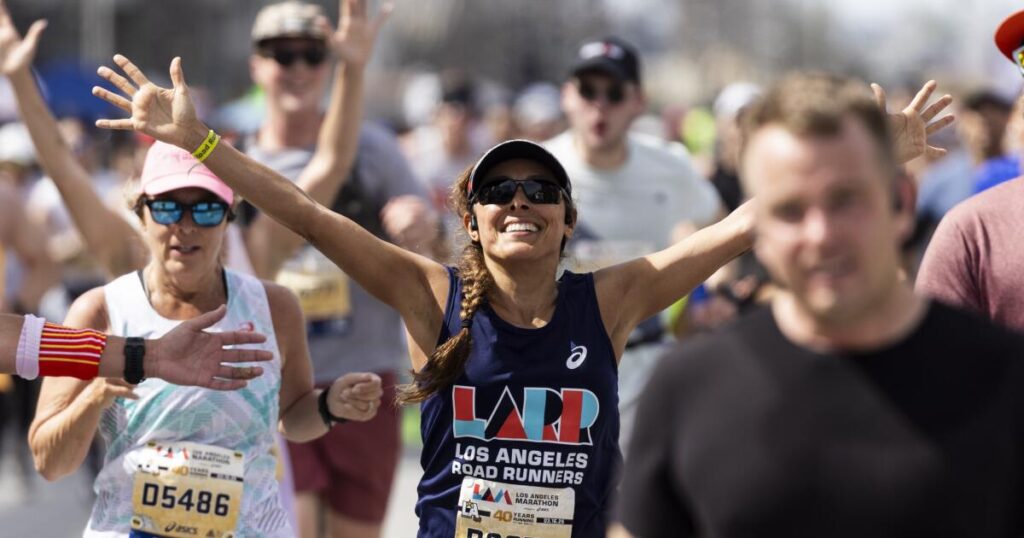
In anticipation of the 2028 Olympic marathon, which is likely to showcase the fastest team of American women ever assembled, the 2026 L.A. Marathon taking place this weekend is poised to return the national conversation around distance running back to the city — especially if it leans into the undeniable momentum behind women’s running.
In just the last two years, the L.A. Marathon has grown 25%, becoming the sixth-largest 26.2-mile race in the country in 2025. The 2026 race sold out of entries more than two months ahead of race day, the fastest pace in event history. Women now make up roughly 40% of the field. And Gen Z women account for 16% of the L.A. field, a two-point jump year over year.
This year’s L.A. Marathon already offers a strong focus on women’s empowerment and community outreach through charity partners including the Women’s Sports Foundation, For All Mothers+ and Girls on the Run. But there is room to attract even more women through competitive and community-driven storytelling.
The 2026 elite field features three of the top American women including Southern California native Makenna Myler, Kellyn Taylor and Savannah Berry. Building a deeper American women’s field — through larger prize purses and intentional recruitment — will only strengthen L.A.’s position as a key stop for athletes chasing Olympic dreams, garnering more mainstream attention.
Los Angeles is home to a thriving competitive female running scene: Groups like Angel City Elite, the Janes Elite Racing and Poppy Athletic Club elevate emerging talent and create pathways for women who may one day contend for a spot on Team USA. Amplifying their voices makes their builds toward 2028 part of the local narrative.
This year, female-led clubs including Sunrise Runners, Running Mamis, and Valley Grls Run will have official cheer stations on the course; other on-course activations include Colibri All Women’s Mariachi between miles 2 and 3, a “Pretty Woman” activation near the Beverly Wilshire hotel in Beverly Hills, and an all-women’s DJ crew near mile 21. Tapping into the energy of even more female-led community clubs in pre-race marketing and when it comes to shaping overall weekend programming centers not just women, but the joyful, participatory aspect of marathoning alongside performance.
Race sponsorships can also influence who feels welcome at the starting line. This year, ASICS collaborated with Believe in the Run to support 100 women training for the Los Angeles Marathon, reflecting research that many women still feel excluded from the sport. Other races have taken more sweeping steps: Maybelline became a partner of the New York City Marathon, and the Every Woman’s Marathon stocked course restrooms with free period products from Daye. Thoughtful details like these expand the experience for women, and signal that female runners are being taken seriously at courses around the world — and that matters.
Today’s marathon culture is one that celebrates competition alongside community and culture, centering grit alongside glamour in the same way Los Angeles always has. If the LA Marathon continues to encourage the women driving this moment, it could position its marathon not just as a local event, but as one of the great American races.
Ashley Mateo is the founder and editor of RUNHER Magazine. Her writing has appeared in the Wall Street Journal, Runner’s World, and TIME.
The post Can women push the L.A. Marathon into the same league as NYC and Boston? appeared first on Los Angeles Times.