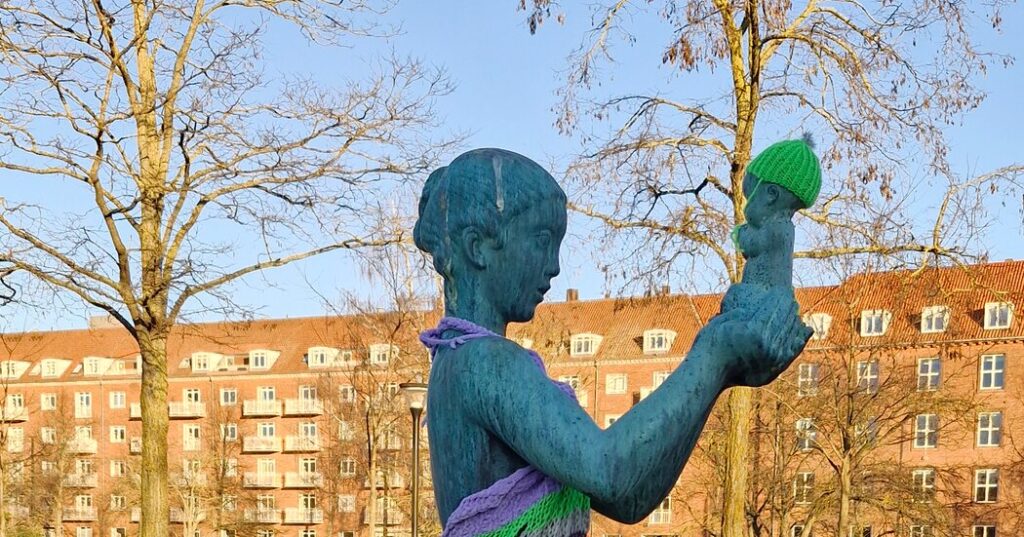
The yarn bombing started with Louise Moerup’s school run in central Copenhagen. On the walk through the park each morning, she and her 10-year-old son would often discuss a naked statue of the goddess Venus there and wonder why there weren’t more statues of real women instead.
Over the Christmas holidays, Moerup decided to stage a gentle provocation that would take that questions public. An avid knitter, she made a striped halter dress and slipped it over the statue’s head.
“It wasn’t really the nudity that made me want to knit her dress,” Moerup said, “but the absence of women who are remembered for their achievements. Knitting the dress was my humorous way to make people look twice and notice what’s missing.”
Her actions have since inspired a broader knitting movement in protest over the gender imbalance in Denmark’s public monuments, which mostly depict men. And late last month, the Danish government announced that it was setting aside $1.5 million to fund public artworks commemorating historically significant women.
Culture Minister Jakob Engel-Schmidt called the timing a coincidence, noting that he had already commissioned a committee to come up with a list of women whose accomplishments merited public commemoration. But the knitters are convinced that they have made an impact.
“It’s very gratifying,” said Matilde Dueholm, a member of the City Council in the city of Aarhus who is among the knitters. “It feels like we have been heard.”
Moerup’s small act of resistance had gained wider traction in early February when a report by the Museum of Art in Public Spaces showed that 484 monuments in Denmark depict historically significant men, while only 43 are of women. Beyond statues of actual people, over 120 public sculptures are female nudes, sometimes representing mythological, literary or allegorical figures.
The author Maren Uthaug posted about those findings on Instagram, making reference to her novel “Eleven Percent,” which imagines a future in which men make up only that share of the population. In the book, the statues of men that once dominated public squares have been gathered into scary theme parks where women can spook themselves with a vision of life under patriarchy.
“It’s going to be really crowded in the horror park, I see,” Uthaug wrote.
That comment inspired Moerup to send Uthaug a photo of the statue she had dressed in the park, and the author posted the picture along with a call for others to engage in “a little activist-feminist handicraft.”
Knitters and crocheters across the country took up their needles, and photos of statues in sweaters — to say nothing of shawls, skirts and bikinis — began pouring in.
“It’s so amazing,” Uthaug said in an interview. “Every day, there are more and more and more women sending me pictures.”
Among the knitters were Dueholm and a fellow Aarhus council member, Anna Thusgaard. “We decided to take things in our own hands and dress the statues in City Hall park,” Dueholm said. “We actually have three ladies there, and none of them have clothes on.”
“It’s important that when young girls and women walk around Aarhus, that we also feel represented in the public environment,” Dueholm said of the motivation behind one pink minidress and a frilly skirt. “Not only as beautiful bodies without clothes, but as individuals with agency and power.”
Not everyone has approved, and Uthaug estimated that she had received thousands of comments criticizing what some perceive as puritanism. (One man wrote, “Shame on you, for covering up beautiful women’s bodies.”)
“That’s missing the point,” Uthaug said. “We don’t want the statues removed, and we don’t really want to cover them up. But we can’t make a point by doing something with historical statues — because they are not there.”
The initiative has also prompted political debate. Katrine Daugaard, a member of Parliament, denounced the knitting as “vandalism” and asked Engel-Schmidt, the culture minister, on the floor of the national legislature whether he objected to the knitting campaign.
“I answered, quite frankly, that I don’t see this as a problem,” Engel-Schmidt said in an interview. “I see it as a very unique kind of protesting the present in order to have a more equal future.”
The knitting hasn’t tapered off since the funding announcement, and Uthaug continues to receive photos of newly dressed statues, including from outside Denmark.
But the statue that started the campaign is once again nude. Curators from the Museum of Copenhagen recently invited Moerup to donate the dress to their collection.
Their motivation was partly preservation: As winter snow turned to rain, the museum was concerned that dyes in the yarn could damage the bronze. But one of the curators, Jakob Ingemann Parby, said it was also archival. “Our goal as a museum is to document the debates around public monuments and how people interact with them,” he said.
Moerup said she couldn’t believe that “something I made from scrap yarn is going to be in a museum collection.” She added that she was pleased to have made a contribution to a much broader discussion.
“If my little knitted intervention helped nudge the conversation forward,” she said, “I’m glad about that.”
The post The Statues Were Mostly Men or Nude Women. So These Knitters Got to Work. appeared first on New York Times.