The messaging discord on the war in the Middle East could be summed up in just a few minutes Tuesday afternoon.
Just past 2:15 p.m., the White House communications office blasted out an urgent news release touting the “unrelenting force of America’s warriors” in a more than 500-word memo highlighting what President Donald Trump considers early successes in the attack on Iran.
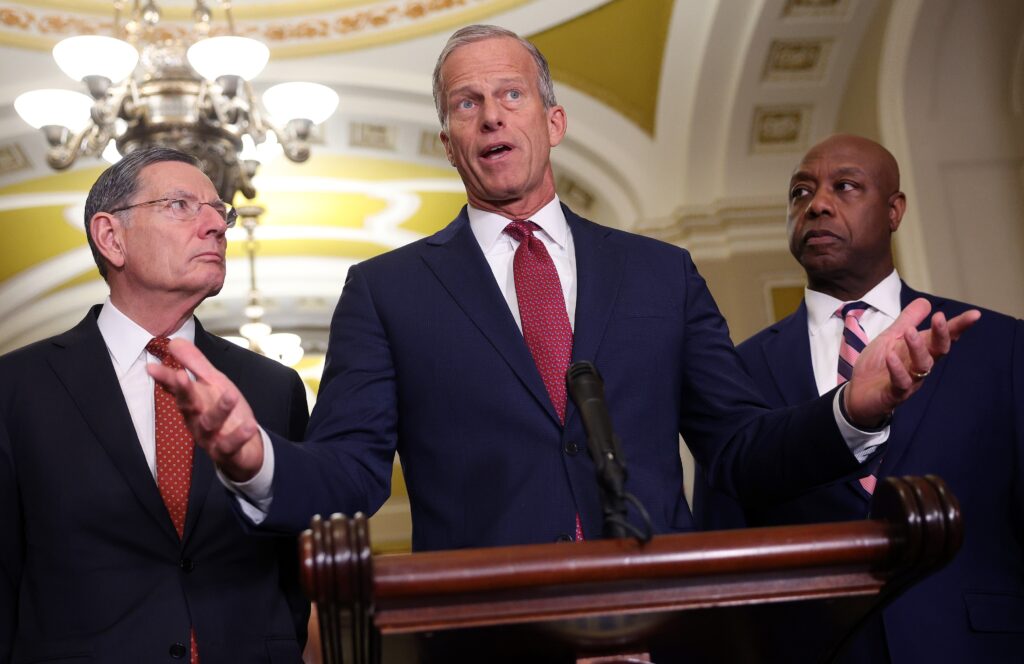
At almost the exact same time, Senate Majority Leader John Thune (R-South Dakota) kicked off his weekly news conference with a 90-second dissertation on an important-but-modest bill to change housing laws to cut down on red tape and increase home building.
“It’s a piece of legislation that strikes at the very heart of the issue of affordability,” Thune told reporters.
He pivoted to complaints about Democrats not yet supporting legislation to reopen the Department of Homeland Security, which has had a funding lapse since mid-February. He never mentioned Iran once, before handing off to another Republican to further highlight the housing bill.
It’s been like this most of the week. After a 90-second statement Monday in support of the Iranian mission, mourning the four U.S. troops killed to that point, Thune gave three Senate floor speeches and the opening remarksat a news conference. He only mentioned Iran twice, in passing.
While he and other Republicans have faced many questions from the media on the war, they have tried to focus on the domestic legislative agenda that voters are most concerned about: cost of living.
Indeed, a trio of initial polls — from The Washington Post, CNN and Reuters — found that, at best, 4 in 10 Americans initially supported the bombing mission against Iran. Only about 20 percent of Americans strongly support the war.
Senate Republicans acknowledged this week that most voters remain preoccupied with their own economic struggles, with a deep dislike for foreign entanglements in a region where U.S. forces have already fought two long wars this century that left almost 7,000 troops dead and tens of thousands wounded.
“A lot of people are dealing with a lot of things at the personal level, at the local level, at their state levels, and this wasn’t on their short list of things to be concerned about,” said Sen. Kevin Cramer (R-North Dakota), a close ally of Thune. “And I think there’s a general skepticism, frankly, about our involvement in the Middle East anyway.”
In terms of the politics of war, the not-so-long-ago days of voters rallying around the flag for a president launching military action have faded.
Trump’s successful bombing of Iran’s nuclear facilities in late June was followed by a slight drop in his approval rating, just as the early October ceasefire in Gaza was followed by another drop in his approval, according to Gallup’s monthly polling.
Voters seem to discount any success in overseas matters, which have consumed a surprising amount of focus for the self-proclaimed “America First” president. A CNN poll last month found that only 32 percent of Americans think Trump is focused on the right priorities.
That’s why Republicans, particularly in the Senate, want to keep their eye on pocketbook issues. The Senate held just two votes by lunchtime Wednesday, both procedural motions that passed with overwhelming bipartisan support to advance the housing bill.
Rejecting any need to debate a war resolution, Republicans have suggested that the only official role for Congress will be to field a request from administration officials whenever they need additional funding to replenish the weapons stockpile.
Democrats forced the only actual war vote this week, on a resolution that, had it passed, would have forced a debate on whether to authorize Trump’s use of the military in the Middle East.
That vote failed, 47 to 53, as just one Republican, Sen. Rand Paul of Kentucky, joined the Democrats in trying to force a debate.
With that vote set aside, Republicans hope to push their housing bill through early next week.
House Republicans have advanced a resolution that is expected to be voted on Thursday “reaffirming Iran remains the largest state sponsor of terrorism” and outlining over two pages many of the attacks their proxies waged in the region. House Democrats have forced their own version of a war-powers vote, which is expected to fail Thursday just as the Senate version failed Wednesday.
Once those votes conclude Thursday, the House will depart on a nearly 11-day break from any legislative action, in part to allow Republicans to fly down to Trump’s luxury resort in Miamito hold a three-day policy retreat.
From Feb. 13, the day the homeland security shutdown began, until March 15, the House will have been in session and voting for just four days.
This post-attack posture follows a pre-attack effort by Trump and his top advisers that had little public campaigning in the run-up to launching a war to win over voters to support the effort.
According to The Washington Post poll taken in the days after the attacks began, just 39 percent support Trump “ordering airstrikes” against Iran, while 52 percent opposed it. In terms of the most intense views, those strongly opposing the airstrikes (39 percent) nearly doubled those strongly supporting them (22 percent) — almost exactly matching CNN’s finding.
This lack of support violates one of the military’s long-standing rules of engagement, often called the “Powell Doctrine,” after Colin Powell when he was chairman of the Joint Chiefs of Staff. Powell, working with other generals and top military, declared that a key failure in the Vietnam War was not sustaining public support for a clearly defined objective.
That’s why both Presidents Bush took a long approach to launching their wars against Iraq, seeking input from Congress and the United Nations to rally public support before launching their attacks.
In January 2002, almost 14 months before the U.S. invasion of Iraq, George W. Bush used the phrase “axis of evil” — Iran, Iraq and North Korea — in a State of the Union address that began to build support for the eventual Iraq invasion. High-profile negotiations with congressional leadership ended with affirmative, bipartisan votes in the House and Senate for the war in October 2002.
Bush fell short of getting the U.N. Security Council behind him as his father, George H.W. Bush, did for the 1991 Iraq War.
The elder Bush also won congressional approval for a war resolution. And a few days into that war, about 80 percent of Americans approved of how Bush was handling the invasion.
While he lacked similar global backing, George W. Bush delivered a prime-time, nationally televised address just days before the invasion, drawing huge support among Americans.
Support went from 59 percent earlier that month to 71 percent, according to a Post-ABC poll at the time. Some 60 percent of Democrats supported going to war in March 2003.
That Iraq War unraveled as the foundation for it, ridding Iraq of weapons of mass destruction, turned out to be false and a quagmire ensued. But it took well into his second term before Bush’s overall job approval rating fell 40 percent, according to Gallup.
Trump started his war with Iran at a much more deeply unpopular position — a Washington Post poll two weeks agofound just 41 percent of Americans approving of his performance.
Cramer noted that lawmakers need to do what they can to amplify their reasons for supporting the war. “It’s important for those of us that believe strongly in it to talk to you all on a regular basis and share why it’s so important,” he told reporters Tuesday.
But he also said that the days of trying to rally Americans behind a presidential military action are done.
“Most people are opposed to wars. I mean, I’m not crazy for them, but I don’t think that’s the first priority, when you have a threat like Iran, is to rally all of the pollsters and voters, so you get to 51 percent favorables. That’s not why we hire intelligence officers,” he said.
The post Senate Republicans sell housing plan and affordability, not war in Iran appeared first on Washington Post.