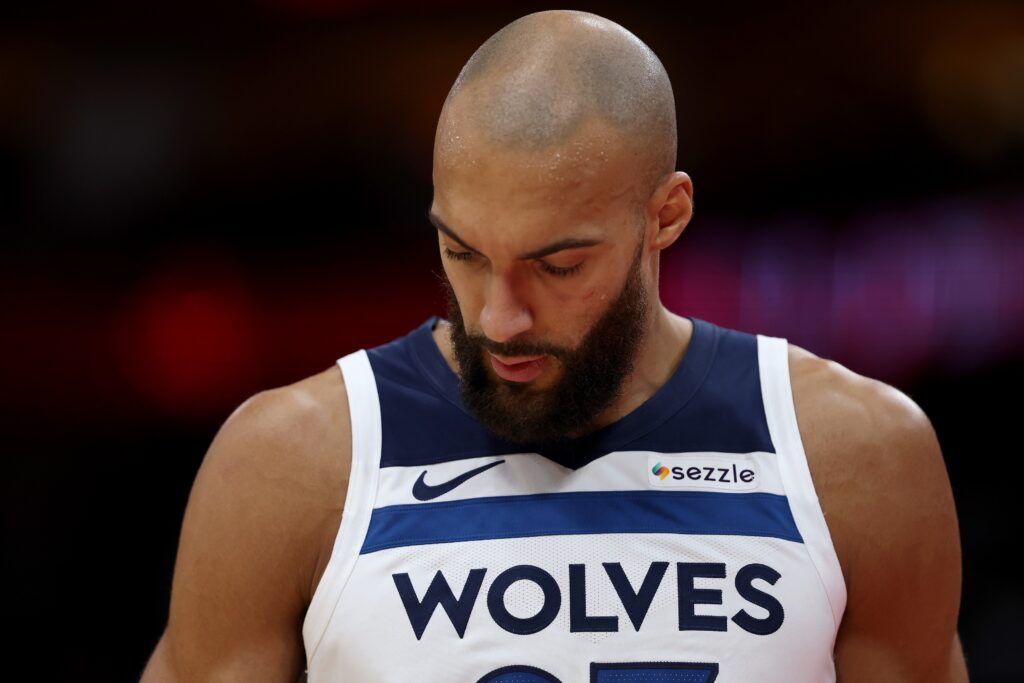
Rudy Gobert is one of the best basketball stories this century. The son of a former college teammate of 1990s Indiana Pacers star Rik Smits — Gobert’s dad had a cameo in the classic Eddie Murphy comedy “Coming to America” — Gobert grew up with his mother in France when the sport was still largely ignored in that country. He worked his way from 27th pick in the 2013 NBA draft — he was traded on draft night — into four-time NBA Defensive Player of the Year, three-time all-star and a key component of the Minnesota Timberwolves, a team that has reached the Western Conference finals the past two seasons and is a legitimate contender again this year. Gobert is a classic underdog story. There is a nonzero chance he ends up in the Basketball Hall of Fame.
But I suspect he’s going to be remembered, forever, as the covid guy.
This comes up every March, even six years later. When the weather begins to warm, those memories return — of where we were when the world changed. And while there were many signpost moments in that frightening period — it seems insane how much time I spent washing my groceries — the most vivid remains March 11. That’s the night Tom Hanks announced he contracted covid-19, President Donald Trump gave a not particularly reassuring address from the Oval Office and the NBA shut down. Because of Rudy Gobert.
Gobert tested positive for the coronavirus just minutes before his Utah Jazz were to take the court in Oklahoma City to play the Thunder. (There were so few tests at the time that the Oklahoma Board of Health had to approve giving Gobert one.) The game was canceled, everyone was sent home, and the NBA announced that the league was suspending its season. “That was a powerful signal to people that something profound about our way of life is about to change,” Vivek Murthy, the former U.S. surgeon general, told ESPN.
It would have been uncomfortable for anyone to be the first player to test positive. But it was particularly uncomfortable for Gobert. Just two days earlier, Gobert had sat at a news conference where he answered the usual questions from sportswriters but was also asked whether he had any fears about this new virus in China. What happened next, when Gobert eventually retires from the NBA, will be shown in his highlight videos at least as prominently as any of his dunks.
As he stood to leave, a smirking Gobert made a point to touch every single microphone in front of him. It was his way of trying to have fun with a tense moment. But it felt, even then, like a mocking of the gods: If this coronavirus business did turn out to be a thing, you knew that was destined to be a Foolishness of Humanity Moment, like a wealthy passenger on the Hindenburg clucking, “There’s nothing safer than a zeppelin!” A day later, Gobert was running a fever and scaring his teammates on the team plane; a day after that, the NBA had shut down. And now it’s who Gobert is, forever.
Six years later, we should probably cut poor Rudy a break. It has been long forgotten why Gobert touched all those microphones. March 9 was the first day of a new protocol for NBA sportswriters: They would no longer be allowed in locker rooms and would have to socially distance from the players at all times. Gobert wasn’t mocking the coronavirus; he was showing solidarity with the reporters, trying to make light of an uncomfortable situation and a policy that many sportswriters were angry about. (We are very touchy about access.)
Six years later, in a world where the ranks of beat reporters have been thinned dramatically, Gobert’s gesture feels almost appreciated: It was a player acknowledging the job those reporters were there to do, and the role the athlete plays in it. He wasn’t mocking covid; he was mocking media restrictions, letting those reporters, ones he saw and worked with every day, know that he was on their side.
But more than that, Gobert was just thinking what we were all thinking: This is no big deal, it’s all going to be fine. If there had been a camera on me on March 9, 2020, I’d have done something dumb, too. It is a fundamentally human reaction to want to believe that the doomsayers are overreacting, that the world is still normal. It is Gobert’s misfortune that he became a symbol of how abnormal things would turn out — how abnormal they remain, all told — but it does not make him unique. He’s just the guy we were all watching.
Thus, this time of year, when memories of that March and those terrifying early days return, I find myself cheering for Rudy Gobert. He’ll never erase his status as a living symbol of covid’s arrival, however unfair that status might be. But he deserves better. He wasn’t any more wrong than the rest of us. He’s just taller.
The post The NBA’s covid guy deserves a break appeared first on Washington Post.