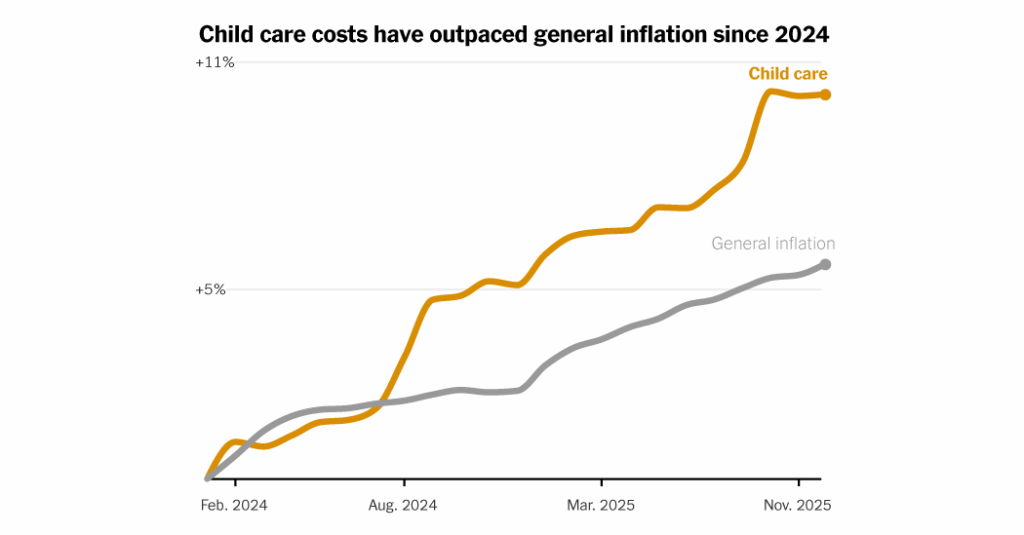
Child care has always been a large expense in parents’ lives. Recently, it has become even more so.
Though costs vary depending on where you live, families earning the median income in every U.S. state spend far more than the 7 percent of household income that the Department of Health and Human Services considers affordable. You can see cost estimates for your state below:
Nationally, the cost of child care now significantly outpaces inflation, rising 8 percent since June 2024, compared with a 4 percent increase in general inflation.
It’s one of the main factors weighing on Americans’ economic outlook, according to New York Times/Siena University polling, which found that affordability concerns are largely about the costs of family life — things like paying for child care, health care and a home. In most states, the average price for child care is even higher than in-state college tuition.
In high-profile races last fall for governor of New Jersey and Virginia and mayor of New York City, the winning candidates all made child care affordability a key issue, including Zohran Mamdani’s pledge to make it free in New York.
Child care has become more expensive because providers’ operating expenses have increased, largely from higher costs and shrinking government financing. And because the business operates on very slim margins, higher costs almost always mean higher fees.
Erica Phillips, the executive director of the National Association for Family Child Care, said care for her 9-month-old and 7-year-old in New Rochelle, N.Y., costs nearly as much as her mortgage, forcing her family to make do with one car and cut back on retirement savings.
“Every winter we have to carefully go over our budget and adjust around child care expenses,” Ms. Phillips said.
Rising costs
Today’s high prices are in part a result of the pandemic, which stressed an already precarious business. Other factors have continued to drive up costs. In a survey of child care providers released last week by the National Association for the Education of Young Children, most said that expenses had increased in the last year — significantly more than said so in 2025 — and that they had raised fees as a result.
Inflation has driven up the prices of supplies and food — in the new survey, nine in 10 respondents said those costs had risen in the last year.
By far the largest expense for child care providers is wages.
The work is labor-intensive, with strict limits set by state governments on the number of children each worker can care for. Pay is the most important contributor to high-quality care, research shows.
Yet the median wage for child care workers is $13 an hour. As states and cities have raised the minimum wage, child care providers said they increasingly compete for workers with fast food jobs paying as much as $20 an hour. Hiring has also become harder as increased immigration enforcement has reduced the number of foreign-born child care workers.
Unlike many industries, which can absorb wage increases by making cuts elsewhere or automating tasks, child care providers have little choice but to pass on wage increases to parents, or decrease their already-low profits.
“I could either raise the prices to where the parents probably couldn’t afford it or not give the workers raises or me take a cut, and I chose myself to take the cut,” said Wanda Crawford, who for three decades has run Ms. Wanda’s Daycare in Nashville, where price increases have been particularly steep. “Being rich is not a part of it. I continue to do it because of my love of working with kids.”
Falling government support
To help pay for child care, millions of low-income families are eligible for subsidies from states and the federal government, the largest source of which is something known as the child care block grant.
But in recent months, many states have cut that funding, facing budget constraints. They are helping fewer families with fees and lowering reimbursement rates. Some states had also temporarily given money to child care providers after the federal pandemic aid for the sector expired, and most of that has now ended too.
In the new survey, nearly one-third of providers said federal or state funding for their program had declined in the past year.
Government support could decrease further: In January, the Trump administration said it planned to freeze $10 billion in funding for child care and other family services in five Democratic states. A judge has temporarily blocked the move.
Sherry Picha and her daughter run a child-care center in La Crosse, Wis. After federal pandemic funding expired, the state provided monthly payments of $13,000 to help offset operating costs, but those end this summer.
Ms. Picha doesn’t know where she’ll make up the difference. Ninety-seven percent of her costs are for wages and benefits for workers, and she and her daughter split a $47,000 salary. She has a second job, teaching part time, to make ends meet.
“You look at those numbers, and you see this is not getting better, this is only getting worse,” she said.
Some policies meant to improve the quality of child care or make it accessible to more children have wound up making it more expensive.
As more cities and states offer public pre-K, for example, it sometimes has the unintended consequence of increasing the cost of care for infants and toddlers. Caring for older children costs less because there can be more of them with each adult. As a result, their tuition helps offset the cost of caring for younger children — and when they enter public programs, infant care costs rise.
Efforts to improve quality — like requiring facility upgrades or caregivers who have college degrees — can also result in higher prices, said RB Fast, who has worked in child care for nearly three decades and opened her own program in Denver in 2022.
“There’s a big effort to improve quality, which is great and I fully support,” she said. “But the government wants it but doesn’t give money, which means it’s the parents who are going to pay for that quality.”
She has, reluctantly, raised fees each year. After taking a significant loss last year, she’s considering closing: “I can’t just not pay myself forever.”
What could help
One solution is for the government to help by financing child-care centers or offsetting parents’ fees — which is what most other rich countries do.
“If you’re looking at trying to reduce the cost to families, the solution lies in how you’re going to subsidize it — there’s not much to do to run down the cost of child care,” said Hailey Gibbs, associate director of early childhood policy at the Center for American Progress, a left-leaning think tank.
Democrats have, in every Congress since 2017, proposed that the government subsidize child care fees so no working family pays more than 7 percent of their income.
When Donald J. Trump was a candidate in 2024, a spokeswoman said he planned to reduce child care prices. But his administration has done little on family policy beyond expanding the child tax credit, and has in some cases blocked child care funding.
Other Republicans, along with Democrats, have generally endorsed tax credits or child allowances — which parents could use as they see fit, including to stay home with children — or an expansion of the child care block grant to cover more low-income families. Another idea is for employers to subsidize child care the way they do health insurance.
But the current approach — parents paying more — is unsustainable, researchers and child care providers said.
“It is a lot of money, but it’s because of the quality, the skilled professionals,” said Nina Buthee, executive director of EveryChild California, an industry group. “It should cost that money — it should cost even more than that — but all that burden shouldn’t be placed on the individual parents.”
Claire Cain Miller is a Times reporter covering gender, families and education.
The post Why Does Child Care Seem Less Affordable Than Ever? appeared first on New York Times.