When South Africa’s president, Cyril Ramaphosa, visited President Trump in the Oval Office last year, he expected to correct Mr. Trump’s false claim that white South Africans were being killed and discriminated against because of their race.
Mr. Ramaphosa said the Oval Office meeting turned into a “spectacle” and an “ambush” instead of a discussion, during which Mr. Trump handed him a stack of newspaper clippings, some of which were unrelated to South Africa, dimmed the lights and presented misleading video footage to double down on his point.
Mr. Trump even suggested that white South Africans now have it as bad as Black people did during apartheid.
“I just thought that he is so uninformed, truly uninformed,” Mr. Ramaphosa said of Mr. Trump. “I realized that he is looking at South Africa through a completely, sort of, foggy lens, without realizing the real, real harm that apartheid did. In my view, he was just dismissive.”
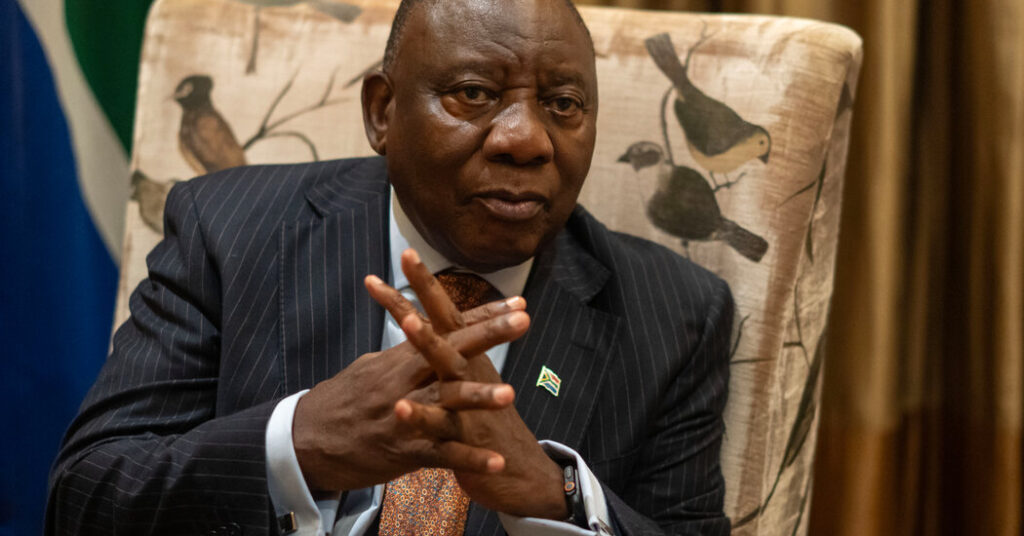
In an interview with The New York Times, Mr. Ramaphosa spoke about his relationship with the American president and the challenges facing South Africa in a world where consensus building and multilateral cooperation appear to be falling away. He called some of Mr. Trump’s policies “racist,” said that Ukraine should not seek to join NATO and pressed the importance of “nonaligned” middle powers like his, particularly during times of crisis and conflict.
The interview took place before last week’s attack by the United States and Israel on Iran, a country that Mr. Ramaphosa and his government have been criticized by Western allies for supporting. Yet Mr. Ramaphosa defended his country’s relations with Tehran, arguing that South Africa’s critics “have much deeper dealings with the very countries that they malign.”
Mr. Ramaphosa, 73, and his country have become regular targets of the second Trump administration. Mr. Trump and his officials have accused South Africa of “doing very bad things,” imposed steep tariffs, cut American aid and created a pathway for Afrikaners, a white ethnic minority, to enter the United States as refugees.
“I do think the Afrikaner policy is racist,” Mr. Ramaphosa said. “It is that racist sort of demeanor that we want to be able to whittle down so that he can see the truth of the situation.”
Mr. Trump is calling attention to “the harrowing stories of Afrikaners,” the White House said in a statement to The Times. “The South African government, at minimum, does not respond, but President Trump has a humanitarian heart. He will continue to speak the truth about these injustices.”
One of Nelson Mandela’s closest lieutenants during apartheid, Mr. Ramaphosa became president in 2018. He acknowledged that South Africa would continue its effort to improve relations with the Trump administration despite the Oval Office blowup and even though “it is irritating, it is demeaning at times when we are insulted.”
But as he sat in a slightly stuffy room in a presidential office in Cape Town with the air-conditioning switched off — it makes him sick — he opened up about how Mr. Trump appeared to be ignorant when it came to the facts on South Africa.
“I think he’s just bereft of any reality about what South Africa is all about and what it stands for,” he said. “We are rather amazed at the attention he gives to us. We are a small country, and we are no threat to the United States.” He said he believed that Mr. Trump’s visa restrictions and bans unfairly targeted African nations and were driven by “a racist demeanor.”
Mr. Ramaphosa has fashioned himself as one of Africa’s leading statesmen. He leads the continent’s largest economy and has lobbied for more African influence on the global stage. “Africa is the future,” he said.
He emphasized that he is in touch with both Iran and China, the United States and the United Nations. (No, South Africa will not be joining the Board of Peace, he said, but he does want African representation on the United Nations Security Council.)
He has also served as a mediator between Presidents Vladimir V. Putin of Russia and Volodymyr Zelensky of Ukraine. As Mr. Ramaphosa sees it, Ukraine’s effort to join NATO was a central cause of the conflict between the two nations. And given that it was one of the causes of the war, he said, Russia’s demand that Ukraine not join NATO “needs to heeded.”
“At the same time, the guarantees that Ukraine wants also need to be heeded,” said Mr. Ramaphosa. “There needs to be a balance.”
The tensions between South Africa and the Trump administration erupted early last year after Mr. Ramaphosa signed into law a measure that would allow the government to take privately held land without providing compensation. Though white South Africans make up roughly 7 percent of the population, white-owned farms still cover about half the country’s entire surface area.
The law is meant, in part, to undo the severe wealth and ownership disparities in South Africa that were created when the white-led colonial and apartheid governments forcibly removed Black people from their land. Redressing such imbalances has been a central pillar of Mr. Ramaphosa’s party, the African National Congress.
But Mr. Trump saw in the law what some South Africans say is anti-white racism. Mr. Trump said falsely that the South African government was using the law to seize white-owned land and that Afrikaners were being targeted and killed, a situation he said amounted to genocide. (No land has been seized as part of the new legislation.)
“There’s no white genocide and there is no grabbing of land, of white people’s land,” Mr. Ramaphosa told The Times. “And white farmers are not being driven out of the country and badly treated.”
He said he was “truly bemused” when Mr. Trump turned down the lights to play the video in the Oval Office. “I didn’t know what was happening,” he said. “As I sort of unpacked it later, I realized that it was an ambush, and I was least prepared for that.”
In the months after that meeting, Mr. Trump has continued his attacks on South Africa, slapped the country with 30 percent tariffs — among the highest in Africa — skipped the Group of 20 meeting in Johannesburg and disinvited South Africa from this year’s G20 meeting hosted by Mr. Trump in Florida.
Mr. Ramaphosa said he invited Mr. Trump for a state visit ahead of the G20 summit last November but did not receive a response. The White House meeting “in many ways, just shook the relationship quite a bit,” he said.
But he said he had not lost hope.
The United States is South Africa’s second-largest trading partner. Away from the cameras, officials from both countries have continued to talk, particularly on trade. “The quiet layer of the relationship continues,” Mr. Ramaphosa said. “It continues because the United States is a strategic country for us.”
He pointed out that South Africa had not been kicked out of a long-running trade agreement between the United States and dozens of African countries, a sign, he said, that efforts to maintain ties were bearing fruit.
“Time is a great healer,” he said.
Mr. Ramaphosa said his optimism was shaped by the dark days of apartheid, when he was arrested twice and almost killed during a police crackdown on protests. “Many people, in looking at the South African situation, would have lost hope. It seemed intractable,” he said.
But Mr. Mandela and many other heroes of the liberation struggle never gave up.
“My hope derives from that human spirit that resides in all of us,” Mr. Ramaphosa said. “And that human spirit to want to do good, to advance, will forever remain embedded in humanity.”
John Eligon is the Johannesburg bureau chief for The Times, covering a wide range of events and trends that influence and shape the lives of ordinary people across southern Africa.
The post South African President Talks Trump, Racism and That Oval Office ‘Ambush’ appeared first on New York Times.