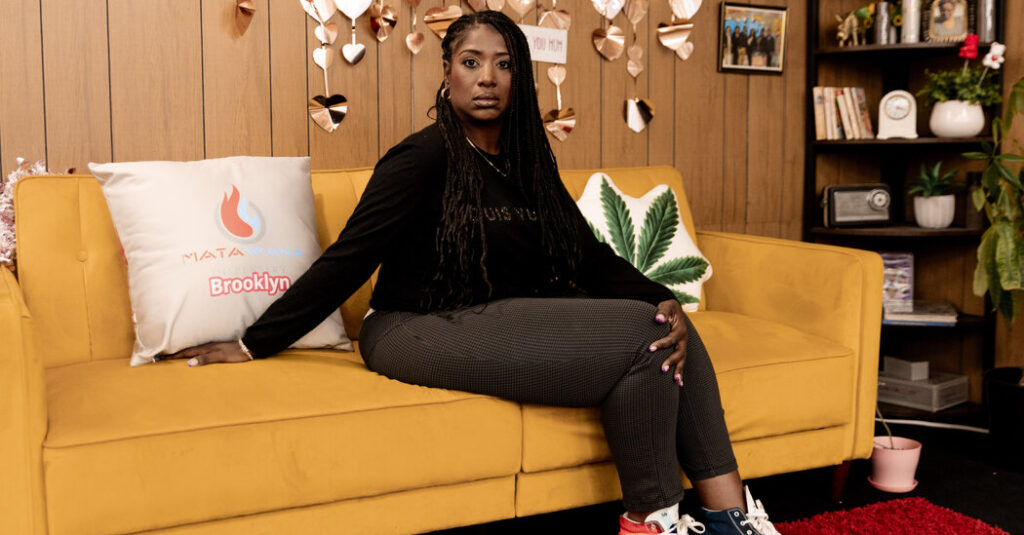
Leeann Mata made history two years ago when she became the first Black woman to open a legal cannabis dispensary in Brooklyn.
She started the business with the support of Housing Works, a nonprofit that assists people living with AIDS. It seemed to be a perfect match — years ago, three of Ms. Mata’s brothers were detained on low-level marijuana offenses under state laws that have since been amended, and Housing Works had expanded its mission to helping those negatively affected by the so-called war on drugs.
But the partnership quickly soured.
Ms. Mata and Housing Works are now locked in a battle. The nonprofit sued Ms. Mata for $2.5 million in unpaid fees, and Ms. Mata filed a complaint with state regulators accusing Housing Works of taking advantage of her.
Their dispute offers a rare glimpse into how one of hundreds of deals negotiated in the frenzy of New York’s legal cannabis rollout fell apart, leaving both parties feeling cheated. It raises questions about what constitutes a fair deal in a nascent industry where cash and expertise are in short supply because selling cannabis remains illegal under federal law.
The last straw, Ms. Mata said, was when a delivery driver for Housing Works’s flagship dispensary in Manhattan visited her store, Matawana, in Park Slope, Brooklyn, in April 2024 and remarked that he was making deliveries in the area. She said she felt the nonprofit was undercutting her because its consultants were telling her that her store was not ready to offer delivery, yet it was itself delivering in her area.
“Everything they were doing was destroying my company,” Ms. Mata, 45, said.
Matthew Bernardo, the president of Housing Works, said the nonprofit delivered to Park Slope before it became involved in Matawana. While he was proud to have helped Ms. Mata make history, he said her store did not have the software or training early on to offer delivery. Doing so unprepared could have gotten her in trouble with regulators, he added. He said the lawsuit filed last September was a last resort after Ms. Mata refused to honor their contract, and they could not agree to a settlement.
“There’s always disagreements,” he said. Ultimately, he added, both parties had to abide by their contract.
The state legalized the sale of recreational cannabis in 2021, promising to finance the first 150 licensed dispensaries, including leasing space for them. But when it became clear that New York would not be able to keep that promise, a flurry of deal-making began. The first license-holders, who either had been convicted of a marijuana-related offense or had a close relative who had been, were sent scrambling to find investors and lock down real estate.
Most lacked access to the kind of networks that could provide them with money and expertise needed to build their businesses. Even the savvier ones found themselves lured into deals designed to extract their revenues and usurp their control, according to the advocates, consultants and lawyers involved and the license holders themselves.
“You took unexperienced players and basically threw them to the wolves,” Jeffrey Hoffman, a New York-based cannabis lawyer who has helped licensees open businesses, said.
Amber Senter, the co-founder of Supernova Women, a nonprofit supporting people of color in the cannabis industry, said similar scenarios had played out in Oakland, Calif.; Los Angeles; and Chicago.
In New York, Housing Works opened the state’s first licensed dispensary in 2022. And as its sales climbed to $24 million that first year, investors began to take notice. Mr. Bernardo said the nonprofit saw an opportunity to create a business incubator, using their experience to help some of the licensees affected by past marijuana convictions.
Dan Morena, the owner of Chelsea Cannabis in Manhattan, also made a deal with Housing Works. He said that he signed on after spurning offers from investors that he felt either crossed the line of what was legally allowed or at least undermined the spirit of the program.
“Everyone either just wanted to buy me out, or do some loophole deal where I’m not in the store and they do it in my name,” Mr. Morena, who also owns a company raising money for technology start-ups, said. “Or they find some way that you can’t fire them and they’re in control.”
Under Ms. Mata’s deal, Housing Works introduced her to investors who put up $700,000 for a 19 percent stake in the company. The nonprofit also assumed responsibility if Matawana defaulted on its lease, and it brought on consultants who hired staff members and managed payroll and accounting. In exchange, Matawana agreed to pay $20,000 a month and give 5 percent of its revenue to Housing Works under a three-year deal. Mr. Bernardo said the nonprofit never collected a cent.
Such deals are common in the cannabis industry. But lawyers, investors and dispensary owners said that having contracts intertwined through a single entity can make it difficult for license holders to exercise control of their businesses and get out of deals that do not work for them.
Benjamin Rattner, an attorney in New York who has reviewed dozens of cannabis contracts, said that compared with other deals, what Housing Works offered did not seem bad on paper.
“It’s definitely not the most predatory agreement I’ve seen,” he said. “And if followed, it has the potential to at least help the licensee get up and running without strangling them.”
Matawana is one of six dispensaries that partnered with Housing Works, and the only one to sever the deal on bad terms. All but one of the stores are among the state’s highest-grossing dispensaries, according to sales data compiled by Lit Alerts, a market research company. Rick Bashkoff, the chief executive officer of Lit Alerts, said the data suggest the partnerships were fruitful, though it does not account for the businesses’ costs.
“They’ve done the job of at least getting the revenue in the door,” he said.
Ms. Mata said Housing Works began courting her in the summer of 2023, after the death in June of her mother, who used cannabis to wean herself off opioids. The nonprofit invited her and other licensees to tour their Manhattan store, where she said they offered to help with her dispensary. She said the deal appealed to her because it was a familiar nonprofit that was already operating a successful dispensary in New York.
“You don’t think they would take advantage of you,” she said.
But Ms. Mata said that because of a string of errors by Housing Works’s consultants, her staff was paid incorrectly and her quarterly business taxes were filed late, resulting in an Internal Revenue Service penalty.
The contract required Ms. Mata to give Housing Works 90 days to fix the problems. But Ms. Mata said she could no longer trust the organization after finding out the nonprofit’s dispensary was delivering orders in her store’s territory. She sent Mr. Bernardo a letter on May 13 outlining why she believed Housing Works was failing to hold up its end of the contract and offering $50,000 to sever the deal.
Mr. Bernardo said the nonprofit could not accept her offer because it left them on the hook for Matawana’s lease if she defaulted. He said Housing Works wanted her to pay the fees until she could replace the nonprofit as a guarantor.
After the nonprofit sued her, Ms. Mata filed a complaint last October against Housing Works with a new unit at the state cannabis agency responsible for ensuring cannabis contracts are fair and legal. But she said she had not heard anything about her case, and the official in charge of the unit, the Trade Practices Bureau, was fired amid the fallout from an unrelated investigation. The Office of Cannabis Management declined to disclose the status of the complaint, citing confidentiality.
Yvette McDowell, a cannabis lawyer in California who recently helped Los Angeles officials redesign their cannabis program, said these kinds of contract disputes were fed by local governments’ unfulfilled promises to help licensees navigate a difficult, high-risk industry.
Unequipped license holders rush into deals that ultimately hurt them, she said. And as a result, many licensees lose their businesses or see them fail.
“Do not set a program up that you are not going to properly fund, that you’re not going to provide the right tools, or the training that’s needed,” she said.
Nicole Lucien, 42, who opened Bliss+Lex in Manhattan with her husband, Chris, said she sympathized with Ms. Mata because she had spoken to other licensees who said they felt pressure to accept the deal from Housing Works.
The couple had hired a lawyer with experience in other states who advised them to negotiate down to fine details, such as how quickly Housing Works had to respond to their calls.
“A lot of people were surprised that we were able to negotiate,” said Ms. Lucien, who previously worked as a software engineer for a medical manufacturing company.
Housing Works helped the Luciens secure a prime storefront on East 86th Street, just above the Lexington Avenue subway stop. And its guidance to spend sparingly in the early months helped the store to reach profitability, she said.
“I’ve always told people: We made it work for us,” she said. “That does not mean it’s going to work for you.”
Ashley Southall writes about cannabis legalization in New York.
The post $2.5 Million Rift Pits Cannabis Pioneer Against Group That Backed Her appeared first on New York Times.