Unfortunately Democrats in Texas cannot avoid a vexing fact: No Democrat has been elected to a statewide office since 1994.
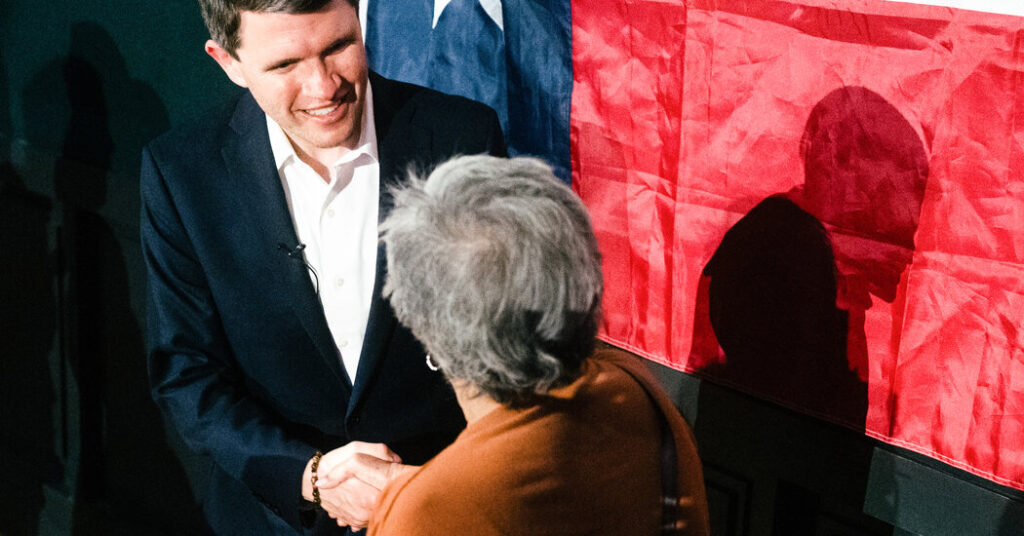
Is this the year they break that curse? James Talarico, a Texas state representative, is the one who gets to try. He prevailed in the Democratic Senate primary over Representative Jasmine Crockett and will face the winner of a runoff between Senator John Cornyn and Ken Paxton, the Texas attorney general.
To dig into that perennial question, Christopher Hooks, a Texas native and contributing editor to Texas Monthly, had a written conversation with John Guida, an editor in Times Opinion.
John Guida: Let’s tackle the question that has haunted Democrats for decades: Can Talarico turn Texas blue?
Christopher Hooks: I have to let some air out of the balloon right away: No, Talarico can’t turn Texas blue in the way you’ve been hearing it predicted for the last two decades. The dream national Democrats and some local ones have of “blue Texas” is about an emerging Democratic majority in the state that makes Texas a two-party state again.
We’re really far away from that, still. The Democratic candidate slate under the Senate race is anemic; the earliest the party can exercise meaningful control over the redistricting process is probably 2040.
Guida: 2040 is really far away — that will not be music to the ears of Democrats.
Hooks: At the same time, I do think Talarico has a narrow shot at winning this race. He needs a lot of factors to line up in his favor. Whatever skepticism the reader might be feeling is warranted here. National folks hear about a promising Democratic statewide candidate in Texas every two to four years and they never win, so it feels like nothing ever changes.
The thing to emphasize as somebody who covers this stuff is that Texas politics is actually in constant churn. The relationship between the two parties is constantly changing, and the Republican Party here is essentially an entirely different party than it was 12 years ago. Eventually things are going to line up in the right way, and the ground is going to shift.
Guida: The Republican pollster Kristen Soltis Anderson (a contributing Times Opinion writer) wrote that for Democrats to win in Texas, they will need three things: “an exceptionally good political environment,” “a good Democrat” and “a bad Republican.” Does that sound about right, in terms of the factors you mentioned, and if so, how would you size up the three criteria?
Hooks: That’s right, and I think you could rank them. In a sense, the “good Democrat” is the least important part. The environment is probably the most important. When an unpopular Republican is in the White House, Texas Democrats can show real strength. In 2008, when President George W. Bush’s approval ratings were tanking, the party came within one seat of taking the state House. In President Trump’s first midterm, Beto O’Rourke came within three points of winning Ted Cruz’s Senate seat. What does this November look like if Trump’s approval rating is, say, 30 percent — if we’re at war, and oil and food prices are spiking?
Guida: What if Trump’s approval is roughly where it is now, hovering around 40 or low 40s percent?
Hooks: I’m not a numbers guy, but my guess is that it looks like the 2018 Senate race again. I think Texas Dems do need the president to get a little crazier.
Guida: And for the Republican candidate quality: How big a difference will it be if, in the general election, Talarico faces John Cornyn versus Ken Paxton?
Hooks: Democrats badly want Paxton to win, and for good reason. This is a man who has been accused of having an extramarital affair, is being divorced by his wife, spent a decade dodging felony prosecution for securities fraud and was accused by his own senior staff of bribery and corruption.
At the same time — this is Texas — a lot of this has been known for a long time and he has still won three statewide elections to be the top law enforcement officer of the state. Count him out at your peril.
I don’t doubt that Cornyn would perform better in a general election than Paxton. But he is also not an ideal candidate. There is real and intense hatred of Cornyn in the Republican base that goes back more than a decade. Right now, it’s being reported that Trump is expected to make an endorsement of Cornyn and effectively ask Paxton to step down. But Cornyn and Paxton hate each other deeply, on a personal level, and I would be a little surprised if Paxton obeys. Rallying around Cornyn, even if it works, will come at a cost.
Guida: Is that hatred of Cornyn among part of the Republican base reflective of the changes you mentioned in the Texas Republican Party over the past decade?
Hooks: Cornyn represents the business class of the Texas G.O.P., which put the party in power back in the George H.W. Bush days and has been fading ever since. Every time I’ve seen Cornyn speak to Texas Republicans, especially at party conventions, he’s been booed. Conservatives have specific reasons to offer why he’s a traitor, but I think underlying all that is this deeply ingrained sense in the Republican Party here that the party has to continually renew itself through this kind of revolutionary, anti-establishment fervor. That’s all the more important because the party has been in total control of the state for 23 years and struggles to find new enemies to fight, new reasons to command the loyalty of its voters.
Our statewide elected officials often serve 12 or 16 years in office. But under the surface, the Republican Party is constantly remaking itself. And it’s remaking itself now in a way that, frankly, as a longtime observer, freaks me out. As recently as 2014, Texas Republicans were advocating a guest-worker program, compassion for immigrants, and for a general kind of traditional American pluralism in what was becoming a very diverse and complex state. That’s all gone. The governor can’t post a picture of a Diwali celebration without getting screamed at for weeks on social media by guys with really big hats.
Tarrant County is one of the most populous red counties in the country. The head of the G.O.P. there until recently was a man named Bo French, who advocates denaturalizing and deporting some 100 million Americans — especially Muslims and Indians. He once ran a Twitter poll to ask if Muslims or Jews were the bigger threat to America. He’s said he wants to deport Native Americans. He tweeted once that in America, we’re “all Rhodesians now.” Bo French ran for a statewide office, a seat on the Railroad Commission, and he’s in the runoff now. What French is saying is what a lot of younger Texas conservatives are saying.
Guida: For the general election, whether it’s Cornyn or Paxton, you mentioned the 2018 race between O’Rourke and Ted Cruz. Beto came as close to victory as any statewide Democrat has in years. Is that the model? Big wins in the big cities, strong performance in South Texas and elsewhere among Hispanic voters and among Black voters? Do you think Talarico’s skills map onto that well?
Hooks: In the primary results, you could see Crockett and Talarico had two halves of the ungainly, uncomfortable coalition that is the Texas Democratic Party. Crockett did well with Black voters and did OK, but not good enough, in the big diverse urban counties that contain Houston, Dallas and Fort Worth. Talarico will need to do some work in these places. But he won because he ran up tremendous margins in suburban counties, the greater Austin area, San Antonio, El Paso and South Texas, and those are tremendously important to statewide campaigns as well.
Guida: Talarico won the most Hispanic counties in Texas by a combined 22 points. He did that in part by forming alliances with people like Bobby Pulido, a moderate Democrat and Latin Grammy Award-winning Tejano singer who won a primary on Tuesday to run in a reshaped 15th District in South Texas. Are those the voters that shifted toward Trump in 2024?
Hooks: In several border counties, Talarico beat Crockett by an almost 2-to-1 margin. There is a lot of reason to believe that Latino voters have turned on Trump. The main driver of the swing right, the border crisis, isn’t a factor anymore, which is an ironic thing — Republicans need migrants to keep coming and they aren’t.
But there’s also a note of caution in the results. There was a significant undervote in the race in several places, where folks came to vote in the party primary for local positions and then cast no vote for either statewide candidate.
I think the conventional wisdom that Talarico is a better general election candidate than Crockett is, for several reasons, absolutely correct. But he is still a very white candidate from a unique part of the state, and he doesn’t necessarily have the communication skills and natural charisma of Beto O’Rourke, who had been a national celebrity for a year by this point of his race. So he’s got a lot of work to do.
Guida: Are Democratic candidates like Talarico and others who did well on Tuesday — Representative Christian Menefee, who is ahead of Representative Al Green in a Democratic fight over a newly drawn district (the race will head to a runoff), Valerie Foushee in North Carolina or Pulido — offering a new generation of liberal normies? Some of them are new to public office (though obviously Talarico isn’t).
Hooks: I do think you can read some of these races as the Democratic Party struggling to push forward and find a new way to be. Menefee is a relatively young and talented candidate who looks favored to take over a seat which has literally seen two Democrats die in office. Pulido is a dream candidate for his district who faced some very weak oppo about his history of telling raunchy jokes, and that’s not the world we’re in anymore.
I think you can read the Crockett-Talarico race that way too. Crockett did well with older voters and the kind of highly partisan Democrats who watch MS NOW all day. She was a candidate from Joe Biden’s Democratic Party, and her supporters slammed Talarico for putting Uncle Joe down. (Kamala Harris did a robocall for her at a late hour, although I think this was effectively her way of staying out of the race.) Talarico did well with younger voters and overcame very low name recognition to do well with party voters who want something more in the future than reliving the summer of 2024 over and over again.
Guida: To take the Senate, Democrats need to win a few races in red states. Texas is on that list of potential states — it also includes Alaska, Iowa, Ohio, North Carolina. Where would you rank Texas on that list?
Hooks: The problem with Texas is that it’s tremendously expensive and difficult to campaign here. Five of the 20 largest cities, and even our smaller cities, are in their own expensive media markets. So if I was advising national Democrats, I’d say go anywhere but Texas if you can. The map being what it is, though, they may not have a choice.
Christopher Hooks is a Texas native and writer based in Austin. He is a contributing editor to Texas Monthly. John Guida is a Times Opinion editor.
The Times is committed to publishing a diversity of letters to the editor. We’d like to hear what you think about this or any of our articles. Here are some tips. And here’s our email: [email protected].
Follow the New York Times Opinion section on Facebook, Instagram, TikTok, Bluesky, WhatsApp and Threads.
The post He’s No Beto, but Can Talarico Win? A Texas Writer Weighs In. appeared first on New York Times.