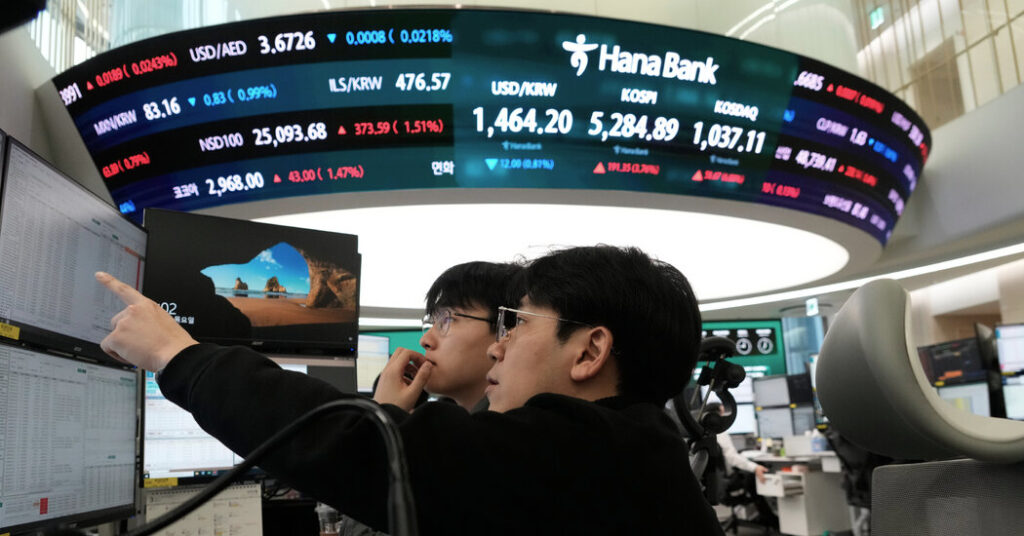
Stocks across most of Asia rallied on Thursday, a day after tumbling over fears around the region’s heavy reliance on imported oil and gas.
The turnaround illustrates the hair-trigger reactions of investors around the world who are trying to assess the immediate and possible long-term effects of the strikes on Iran by the United States and Israel and the repercussions around the Persian Gulf, where much of the world’s oil and gas is produced.
The swing was particularly stark for South Korea’s Kospi index, which had dropped 12 percent in its worst single-day crash, then turned around to trade 11 percent higher. At one point on Wednesday the plunge was so rapid that trading was temporarily halted to stem the losses.
Stocks in Taiwan also swung, falling more than 4 percent on Wednesday before jumping nearly 3 percent 24 hours later.
The recovery in Asia took the lead from trading on Wednesday in the United States, where stocks opened higher for the first time all week after President Trump suggested that the U.S. Navy may escort ships through the Strait of Hormuz, and President Emmanuel Macron of France called for an international coalition to help secure commercial shipping routes.
Over the past year, intense optimism about artificial intelligence has led investors to pour money into tech stocks in Taiwan and South Korea. The two places make most of the equipment like computer chips and servers that power the world’s A.I. systems. They also depend on imports for virtually all of their energy.
The stock market seesaw served as a reminder not only of the central role that these two East Asian democracies play in the global economy, but how bullish investors remain about A.I.
Jim Fontanelli, a senior analyst at Arete Research, an equity research firm, said the movement in the stocks was “not a reflection of a change in the fundamentals of A.I.”
“Questions around A.I. optimism have been a consistent theme for all these stocks over the past few years,” he said. “The conflict has little direct impact on that question.”
In February, the share prices of many of East Asia’s biggest companies climbed to record highs, including Taiwan Semiconductor Manufacturing Company, which makes chips for Apple and Nvidia, as well as Samsung and SK Hynix, which manufacture memory chips for Nvidia’s sought-after A.I. servers. All three closed lower on Wednesday and then recovered.
“The conflict in the Middle East probably does not directly impact the fundamental demand for companies like TSMC and Samsung,” said Vey-Sern Ling, an equities adviser based in Singapore at the bank Union Bancaire Privé. “Heavy investment in A.I. infrastructure could continue for years even with the war.”
Yet, a prolonged and ever-wider conflict in the Middle East that interrupts the supply of energy to Asia could damage the electricity-intensive production of chips.
Since they are so dependent on imported oil and gas, Asia’s semiconductor manufacturing hubs would bear the brunt of the shock from any energy disruptions, said Randy Yang, an analyst at TrendForce, a market research firm in Taipei. The build-out of A.I. infrastructure in the United States faces a lower risk from the Persian Gulf conflict, since America can rely on its own sources of energy, Mr. Yang said.
Meaghan Tobin covers business and tech stories in Asia with a focus on China and is based in Taipei.
The post What the Extraordinary Market Volatility in Asia Says About Energy and A.I. appeared first on New York Times.