This article is part of a Women and Leadership special report highlighting leaders in women’s rights, health, business and much more.
The New York Times asked nine influential women from around the world a single question about their work and approach to leading. Their responses have been edited and condensed.
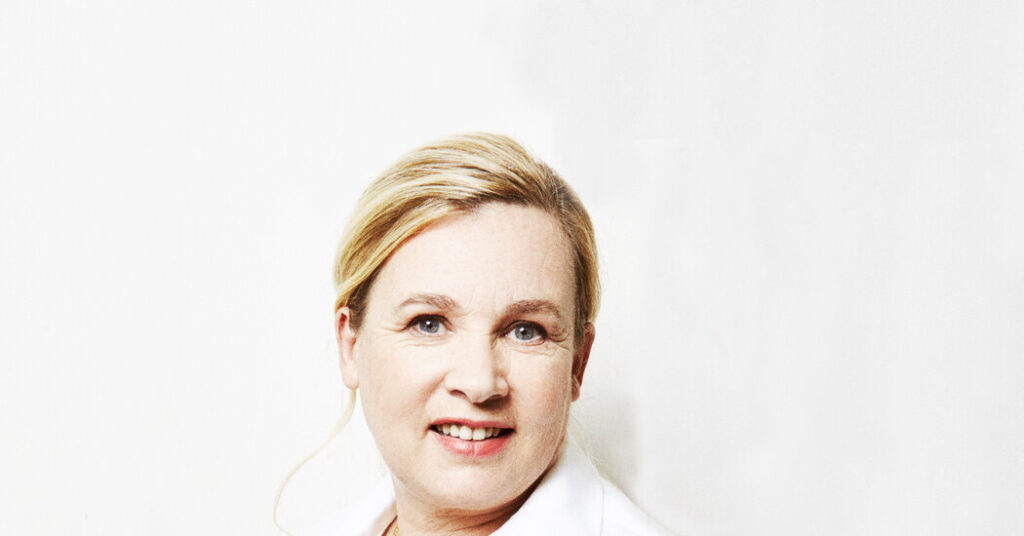
Hélène Darroze, Paris, 58
How She Leads: Ms. Darroze comes from a family of chefs and is the fourth generation in the profession. Her restaurant Hélène Darroze at the Connaught in London holds three Michelin stars, while Marsan par Hélène Darroze in Paris holds two. She is known for building team cultures centered on respect, mentorship and personal growth.
Professional kitchens have long been demanding and hierarchical. How have you tried to create a different environment, especially for women coming up in the industry?
Professional kitchens have always been intense. I was trained in that system and learned a lot from it: discipline, precision, respect for the product and for the craft. But I have never been comfortable with the very military side of kitchens.
That is also why I have never liked being called chef. In my teams, everyone calls me Hélène. Authority should come from knowledge, experience and respect, not from distance or fear. I try to create an environment where excellence is still essential but where people feel supported and listened to. I want teams where people feel free to express themselves, to ask questions and to grow.
I don’t make a distinction between women and men. What matters to me is talent, commitment, generosity and the ability to work as a team. That said, I am always especially happy to see talented women succeed in this profession because I know how difficult the path used to be.
Niyamat Kochhar, New Delhi, 18
How She Leads: Ms. Kochhar is the founder of Menstra, a youth-led initiative addressing period poverty that has distributed 50,000 biodegradable pads to over 2,500 women in rural communities in India. She also founded HerCode, a digital education camp for girls from migrant communities in New Delhi.
While working on menstrual health and digital education, what surprised you most when you tried to turn ideas into action?
How deeply stigma translates into control, silence and unequal access, even when resources exist. Recently, while donating sanitary pads in a rural community, a woman came twice, saying the second set was for her daughter-in-law. As we were leaving, we saw the daughter-in-law outside. When we offered her a pad, the mother-in-law blocked her path and firmly said no — the pads were for her, not her daughter-in-law. That moment made it clear that menstrual stigma can manifest as control, fear and, at times, sexual and gender-based violence.
I have heard endless stories of girls dropping out of school simply because their menstrual cycles began. India is reported to have nearly 23 million girls dropping out of school each year due to inadequate menstrual hygiene facilities. This lack of safe infrastructure often places girls at risk of harassment and abuse, highlighting how closely menstrual health is tied to safety and dignity.
In my digital education work with daughters of migrant construction workers, I saw similar exclusion. Girls were emotional when opening a laptop for the first time, grateful for access that should have been basic. These experiences reinforced the urgency of ensuring that women are represented in fields such as technology and medicine, so that systems are more inclusive and accessible.
Wendy Lee, Palo Alto, Calif., and New York City, 36
How She Leads: Ms. Lee is a director of product management at Uber and is overseeing the launch and expansion of the company’s autonomous vehicle program.
You are responsible for shaping how people will experience autonomous transportation. When you are building something this new, what guides your decisions about what should come first?
The first things I optimize for are safety and trust. I think about my mom. She’s smart, curious and not especially impressed by tech hype. If she steps into an autonomous vehicle for the first time, I don’t want her to think, “Wow, I’m inside a robot.” I want her to think, “This feels like an Uber.”
That idea — familiarity before flash — guides almost every product decision I make. When you’re building something radically new, it’s tempting to lead with novelty. But the best autonomous experience is one where you briefly notice the steering wheel turning on its own and then forget about it.
That means we often start with invisible details: How does a rider know they’re getting into the right vehicle? What happens if they’re visually impaired? How does the car explain what it’s about to do before it does it?
Designing without someone in the driver’s seat changes the rules. The car becomes the interface. So we focus intensely on small signals — audio cues, lighting, in-app navigation, vehicle identification and clear language — because those signals build confidence.
For every autonomous-vehicle enthusiast, there is someone encountering this technology for the first time. They deserve an experience that feels intuitive, low pressure and safe to explore. The future doesn’t feel futuristic when you trust it. It feels normal.
Ingrid Silva, New York City, 37
How She Leads: Born and raised in Rio de Janeiro, Ms. Silva is a principal dancer at the Dance Theater of Harlem and is a co-founder of Blacks in Ballet, an organization that supports and promotes dancers of color worldwide.
Building a career within ballet while also advocating its evolution is not simple. How do you think about leadership when the institution you’re challenging is also the one you love?
It requires a deep understanding of both love and accountability. Ballet is the art form that shaped me, but it is also an institution built on rigid traditions that have historically excluded bodies and identities like mine. For me, leadership means refusing to choose between excellence and equity. It means believing that ballet can honor its history while still evolving to reflect the world we live in.
I think about leadership as action rooted in lived experience. In my career, I spent over a decade dyeing my pointe shoes to match my skin tone, conforming to a visual standard that was never designed for dancers of color. Instead of accepting that as “just the way it is,” I chose to share my experience publicly on social media. In 2019, after years of advocacy, I helped push the industry toward creating inclusive pointe shoes. That shift was not just about color; it was about belonging.
Through Blacks in Ballet, I support artists by creating opportunities, mentorship and platforms that didn’t exist when I was coming up. I don’t see this as working against ballet, but working for its future. Being a principal dancer with Dance Theater of Harlem, an institution that challenges ballet’s exclusionary norms, has deeply informed my leadership philosophy. I lead by example, by showing what is possible, and by using my voice responsibly. Leadership, to me, is staying in the room, even when it’s uncomfortable, and helping build a future generation that won’t have to fight just to belong.
Dilanaz Güler, Ankara, Turkey, 22
How She Leads: A member of the U.N. Women Leaders Network and a National Gender Youth Advocate, Ms. Güler works to counter online gender-based violence and expand digital literacy among young people.
Digital gender-based violence spreads fast and often stays hidden. What has been the most challenging part of trying to change behavior online?
The biggest challenge is the lack of institutional support in countering digital gender-based violence. Many people imagine my work on internet de-radicalization as me individually reaching out to young people and trying to talk them out of the predatory rabbit holes they have fallen into. This is not entirely wrong: A sizable portion of my time is spent speaking about the real-life consequences of internet culture. But de-radicalization means very little without systems in place to prevent digital gender-based violence and support its victims.
The lack of laws, inconsistent enforcement of existing laws and limited accountability for digital platforms make our work extremely difficult. Victims cannot report stalkerware in countries where stalking itself is not criminalized. Law enforcement’s dismissal of gender-based violence further complicates legal processes needed to protect victims. Our offline realities — including systemic bias — often shape online ones. That is especially true for digital platforms, where prioritizing profit over safety continues to fuel radicalizing networks in the name of sustained engagement.
Eva Chisom Chukwunelo, Abuja, Nigeria, 31
How She Leads: An amputee who has used a prosthetic leg since 2013, after having osteomyelitis, a bone infection, Ms. Chukwunelo is a disability advocate who speaks globally about disability inclusion and feminism. She is also the founder of The Body as Canvas, an initiative that stages art exhibitions celebrating disabled bodies and the stories behind them.
What has been hardest about bringing lived experience and storytelling into policy conversations?
In Nigeria, where disability is often discussed at a distance from the lived realities of disabled people, the obstacle is that stories are welcomed for inspiration but resisted when they challenge power, funding priorities or existing systems.
As a woman with a disability, I have spoken in cultural, advocacy and leadership spaces about navigating inaccessible environments, exclusion from creative and professional opportunities and the cost of visibility as a disabled woman. In many of these rooms, my story is received with admiration. The response is often emotional and affirming, but it stops there. What rarely follows is structural action: no reconsideration of access, no shift in programming, no reallocation of resources. It shows how systems fail in real life.
Storytelling is most powerful when it is not used to gain sympathy, but to demand real change. My work challenges institutions to move beyond admiration and take responsibility, because representation without real action, resources or policy change is not true inclusion.
Areej Hussein, Port Sudan, Sudan, 29
How She Leads: Ms. Hussein is a feminist activist and co-founder of the March 8 Feminist Group, which works to advance gender equality and inclusion for Sudanese women in social and political decision making. The collective also organizes forums where women share the challenges of living through civil war in a male-dominated society.
Leading grass-roots efforts to challenge gender norms while living through conflict in Sudan comes with real risks. What has been hardest about sustaining that work under these conditions?
One of the most significant challenges is sustaining feminist organizing in a context where patriarchal control is intensified by war, women’s mobility is restricted and civic engagement — especially when led by women — is viewed with suspicion or criminalization.
I have faced direct threats, social pressure and repeated attempts to silence our work. In many communities, advocating women’s rights is perceived as a “luxury” or a provocation during wartime. Nevertheless, we firmly believe that gender justice is not separate from peace — it is central to it.
One tangible challenge has been organizing public discussions on women’s roles in peace building. We encountered resistance from some community leaders who viewed women-led dialogue as a departure from prevailing social norms. To address this, we created safe spaces for dialogue, such as small-group discussions and working through trusted local women.
Another equally demanding challenge is psychological and physical exhaustion. Feminist leadership in times of war entails carrying collective trauma while continuing to meet societal expectations. During periods of escalating violence, we redirected part of our activities toward psychosocial support circles and informal learning spaces to ensure continuity while minimizing risks to women.
Our leadership has endured because it is collective, locally grounded and centered on women’s lived experiences. For us, resistance is not only protest — it is perseverance. Continuing this work in Sudan today is an act of courage, care and belief in a future where women are not merely survivors of conflict but leaders in shaping peace.
Sukhinder Singh Cassidy, San Mateo, Calif., 56
How She Leads: Ms. Singh Cassidy is the chief executive of Xero, a New Zealand-based small business platform and the founder of theBoardlist, a talent marketplace connecting companies with diverse board candidates. Born in Dar es Salaam, Tanzania, Ms. Cassidy has built her career around examining who has access to corporate power and how broader representation strengthens decision making.
After leading some of the most influential companies in tech, how has your understanding of leadership changed now that you’re focused on who gets access to power in the first place?
I have learned that great leadership starts with who has access to a seat at the table, whether that is the boardroom, the C-suite or other decision-making spaces. When people with strong capability and potential are invited in, not just those with experience on paper, both the organization and the individual benefit.
Early in my career, when I co-founded Yodlee, Bud Colligan, then a partner at Accel and on our board, suggested me for my first board seat at another Accel portfolio company. It never occurred to me that I might have the skills to sit at that table, but the opportunity helped me see my own capabilities in a new light. I did not get that board role, but a few years later, Bud invited me to join a nonprofit board, which helped launch my board career. That experience later inspired me to found theBoardlist, which grew to more than 40,000 members and helped over 1,000 companies look for board talent.
In my first year at Xero, we made decisions to improve profitability and strengthen the core of the business, while increasing investment in AI -powered products. That required leadership capable of holding two truths at once: driving growth in the core business while funding the next wave of AI innovation and keeping teams steady, motivated and informed through change.
Today, we often celebrate leaders for resilience, grit, ambition and expertise. But we also need to reward agility — the ability to hold the present and the future together, and to see them as complementary, not competing.
Maryangel Garcia-Ramos, Monterrey, Mexico, 40
How She Leads: Ms. Garcia-Ramos has used a wheelchair since 1999 after a spinal cord injury. Finding herself in an inaccessible world started her activist and leadership journey. She is the executive director of Women Enabled International, a global organization that works on human rights and justice for women with disabilities, serving as a connector to local activists. She is also the founder of Mexicanas con Discapacidad (Mexican Women with Disabilities), a collective that seeks to create community for women with disabilities in Mexico.
After 16 years working at the intersection of gender and disability rights, what has leadership required when progress has been slow or uneven?
Being a Mexican disabled feminist leader in global spaces has required a strategic recognition of disability as a transversal identity issue, just like race and gender, so when I lead my organization or support activists with disabilities, we know how to organize, protest, advocate and identify what is crucial for the collective to focus on.
It has also required overcoming ableist narratives and systemic discrimination and resistance for survival in key issues like gender-based violence, sexual and abortion rights, care systems, democracy and climate change.
The post 9 Women Discuss Their Approach to Leadership appeared first on New York Times.