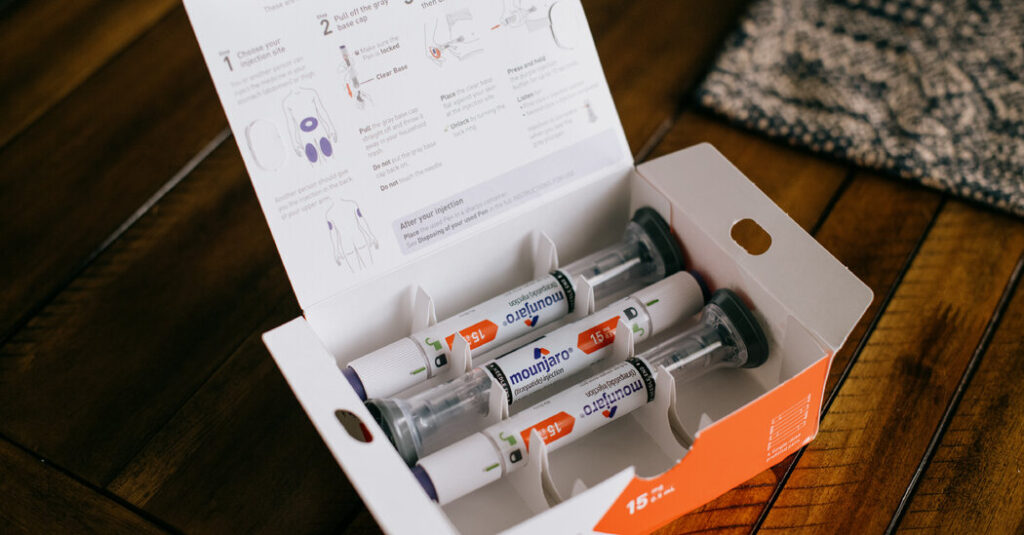
The doctor kept hearing the same story from his patients. After taking GLP-1 weight-loss drugs and finally shedding those excess pounds, some had gone a bit rogue. They began spacing out the shots instead of injecting themselves every week.
And it seemed to be working, said Dr. Mitch Biermann, an obesity and internal medicine specialist at Scripps Clinic in San Diego.
“By the time the third person told me they were taking it every second or third week and still maintaining their weight, I started recommending it to other patients,” he said.
Dr. Biermann also conceived a study to test the strategy. Now the results of that research are in: After 36 weeks of follow-up, most of the patients who spaced out their GLP-1 injections kept the weight off and also maintained health benefits like reduced blood pressure and better blood sugar control.
Only four patients gained weight after making the switch, and they quickly reverted back to weekly injections, the report said.
The study was small, only 34 patients in a relatively homogeneous group — mostly white and privately uninsured. And it was done by analyzing their existing medical charts.
Still, the research, published in February in the journal Obesity, provides a potentially appealing new option for patients who are loath to commit to lifelong weekly injections of a costly medication that may not be covered by insurance and that some fear could have unknown side effects.
Studies have consistently found that people who stop taking GLP-1s regain the weight they lost, putting the pounds back on even more rapidly than they would have if they had lost weight without drugs. They also see the metabolic benefits dissipate.
But experts said the study’s results should be interpreted with caution. They emphasized that the patients did not quit the medications. They just took them less frequently, and took the standard doses they had been using (they were not taking smaller than standard doses, a practice called microdosing).
And the patients reduced the frequency only after achieving their desired weight loss and reaching a weight-loss plateau.
There was no control group for comparison, and the study was not a randomized trial of the kind considered the gold standard in medicine, said Dr. Fatima C. Stanford, an obesity specialist and associate professor of medicine and pediatrics at Harvard Medical School.
Importantly, participants had chosen to participate. “Individuals who agree to reduce treatment frequency may already be more adherent, more confident in their behaviors or metabolically more responsive,” she said.
She noted that about 12 percent of the participants who tried to stretch out their doses wound up going back to weekly shots after regaining weight.
Still, the study does help “reframe the conversation,” she said. “Chronic treatment does not necessarily mean maximal weekly dosing forever.” Individualized dosing may be more effective, she added.
Scott McMillin, 65, is a patient of Dr. Biermann who spends 30 minutes on an elliptical machine five days a week. He has struggled with his weight for years.
After starting weekly Wegovy injections in late 2023, he lost 20 lbs. and got his blood pressure and cholesterol into normal ranges. But when he tried to go cold turkey without the medication, he quickly gained back 10 lbs.
So he resumed the weekly injections and lost the weight he had regained. Then, in July, Mr. McMillin took up Dr. Biermann’s suggestion to space injections two weeks apart.
He has been able to maintain his weight and the resulting health benefits, eating two meals a day with no seconds and no snacking in between.
“It made no difference for me whether I was taking injections every week or every two weeks, and I just thought, well, less is better,” he said in an interview.
Most of the patients whose charts were reviewed as part of the study had already significantly reduced their body weight from a body mass index of 30 on average, the threshold for obesity, to 25.2 on average, which is considered just overweight.
Seventeen took the standard drug dose every other week, while six took it every 10 to 14 days. Seven others spaced shots out more than two weeks apart, with the longest interval six weeks.
While on less frequent dosing, most participants continued to lose modest amounts of weight or maintained their weight; only five gained a modest amount of weight. After 36 weeks, the patients’ average B.M.I. dropped to 24.6, which is considered normal weight.
The extra weight lost during this period was from fat, and not muscle, the study also found. And patients maintained their improvements on measures including prediabetes, triglycerides, high density lipoprotein (so-called good cholesterol) and blood pressure.
When Dr. Biermann, who is a clinical trial site investigator for GLP-1 agents for both Eli Lilly and Novo Nordisk, presented the initial results at the Obesity Society’s Obesity Week meeting in Atlanta, he said doctors crowded into the room, standing in the back to hear about it.
He wasn’t surprised, because while patients face many barriers to taking GLP-1s, including cost and access, many are also deterred by the prospect of lifelong weekly treatments. Only 6 percent of Americans report using the GLP-1s, though some 51 percent of U.S. adults meet eligibility criteria.
“The number one question patients give me about this drug is, ‘Will I have to take this every week forever?’” Dr. Biermann said.
Roni Caryn Rabin is a Times health reporter focused on maternal and child health, racial and economic disparities in health care, and the influence of money on medicine.
The post Most Patients Keep Weight Off With Fewer GLP-1 Shots, Study Finds appeared first on New York Times.