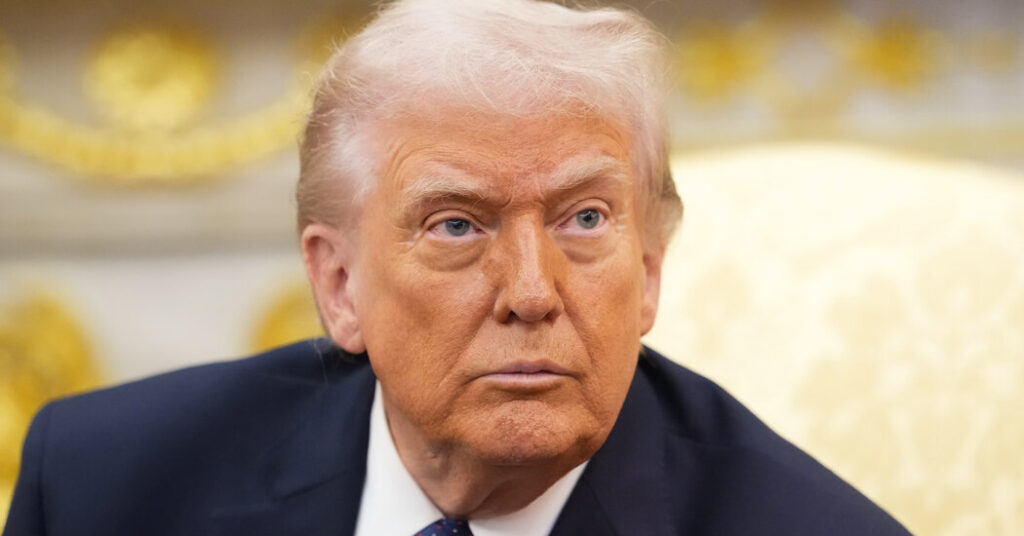
Sitting beside Germany’s chancellor in the Oval Office on Tuesday, President Trump offered a brief moment of insight into the decision-making process in the White House on the most consequential of matters: Whether to take the country to war.
His decision to order the attack on Iran, he said, was mostly a matter of gut instinct about Iranian intentions.
“We were having negotiations with these lunatics, and it was my opinion that they were going to attack first,” he said, while his guest, Friedrich Merz, sat expressionless. “I think they were going to attack first, and I didn’t want that to happen. So if anything, I might’ve forced Israel’s hand. But Israel was ready and we were ready.”
Set aside for a moment that Secretary of State Marco Rubio had offered the opposite explanation the previous day, telling reporters that because Israel was going to act, Mr. Trump had no choice but to join what he called a “pre-emptive” strike before Iran counterattacked U.S. bases and allies.
The next day, Mr. Rubio tried to walk back his comments. Then on Wednesday, the White House press secretary, Karoline Leavitt, said Mr. Trump acted because he had “a good feeling” that Iran would soon strike American interests.
The back and forth confirmed what his former aides almost universally report — that Mr. Trump’s determination to cut out the bureaucracy, to reduce his advisers to a tiny, leakproof few and to trust instinct over intelligence briefings — applied as he made the gravest decision any commander in chief can make.
Every president, of course, creates a decision-making structure tailor-made for his own style. Franklin D. Roosevelt relied heavily on a kitchen cabinet. Harry S. Truman created the National Security Council to formally weigh options and coordinate among departments fighting the Cold War. Richard Nixon and Jimmy Carter turned the N.S.C. into an idea generator. In the Obama administration, members of the N.S.C. staff talked about “death by Situation Room meeting” and compared the process of policymaking to watching a python swallow a pig.
The Trump administration doesn’t have much patience for that. When he came to office, Mr. Trump reduced the size of the N.S.C. staff by at least two thirds, casting out some of its members because of vague suspicions about their loyalty. Mr. Trump has made clear that his N.S.C. is not there to generate options, but to execute his decisions.
And when debates take place, the number of players often shrinks to a tiny group. In the Iran case, Mr. Rubio, Vice President JD Vance, C.I.A. director John Ratcliffe, the four-star head of Central Command, Brad Cooper, and the chairman of the Joint Chiefs Gen. Dan Caine. (Mr. Trump loves the chairman’s nickname, Raizin’ Caine, just as he loved ‘Mad Dog’ for his first defense secretary, Jim Mattis, who hated the moniker.)
Not much leaks from those sessions, a major change from, say, the early Obama era, when Situation Room conversations sometimes appeared on news websites before the meetings were over. Still, it was widely reported that General Caine warned Mr. Trump that he needed to expect casualties and that he would have to deal with the real possibility of munitions shortages. Mr. Vance’s public silences could be explained by his initial, internal cautions against entering the war; once he lost that battle Mr. Vance told the president and his national security team that they should “go big and go fast.”
But what Mr. Trump gains in secrecy he loses in message control. On a range of issues, from the goals of the Iran strike to Mr. Trump’s objectives in Venezuela or even in threatening Greenland, there are a blitz of answers. Inconsistency is sometimes celebrated by the administration as wily strategic deception, rather than as a failure to think several chess moves ahead.
“Trump seems to think he doesn’t need options or contingency plans,” said Thomas Wright, a scholar at the Brookings Institution who worked on long-term strategic planning in the National Security Council during the Biden years. “He just wants a small team to execute his instincts. But when events go wrong, as they often do, a president without prepared choices will be gambling with a pair of twos.”
That is what has many foreign ministers, defense officials and world leaders worried. A top Arab diplomat said this week that his government has no real insight into the administration’s planning for a transition of government in Iran — or even whether it wants to play a role, given Mr. Hegseth’s repeated statements that “nation building” was not on the Pentagon’s list of tasks. People familiar with Mr. Merz’s visit say he pressed on whether the president has thought ahead to how, and under what conditions, the action in Iran might end.
In other administrations, these are the kinds of questions the National Security Council would be tasked to answer. It would also have been the N.S.C.’s role to make sure there was plenty of warning to U.S. citizens to leave the Middle East. Instead, that advice came from the government only after the fighting was well underway, leaving thousands of Americans stranded.
David Rothkopf, the author of “Running the World: The Inside Story of the National Security Council and the Architects of American Power,” said he was struck by the absence of basic process.
“Never has so much risk or such sweeping military action of so much consequence been undertaken with so little apparent planning or weighing of potential consequences, both intended and unintended,” he said.
It is the military, he notes, that develops operational plans, which are then vetted at the N.S.C. “That process has atrophied to virtually nothing in this administration and what planning there has been is often ignored by a president who trusts his own instincts more than any advisers. That may work with actions that are narrow in scope, but it does not when waging war against a large, consequential country like Iran.”
Perhaps Mr. Trump was emboldened by the fact that his previous missions have worked out well. The June 2025 air attack on Iran’s three major nuclear sites was the product of months of careful planning, and the targets were all deep underground facilities that the United States thought it could damage severely with a dozen giant bunker-busting bombs. The calculations were more about physics than politics.
The mission was limited. Most of the targets were so remote that there was little worry about civilian casualties. Its success depended more on physics.
The operation to remove Nicolás Maduro from power was riskier, but Mr. Trump made no effort to truly change the government. Instead, he kept the power structure of the country in place, save for Mr. Maduro, and made it clear that he was not going to insist on the installation of the clear winners of a 2024 election — the Venezuelan opposition — as long as the United States had access to Venezuela’s huge oil reserves.
But veterans of that long, often drawn-out National Security Council process say that is exactly the kind of imperfect analogy that the president’s staff should be deflating. Iran and Venezuela could not be more different, in history, geography, culture or politics. Their biggest commonality is their reliance on pumping oil out of the ground.
Mr. Trump said in an interview with the Times that he hoped that the hardened members of the Islamic Revolutionary Guard Corps and the Basij militia would just surrender their arms to “the people,’’ which sounded more like hope than a plan.
But his political supporters see the conversation about strategic planning as a wonky effort to keep Trump from being Trump. After all, they note, the Supreme Leader perished in one of the first strikes of the war.
Mr. Trump’s critics see in this conflict everything that is wrong with the working of the Trump White House. “The president and his administration keep shifting their rationale for the war, the length and level of commitment to the war, the goals for the war and whether or not we’re actually at war at all,” said Senator Chris Coons, a Democrat of Delaware. “The only thing that has remained consistent is the lack of strategy for how to wage it. That’s what happens when you launch a war based on gut feelings, rather than analysis and advice from experts.”
Eric Schmitt contributed reporting.
David E. Sanger covers the Trump administration and a range of national security issues. He has been a Times journalist for more than four decades and has written four books on foreign policy and national security challenges.
The post Trump Follows His Gut. His National Security Advisers Try to Keep Up. appeared first on New York Times.