Homeland Security Secretary Kristi Noem on Wednesday pushed back against allegations that she and her deputies had “systematically obstructed the work” of the department’s inspector general, as he complained in a letter to Congress this week.
“He can have access to anything at the Department of Homeland Security; he can,” Ms. Noem said during testimony before the House Judiciary Committee, her second appearance on Capitol Hill this week.
“He just needs to provide a scoping memo,” she continued, adding: “He just hasn’t done that. He wants unfettered access to every single thing in the department, and that’s not the process.”
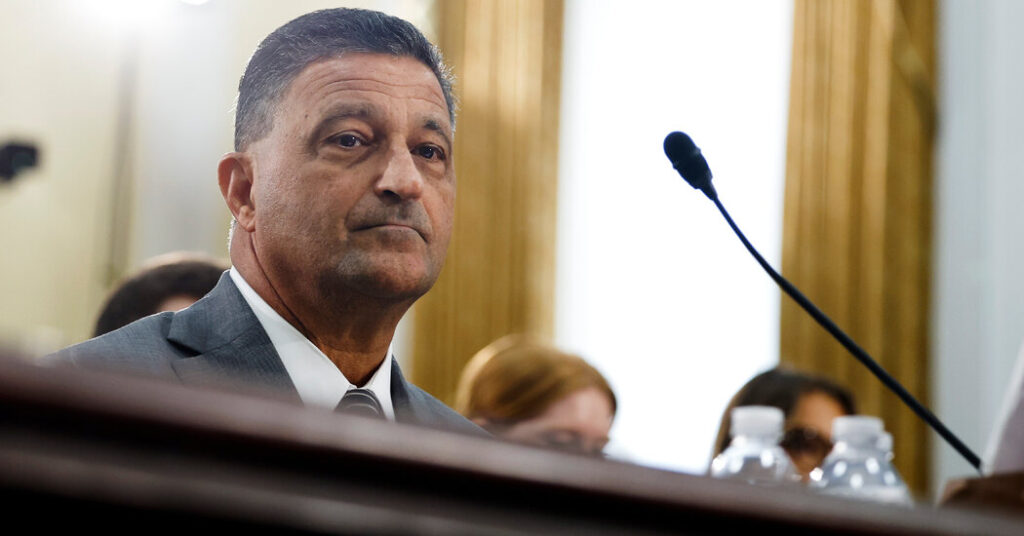
Ms. Noem’s comments come on the heels of a letter that her department’s inspector general, Joseph V. Cuffari, sent to the leaders of three congressional committees. The independent agency watchdog wrote that the department had blocked or revoked his office’s access to databases and other information systems, hampering investigative efforts. The pattern included obstructing his office’s efforts to assist in a criminal inquiry that originated with a separate federal law enforcement agency, he wrote.
The dispute is significant in part because President Trump fired more than two dozen independent government watchdogs last year. Mr. Cuffari, who was appointed by Mr. Trump during his first term, is one of a few inspectors general who has managed to hold on to his job.
In a statement on Wednesday, the inspector general’s office rejected Ms. Noem’s contention that they did not outline the scope of their probes.
“When the Office of Inspector General (O.I.G.) initiates a new audit, inspection or evaluation, the inspector general formally notifies” the department and its agencies, the office said. The notice comes in “a memorandum stating the scope and objective of our project, as we have done for over 20 years.”
The statement added that the office “has a right of access to all records, information and other materials available to the Department of Homeland Security that relate to the department’s programs and operations.”
Mr. Cuffari’s office has opened investigations into a number of D.H.S. operations, including an audit of how Immigration and Customs Enforcement investigates use-of-force incidents and a review of the process used to determine whether someone who has been arrested is a U.S. citizen.
In his letter to Congress this week, Mr. Cuffari listed 11 instances when his office clashed with Ms. Noem or her top deputies over access to sources of department data. Last year, he wrote, U.S. Customs and Border Protection refused to give his office access to databases with information about border crossings, screening processes and arrests.
In another incident, the Transportation Security Administration, which is housed within the Department of Homeland Security, refused to provide the inspector general direct access to its Secure Flight program database, Mr. Cuffari wrote. And the department revoked his office’s access to a database detailing immigration enforcement operations, as well as a system containing information about employees with access to classified materials.
And on multiple occasions, he wrote, department officials denied access to intelligence databases vital to a criminal inquiry and a separate investigation into how the Secret Service handles threat intelligence, that was begun in the wake of the July 2024 assassination attempt on Mr. Trump.
Homeland Security Department leaders are allowed to refuse to provide information in cases involving national security or counterintelligence concerns. But department leaders did not invoke any such authority while blocking his access.
He told lawmakers that the department’s conduct had been “particularly egregious in a specific pending criminal investigation” that originated with another federal law enforcement agency, but involved homeland security matters. Mr. Cuffari’s office had requested access in April to a database controlled by the department, he wrote, but leaders tried to condition access on inspectors revealing details to people who could be related to the allegations or the targets of the investigation, he stated in the letter.
“The department’s approach would risk compromising the investigation and needlessly complicate it and any potential prosecution,” Mr. Cuffari wrote.
Before informing Congress of his frustrations, Mr. Cuffari said, he tried to resolve them internally with department leaders. But those negotiations hit an apparent roadblock in late January. James H. Percival II, the department’s general counsel, told Mr. Cuffari in a letter that the scope of inspector general’s requests were too broad.
“Providing you that level of access would be unlawful,” Mr. Percival wrote in the letter, which the inspector general also provided to Congress. He warned Mr. Cuffari that taking his complaints to Congress would be viewed as acting “in bad faith.”
In a statement Wednesday, the Department of Homeland Security repeated that it cannot give the inspector general more access without more discussion about the scope of the requests.
Mr. Cuffari’s letter is dated March 2, one day before Ms. Noem was scheduled to appear before the Senate Judiciary Committee for testimony. The alleged offenses listed in the letter began over a year ago. The Wall Street Journal earlier reported the letter.
Senator Thom Tillis, Republican of North Carolina, referred to Mr. Cuffari’s letter during that hearing, holding up a copy of it as he excoriated Ms. Noem.
“Does anybody have any idea how bad it has to be for the O.I.G. in this agency to come out and do this publicly?” he said. “That is stonewalling, that’s a failure of leadership, and that is why I’ve called for your resignation.”
Last week, The Wall Street Journal reported that Mr. Cuffari had warned in a separate letter that Ms. Noem’s decision to end the T.S.A. policy of requiring passengers to take off their shoes had created “significant” security risks.
In 2024, congressional Democrats called for Mr. Cuffari’s ouster after a report from the Council of the Inspectors General on Integrity and Efficiency, an independent entity within the executive branch, found examples of misconduct, including a finding that he made misleading statements to the Senate during his confirmation process in 2019.
Karoun Demirjian is a breaking news reporter for The Times.
The post Noem and D.H.S. Inspector General Spar Over Obstruction Claim appeared first on New York Times.