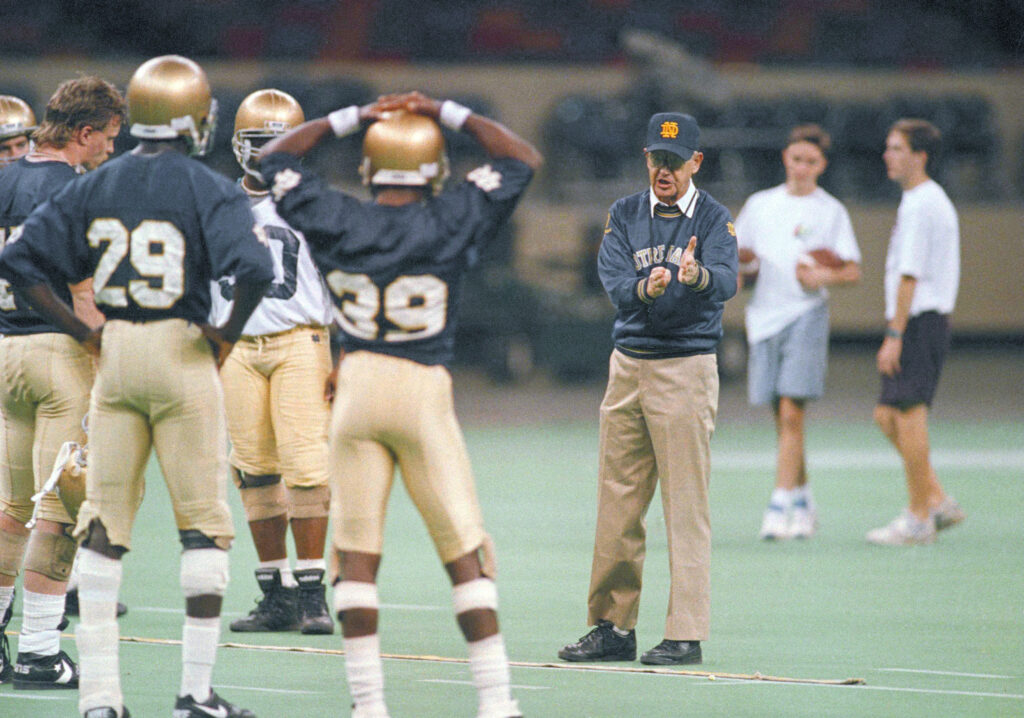
Lou Holtz, a Hall of Fame college football coach who led Notre Dame to a national title and was known for his humor on the sidelines and as a television analyst, has died at 89.
His death, in Orlando, was announced Wednesday in a family statementshared by Notre Dame. It did not say when or how he died.
As the head coach at six colleges, Mr. Holtz had a knack for transforming struggling teams into winners, including Notre Dame. Rebuilding the pride of the Fighting Irish, he guided the team to a perfect 12-0 record and the 1988 national championship.
Mr. Holtz was considered a master of motivation, enforcing strict rules and putting his players through early-morning drills that often forged a strong team spirit. He used humor and sleight-of-hand tricks to lighten the mood and was considered one of football’s master storytellers and jokesters.
When he became head coach at the University of Minnesota in 1984, he appealed to state pride by saying, “The body and soul of this team will come from Minnesota,” before adding, “but for arms and legs we will have to go elsewhere.”
Mr. Holtz’s outspoken political comments sometimes led to public reproach. His endorsement of archconservative Sen. Jesse Helms (R-North Carolina) may have cost him his coaching job at Arkansas, and his campaign speeches on behalf of President Donald Trump in 2016 and 2020 led to a backlash, including from some of his former players.
At Notre Dame, a Catholic university in South Bend, Indiana, with perhaps the most storied name in college football, Mr. Holtz became a revered figure during his 11-year tenure from 1986 through 1996. He had exactly 100 victories, third in school history after Knute Rockne, who coached from 1918 to 1930, and Brian Kelly. Mr. Holtz was sometimes dubbed “the Quipper,” in ironic homage to George Gipp, a Rockne-era star nicknamed “the Gipper.”
Much of Mr. Holtz’s humor was directed at himself. He was hardly the classic image of a burly football coach, once describing himself to Sports Illustrated as “a guy 5-10, 152 pounds, who wears glasses, talks with a lisp and has a physique that looks like I’ve had beriberi and scurvy.”
Yet again and again, from his first head coaching job at William & Mary to North Carolina State, Arkansas, Minnesota, Notre Dame and finally South Carolina, he had a way of instilling confidence and competence in his players. He was the only coach in history to lead six schools to bowl games.
After three years at William & Mary, starting in 1969, Mr. Holtz gained national attention at North Carolina State, turning around a losing team from 1972 to 1975. During his sole foray into professional football, he coached the New York Jets in 1976, only to quit before the final game of a 3-11 season.
“God did not put Lou Holtz on this earth to coach pro football,” he said as he returned to the college ranks at the University of Arkansas. In his first season, he took a Razorback team that had been 5-5-1 the previous year to a 10-1 record and a trip to the Orange Bowl.
When fans threw oranges on the field to celebrate the bowl-game appearance, Mr. Holtz joked, “Thank God we didn’t get invited to the Gator Bowl.”
Leading up to the Orange Bowl, Mr. Holtz suspended three players — who accounted for three-quarters of the team’s touchdowns — for an alleged sexual assault involving a female student. The Washington Post reported at the time that Mr. Holtz agreed to suspend the players, all of whom were Black, if the White female student did not file criminal charges.
The players filed and then dropped a federal lawsuit to be reinstated to the team, and other Black players on the team threatened a boycott. But Mr. Holtz held firm, saying his rules applied to everyone on the team, Black or White.
Using substitute players in the Orange Bowl, Mr. Holtz led his underdog team to an upset win over heavily favored Oklahoma, 31-6. Arkansas finished the season with an 11-1 record and a No. 3 ranking.
In 1983, his seventh year at Arkansas, Mr. Holtz’s team had a middling 6-5 record, leading some to question whether he was spending too much time on the banquet circuit and TV talk shows. His endorsement of Helms, for whom he had campaigned since the 1970s, drew attention when Helms led the opposition to a national holiday honoring the Rev. Martin Luther King Jr.
The association with Helms was seen as a liability for a coach who needed to recruit Black players, and Mr. Holtz resigned under pressure in December 1983.
Following one of his mottoes — “Just remember, happiness is having a poor memory about what happened yesterday” — Mr. Holtz then moved on to Minnesota. He planned to stay indefinitely, but he presciently asked for a clause in his contract that would allow him to leave if he should be offered the top job at Notre Dame.
Two years later, Notre Dame came calling. The football team had floundered for several years, yet for Mr. Holtz it was the fulfillment of a lifelong dream. As a child attending Catholic school in Ohio, he heard the Notre Dame fight song every day.
As football coach, he stepped into a tradition that had been shaped by such gridiron coaching icons as Rockne, Frank Leahy and Ara Parseghian. When Mr. Holtz met his players for the first time and saw them slouching and looking bored, he introduced himself by saying, “Get your feet off the chairs and sit up straight!”
During the winter, he required his players to appear for punishing early-morning agility drills that left many so exhausted that they vomited.
“Getting up at 5 a.m., walking across campus in a blizzard and then throwing up together — that’s what brings a team together,” linebacker Ned Bolcar told Sports Illustrated in 1987. “That’s when you look to your teammates for comfort first and not to your friends back home.”
After the graduation of 1987 Heisman Trophy winner Tim Brown, Mr. Holtz had few marquee players, but his demanding team-first approach paid off in 1988.
With a gritty defense and option-running quarterback Tony Rice, the Fighting Irish defeated the country’s top team, the University of Miami, on Oct. 15. In the season’s final game, Notre Dame traveled to Los Angeles to face Southern California. Both teams were undefeated.
The night before the game, Notre Dame’s star running back and top receiver were 40 minutes late for a team dinner. Mr. Holtz sent them back to South Bend and played the game without them. With Rice running for a 65-yard touchdown, and the defense capitalizing on turnovers, Notre Dame triumphed, 27-10.
In the postseason Fiesta Bowl, the Irish vanquished unbeaten West Virginia, 34-21, to finish a 12-0 season and claim the national title. The next year, they were almost as good, winning their first 11 games. (The 23-game winning streak in 1988-89 remains the best in school history.)
After a late-season loss to Miami, the Irish won the Orange Bowl and were ranked No. 2 in the country. Mr. Holtz became a celebrity, appeared on “The Tonight Show Starring Johnny Carson,” and was considered, in the words of Sports Illustrated journalist Austin Murphy, “possibly the most charismatic coach of his generation.”
But even before Mr. Holtz left Notre Dame after the 1996 season, questions were being raised about his methods. After he left Minnesota, the school’s football program was put on probation by the NCAA for illegal payments to players during his tenure. Mr. Holtz received minor sanctions that did not prevent him from coaching. At Notre Dame, his players were involved in brawls with opposing teams.
In a 1993 book, “Under the Tarnished Dome,” reporters Douglas S. Looney and Don Yaeger charged that Mr. Holtz tolerated poor academic achievement and steroid use at Notre Dame and was emotionally abusive toward his players.
After several years in broadcasting, Mr. Holtz returned to coaching in 1999 at the University of South Carolina. He had some initial success, but with a more relaxed emphasis on discipline, star players escaped punishment for breaking team rules. In the months after Mr. Holtz’s retirement in 2004, several of his former players were arrested for theft and burglary, and another was dismissed from the team for failing drug tests.
By the time the next season started, Mr. Holtz had left South Carolina, but the football program he had led was facing three years of NCAA probation for various infractions, including a “lack of institutional control.” Mr. Holtz retired after 33 years of college coaching with a record of a 249-132-7. He then spent 11 as a television analyst for ESPN and later was inducted into the College Football Hall of Fame.
Poor and undersized
Louis Leo Holtz was born Jan. 6, 1937, in Follansbee, West Virginia, and lived in near-poverty during his childhood. His mother became a nurse, and his father was a bus driver.
The family moved to nearby East Liverpool, Ohio, which Mr. Holtz described as “on the river, except every spring when it’s in the river.”
Poor and undersized, Mr. Holtz said he learned to compensate with humor and tenacity. As a 103-pound blocking back and guard in high school, he realized his greatest contribution to football would not be as a player, but as a coach. At Ohio’s Kent State University, from which he graduated in 1959, he was a benchwarmer. Asked if he dreamed of winning the Heisman Trophy, he quipped, “I would have been the first third-string linebacker ever to win it.”
He received a master’s degree in education in 1961 from the University of Iowa, where he began a decade-long coaching apprenticeship at several schools, including Ohio State under Hall of Fame coach Woody Hayes.
After retiring from coaching, Mr. Holtz lived in Orlando. He published several best-selling books, including a 2006 memoir.
His wife of 58 years, Beth Barcus Holtz, died in 2020. Survivors include four children, Luanne Altenbaumer, Skip and Kevin Holtz, and Elizabeth Holtz Messaglia; nine grandchildren; and two great-grandchildren.
In 2016, while campaigning for Trump in the presidential election, Mr. Holtz condemned what he called an “invasion” of immigrants but said some of his comments were taken out of context.
Four years later, during a speech at the Republican National Convention, Mr. Holtz denounced “politicians, professors, protesters and, of course, President Trump’s naysayers in the media” and called Democratic nominee Joe Biden a Catholic “in name only” for his support of abortion rights.
The Rev. John Jenkins, Notre Dame’s president, rebuked Mr. Holtz for invoking the university’s name in a political endorsement and for impugning Biden’s faith. Some Notre Dame students, alumni and players, many of them African American, denounced Mr. Holtz for being insensitive to the Black Lives Matter movement.
“We feel as though the hero we loved and adored, that we would run through a brick wall for, died in front of our eyes,” former player Bobby Brown told the Chicago Tribune.
There were calls for a statue of Mr. Holtz outside the football stadium to be removed. The statue remained. And that December, Mr. Holtz visited the White House, where Trump presented him with the Presidential Medal of Freedom, the nation’s highest civilian honor.
Mr. Holtz, he said, was “one of the greatest coaches in American history.”
The post Lou Holtz, Hall of Fame coach who won a title at Notre Dame, dies at 89 appeared first on Washington Post.