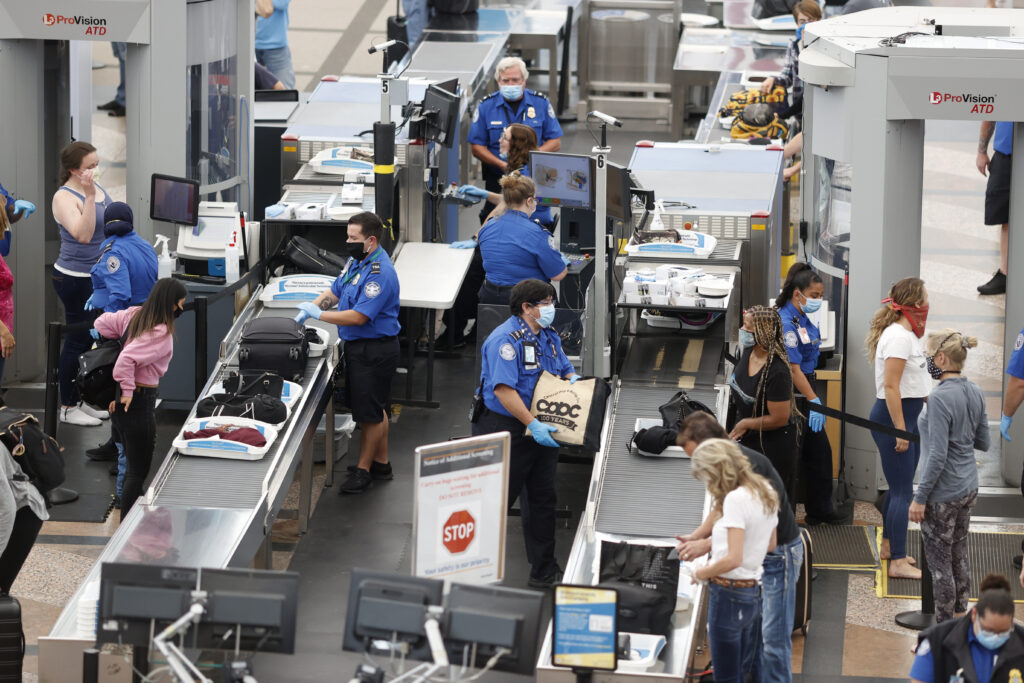
The United States tried a contractor-led screening model before the Transportation Security Administration existed. Going back to a privatized system, as the Feb. 24 editorial “Privatize airport security” called for, would be a step backward.
After Sept. 11, 2001, the country made a bipartisan decision to professionalize aviation security because “lowest bidder” screening, high turnover and uneven standards are not a serious foundation for public safety.
Privatization does not remove politics from security. It inserts a profit-taking middleman and shifts incentives toward cutting labor costs and training time while the public bears the risk. If policymakers are frustrated by recent disruptions, the answer is straightforward: Stop using the traveling public and frontline security workers as leverage in funding fights. The problem is political dysfunction, not the existence of a federal workforce.
What we should not do is recycle a model that has already proved inadequate and pretend it is innovation.
The functions TSA performs require uniform standards, rigorous oversight and a professional workforce accountable chiefly to the public. If improvements are needed, Congress should strengthen management, invest in training and technology, and provide stable funding.
Turning airport security into a revenue stream for private contractors is not reform. Americans do not want security theater. They want security delivered by a stable, vetted, professional workforce accountable to the public.
Hydrick Thomas, New York
The writer is president of the American Federation of Government Employees TSA Council 100.
The Editorial Board cited several relevant examples of successful private security screening in foreign airports. However, it did not mention a compelling example close to America: Canada.
Indeed, the Canadian Air Transport Security Authority was established in 2002 as part of an enhanced air travel security system after Sept. 11, 2001. CATSA directly employs about 400 full-time staff and contracts with various private security companies that employ about 8,000 officers to conduct screening at airports across Canada. These officers apply rigorous standards established by this government agency and wear CATSA uniforms.
By entrusting such private security agents to provide security instead of unionized bureaucrats, Canadian airports have ended up outperforming their American counterparts on most metrics. A 2017 study by the Heritage Foundation found that Canada spent about 40 percent less per capita on aviation security than the U.S. and approximately 15 percent less per traveler. Yet, despite these lower costs, in 2016, CATSA screened 159 travelers per hour, compared with 150 for TSA.
Canada’s model of highly trained private security professionals providing preboarding security screening and physical security at airports could thus serve as a concrete source of inspiration for the long-awaited changes for TSA, helping it deliver a more efficient and cost-effective service to the traveling public in the United States. Canada’s experience over the past two decades also illustrates that these policy objectives can be achieved without conceding an inch in terms of security standards.
Michel Kelly-Gagnon, Calgary, Alberta
The writer is founding president of the Montreal Economic Institute.
Lawmakers shouldn’t trade stocks
The Feb. 27 editorial “The real fix for congressional stock trading” argued that increased transparency would sufficiently address the ethical controversies surrounding congressional stock trading. The editorial cited my organization, Campaign Legal Center, but did not capture CLC’s full recommendations for reform.
The editorial pointed out that “insider trading is already illegal,” but the true issue is conflicts of interest. Nearly 50 percent of members of Congress hold stock, so it is inevitable that their policy decisions directly and indirectly influence industries in which they invest.
The board also stated that consensus reform is “nearly impossible,” noting opposition to the bill President Donald Trump promoted during his State of the Union speech. But the Trump-endorsed bill would thwart the Restore Trust in Congress Act, which is a total ban on congressional stock trading with more than 125 bipartisan co-sponsors.
The editorial concluded that disclosure of a lawmaker’s anticipated stock trade would improve the situation. But many investors monitor lawmakers’ trades, so a disclosure could trigger a change in the price before that trade, impacting other shareholders and lawmakers alike.
Meaningful, workable reform requires a full ban on the purchase, sale and ownership of stocks for sitting members, while allowing them to invest in non-corrupting options such as mutual funds. That’s a small price to pay to increase Americans’ confidence in government.
Kedric Payne, Washington
The writer is vice president, general counsel and senior director for ethics at Campaign Legal Center.
Context for the ‘Bridge to Nowhere’
I was peeved to read the following framing in the Feb. 26 online Business article “How $15.5 billion will be spent on Congress’s pet projects”:
“A string of corruption scandals — including the ‘Bridge to Nowhere,’ in which an Alaska lawmaker directed $223 million to connect a small town to an island with 50 residents — turned public opinion sharply against the practice. Congress banned earmarks entirely in 2011.”
This was no “scandal.” It was controversial but not scandalous. And that bridge would have connected the 8,000 Ketchikan residents to their airport. I’ve been on the ferry to the airport, and on a winter’s day it is unpleasant, to say the least.
Jim Lavrakas, Sequim, Washington
Following Neal Katyal’s Feb. 25 op-ed, “Tariffs were illegal. Now Trump wants to delay refunds.,” Post Opinions wants to know: If you run a business, what opportunities did your company lose because capital was redirected to tariffs? Send us your response, and it might be published as a letter to the editor. wapo.st/tariff_costs
The post Don’t gamble with airport security appeared first on Washington Post.