Elon Musk on Wednesday defended social media posts calling his deal to acquire Twitter into question in the lead-up to his purchase of the site in 2022, saying he did not realize they would drastically affect the company’s stock price.
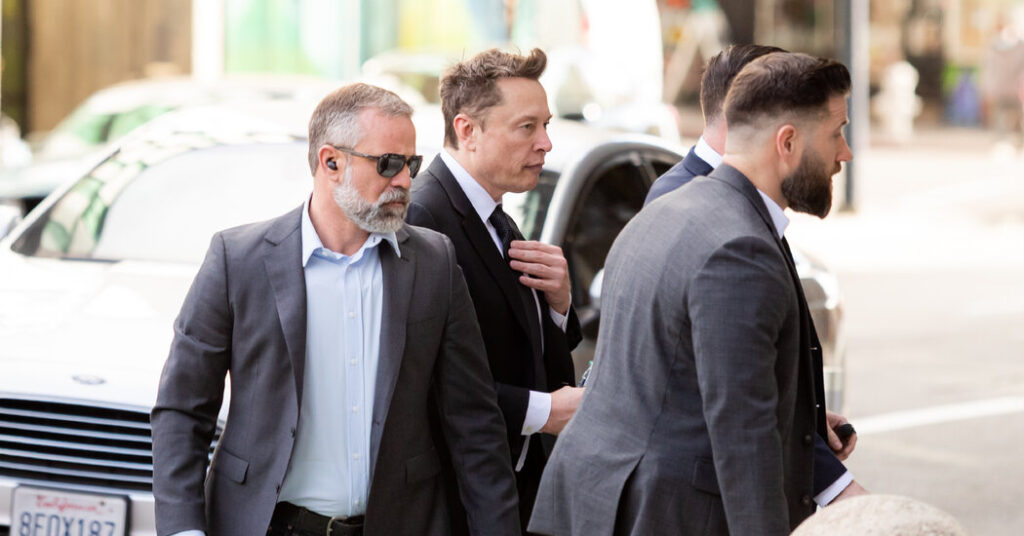
Mr. Musk took the stand at the U.S. District Court for the Northern District of California, in San Francisco, to testify in a shareholder lawsuit accusing him of attempting to drive down Twitter’s share price in a failed attempt to force a renegotiation of the $44 billion deal. In the months before completing his purchase of the company now called X, Mr. Musk claimed the site was overrun with fake accounts, known as bots, and declared he would call off the acquisition.
In one post, he said the deal was “on hold.” Mr. Musk testified he did not expect Twitter’s stock to drop on the news. He compared the claim to saying he was running late to a meeting, which doesn’t mean it’s canceled.
“It may not be my wisest tweet,” Mr. Musk said. “I wouldn’t necessarily describe it as incredibly stupid. But if it led to this trial, I guess I would qualify it as such.”
He said he didn’t think it would jolt markets. “I didn’t think there was anything material that would happen if I said I was still committed to the deal,” he added.
While many companies prefer to settle shareholder disputes, Mr. Musk has made a habit of battling them in court. In 2023, Mr. Musk won a case brought by investors in his electric vehicle company, Tesla, who said that they had experienced significant losses after he claimed in a 2018 social media post that he had “funding secured” to take the company private.
He also won a lawsuit brought by Tesla shareholders over the company’s 2016 acquisition of SolarCity, who claimed Mr. Musk pushed the car company’s board into the deal to bail out his own investment in the struggling business. And the Delaware Supreme Court reinstated Mr. Musk’s $139 billion pay package as chief executive of Tesla last year, after a lower court had stripped it in response to a shareholder suit.
Now, he’s testifying in a case brought by former Twitter investors, who claim they were misled by Mr. Musk. If a jury rules in the investors’ favor, Mr. Musk could be forced to pay up to a billion dollars in damages.
The case centers on the time period after Mr. Musk made a surprise offer to buy Twitter in April 2022. The billionaire quickly began to voice concerns about the number of fake accounts on the site, and posted in May that the deal was “temporarily on hold.” By July, Mr. Musk attempted to call off the deal altogether. Twitter sued, forcing Mr. Musk to go through with the purchase in October 2022.
The investors said they took Mr. Musk at his word, and sold their shares at a lower price because they believed — incorrectly — that the billionaire would never end up buying Twitter.
“He wanted a different deal, where he paid investors less money for their company,” Aaron Arnzen, a lawyer for the investors, said in court on Monday. “So he mounted a public spectacle to trash the company, to drive the stock price down, to renegotiate or escape the deal.”
One shareholder, Brian Belgrave, testified that he sold about 15,000 shares at a loss after Mr. Musk posted he wouldn’t go through with the deal. He sold his shares for about $33 each in July 2022, a far lower price than the $54.20 shareholders received when Mr. Musk completed the deal later that year.
“It’s like I got lied to,” Mr. Belgrave said. “I had sold my shares because I thought, he’s not going to buy the company.”
But Mr. Musk and his lawyers have maintained that his concerns about fake accounts were genuine, and were not an attempt to drive down Twitter’s stock price.
“Mr. Musk didn’t break the law,” Michael Lifrak, a lawyer for Mr. Musk, said during opening statements on Monday. “He wanted to know the truth about bots on Twitter.”
On Wednesday, Mr. Musk said he got cold feet over the Twitter purchase because the company’s executives were not giving him enough information about how it determined how many accounts on the platform were fake. The company’s former leadership had maintained that no more than 5 percent of Twitter’s daily active users were bots. Mr. Musk speculated that the number could be 50 percent, or even 90 percent.
Mr. Musk said that he was “shocked” during a May 2022 meeting with Twitter executives, in which he asked them to explain how they calculated their bot numbers and they did not provide the details he wanted.
“They did not actually know,” Mr. Musk said. “My jaw hit the floor. That was stunning.”
Kate Conger is a technology reporter based in San Francisco. She can be reached at [email protected].
The post Elon Musk Defends Social Media Posts in Twitter Shareholder Lawsuit appeared first on New York Times.