This article is part of a Women and Leadership special report highlighting leaders in women’s rights, health, business and much more.
In a sense, it was her own hypocrisy that led Isata Dumbuya, a midwife and obstetrics nurse, back home to Sierra Leone.
Ms. Dumbuya, 55, worked for the National Health Service for over two decades in various hospitals across Britain and would constantly regale her colleagues with stories about how fantastic her country of birth was, where she lived during part of her childhood and teenage years.
Yet, some of them would take exception to her argument, pointing out that Sierra Leone — torn apart by civil war during the 1990s and devastated by the Ebola outbreak from 2014 to 2016 — had the highest maternal mortality rate in the world at the start of the 21st century.
It was a fact that Ms. Dumbuya, who has delivered more than 3,000 babies, found hard to defend. “It was almost a challenge like, ‘you have all this inspiration and talk about how Sierra Leone is so wonderful, and yet you’re here and there are women dying,’” said Ms. Dumbuya during a video interview from Koidu, Sierra Leone. “You almost felt like it’s your fault or responsibility.”
She ended up taking that responsibility so seriously that in 2018, Ms. Dumbuya, a mother of five, moved back to Sierra Leone to help tackle the country’s maternal, adolescent and neonatal health concerns.
She started working at the Koidu Government Hospital in the underdeveloped eastern Kono District, which is supported by Partners in Health, a global nonprofit that focuses on delivering health care to people living in poverty and working with governments to strengthen public health systems and policies. She later became the director of the reproductive, maternal, newborn, adolescent and child health program with Partners in Health Sierra Leone.
Over the last eight years, she has trained nurses and midwives in a range of skills, including innovative ways to identify warning signs of at-risk pregnancies and improve access to family planning. (Last month, her role was expanded to include being director of nursing and midwifery.)
More recently, Ms. Dumbuya has been integral in overseeing the building design and training for the new Maternal Center of Excellence, a separate wing of the hospital which opened last month and is jointly managed with the Ministry of Health.
The trailblazing $25 million facility, with a staff of almost 500 that includes obstetricians, gynecologists, nurses, midwives and administrators, is expected to help transform maternal and newborn care in Sierra Leone and could serve as a model for maternal health care elsewhere there.
“It’s not a hope, this is what we are doing,” said Minister of Health Austin Demby in a video interview. “The value of the M.C.O.E. is it is serving multiple purposes. One is that it’s delivering services. Two, it’s a training venue for not only nurses and doctors, but they are enrolled in the residency program where OB-GYNs are going out there to practice. So it comes with faculty and students as well.”
On top of the civil war and the Ebola outbreak, there have been continued endemic problems in Sierra Leone that have led to the high maternal mortality rate. When it comes to maternal mortality, “a lot of things converge to result in the preventable death of a woman,” said Kunle Adeniyi, the United Nations Population Fund representative for Sierra Leone, in a video call.
While Mr. Adeniyi said that up to 85 percent of pregnant women in the country were giving birth in a facility, those were the lucky ones who could get to a clinic or hospital.
“When you have a woman coming in a very poor condition, you tend to think ‘Why did she wait? Why did this happen,’” Ms. Dumbuya said, adding that poor road conditions and lack of access to clinics for rural patients is a continuing problem.
Ms. Dumbuya has been very involved in helping design the new facility — including making sure that things like faucets in the surgical theater conform to international infection protocols — and setting standards of quality and capacity building both within the staff and the greater community.
“Isata has been vital in ensuring that this project gets off the ground,” said Vicky Reed, the executive director of Partners in Health Sierra Leone. “It shouldn’t be because Sierra Leone is considered a developing country that is a limiting factor. The same standard of care, the same sort of technology, the same sort of systems that she was used to in the U.K., those should be the same standards and systems in Sierra Leone.”
The maternal center, which will cost an estimated $10 to $12 million a year to run and includes a birthing center, inpatient wards with a 120-bed capacity, three operating theaters, a lab and the country’s first facility that provides mechanical ventilation for premature babies, is expected to be able to handle over 4,700 births annually. While many of those patients will be from Sierra Leone, the center estimates that women from neighboring countries, including Guinea and Liberia, will also take advantage of their services.
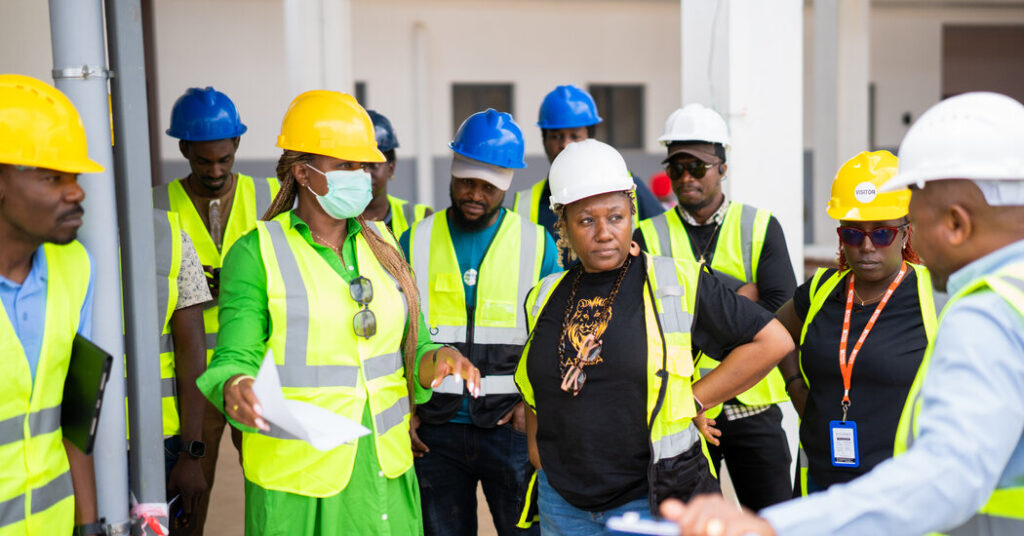
One unexpected benefit of building the hospital, Ms. Dumbuya said, was that more than 60 percent of the construction workers on the project were women, many without skills. “One of them said, ‘I’m building for my great-grandchildren who will still be here and my great-grandchild would have her child here. Even if I am not here, I will know I have done something good,’” she said.
Though Sierra Leone has, according to Dr. Demby, seen a 70 percent drop in maternal deaths over the last few years, which he said is “the fastest drop in the world,” the country’s numbers still hover in the top 20 in the world. So a facility like the one in Koidu, which has a focus on training and best practices, could help bring about significant changes in health outcomes for women and children across the country.
Ms. Dumbuya, Ms. Reed and Dr. Demby all agree that the center could also be an important blueprint in helping the country continue to drive down numbers of women dying during pregnancy and childbirth. Ms. Dumbuya said that they have already had interest from a number of development partners wanting to learn more about the facility, including its construction and health care development.
“If we can get this to another three, four parts of the country, happy days,” she said. “That would really make a great difference to our entire health care outcomes in this country, honestly.”
The post In Sierra Leone, a New Maternal Care Center Aims to be a Blueprint appeared first on New York Times.