On Iran’s official television networks and through a network of affiliated or sympathetic social media accounts, the country is striving to present a resolute image despite thousands of strikes from Israel and the United States that have hammered its cities, military bases and political leadership.
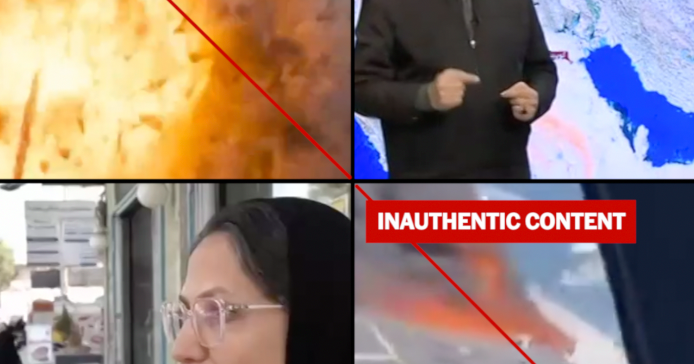
It is waging an information war parallel to the real-world fighting, blending fact and fiction, often using unproven claims and fake videos generated using artificial intelligence.
In Tehran’s telling, Iranian missiles have ravaged Tel Aviv and other Israeli cities, its jets have decimated an American aircraft carrier, and hundreds of Americans have been killed at bases and embassies around the region. The messages convey resilience, presenting the country as not only fighting back but winning. In reality, while Iran has retaliated on multiple fronts, damaging Israeli cities and nearby American bases, the country’s counteroffensive has resulted in fewer deaths and less damage than its state media has described.
“It’s flooding the zone with content that projects strength in the wake of attacks on Iran — and it’s similarly distorting the picture of what is actually happening inside the country,” said Moustafa Ayad, a researcher at the Institute for Strategic Dialogue, a group in London that studies disinformation.
Propaganda has long been a feature of warfare, but the sweep of social media and the persuasiveness of artificial intelligence have made influence campaigns farther reaching and often more effective. Russia has made such campaigns a central tactic in its war in Ukraine, and Iran, a Russian ally, has adopted similar methods, including the increasing use of A.I.
To Iran’s adversaries, the danger of its media apparatus is clear. The United States has made an effort to debunk some of the claims. Among Israel’s bombing targets, along with military and government infrastructure, was the hub of Islamic Republic of Iran Broadcasting, the state television and radio broadcaster. The United States and Israel have also tried to shape coverage of the conflict, including by providing limited information about some of the damages they have incurred.
With the internet inside Iran once again shut down and largely inaccessible, Iran’s propaganda appears focused more on swaying international audiences, friends and foes alike. Much of Iran’s official communication strategy — issued in Farsi, Arabic and English — sought to inflate the success of Tehran’s counteroffensive in effusive terms, with one senior official saying in a statement aired on state television that its “extensive and successful operation” against Israel and other countries had “left all military experts in awe.”
State-linked outlets are also amplifying unverified claims and half-truths, according to Alethea, a digital risk analysis company. An unverified claim that the Iranian military completely destroyed an American radar installation in Qatar, for example, was shared in an online article by the Tehran Times newspaper and in an X post accompanied by an A.I.-manipulated image from the Tasnim news agency, according to Alethea.
Tasnim crowed in one article that Iranian forces shot down an American fighter jet near Kuwait “in a brilliant move.” The U.S. military described “an apparently friendly-fire incident,” with three American jets downed by Kuwaiti air defenses.
Addressing the friendly-fire claims, a state television channel said that Iran still deserved credit, having earlier attacked Kuwait’s radar systems.
“The fact that Iran has struck it is obvious,” one television host said on Islamic Republic of Iran News Network, a state news channel. “But even if it was friendly fire, it was as a result of Iran’s strike.”
State outlets are also circulating images of the destruction caused by airstrikes in hopes of signaling that a peaceful transition of power, one of President Trump’s stated war aims, is impossible, said Omid Memarian, a senior analyst at DAWN, a nonprofit in Washington.
“They want to send the message to the Americans or Israelis that this is not a Disney-like scenario, where you attack us and we give up power on a silver platter,” he said. “This is going to be bloody and costly.”
A social media account linked to the Iranian military claimed that 560 Americans had been killed or wounded so far in the fighting, far higher than the six deaths reported by the Pentagon. From there, TASS, a Russian state news agency, circulated the claim, followed by RT, another Kremlin-backed outlet. The claim was eventually picked up by a variety of social media accounts and channels.
Mr. Ayad of the Institute for Strategic Dialogue said that many of those accounts appeared to be coordinating or copying the messaging. Some were until recently focused on entertainment content, but appeared to have been purchased or taken over for influence operations.
Iranian state media has also criticized foreign news sources and social media for presenting what it called a warped vision of the war effort. “It is broadcasting fake, disheartening news, and in no way does it cover our successes at all,” a media analyst complained during an interview on Islamic Republic of Iran News Network.
Advances in artificial intelligence tools have allowed countries at war to supercharge their propaganda campaigns, creating and spreading seemingly realistic videos and images as fast as their adversaries can debunk them. A result is to compound confusion over what is really happening on the battlefield, which in this case has spread throughout the region.
PressTV, one of Iran’s state broadcasters that airs in English and French, posted a video on X that seemed generated by A.I., describing a high-rise building in Bahrain aflame after Iranian airstrikes. (The post was later removed.) Another image that purported to show the United States Embassy in Saudi Arabia on fire spread widely on social media, including X and Telegram. Neither video was consistent with credible accounts and footage from the ground.
“It’s been stunning how much the Iranian cyber apparatus is producing A.I.-related content to boost the image of the Iranian military online,” Mr. Memarian said.
Social media accounts controlled by or sympathetic to Iran also played a role in the propaganda efforts. They, too, have exaggerated military successes and made unfounded claims that senior American and Israeli officials had been killed, including Prime Minister Benjamin Netanyahu.
Some accounts disseminated debunked rumors via copypasta, a type of internet message that is repeatedly copied and pasted and shared. Alethea researchers discovered what they called “a recurrent propaganda format designed to visually communicate psychological defeat”: a series of A.I.-generated videos claiming to show U.S. soldiers emotional or crying after missile strikes, all accompanied by the same caption. Similar ones have shown Israeli soldiers.
NewsGuard, a company that tracks false narratives online, found accounts that shared a video of a large explosion and cloud of smoke and attributed it to an Iranian attack against a nuclear facility in southern Israel; the footage is actually from a fire at an ammunition depot in Ukraine in 2017. Other accounts circulated a video purportedly of a C.I.A. building in Dubai ablaze after being struck by an Iranian missile; the clip is actually from a fire at a residential tower in a different city in 2015, it said.
The United States has taken steps to respond to some of the narratives.
On the second day of the war, an anchor on Iranian state television read a statement from the military claiming that the Abraham Lincoln, one of the American aircraft carriers involved in the initial strikes, had been “attacked by four ballistic missiles.” It was not.
The claim, which also mentioned the “powerful blows of the armed forces,” soon spread across pro-Iranian accounts on social media, often accompanied by images from a video game or generated by A.I. Another series used an old video of an international scuttling of a decommissioned ship to create a reef, according to NewsGuard.
The United States Central Command, which oversees American forces in the region, used its account on X to fact-check false claims. “LIE,” it wrote in response to the posts about the Abraham Lincoln, which had been seen by millions of users. “The Lincoln was not hit. The missiles launched didn’t even come close.”
Farnaz Fassihi and Artemis Moshtaghian contributed reporting.
Tiffany Hsu reports on the information ecosystem, including foreign influence, political speech and disinformation
The post Iranian TV and Social Media Project Defiant and Distorted View of the War appeared first on New York Times.