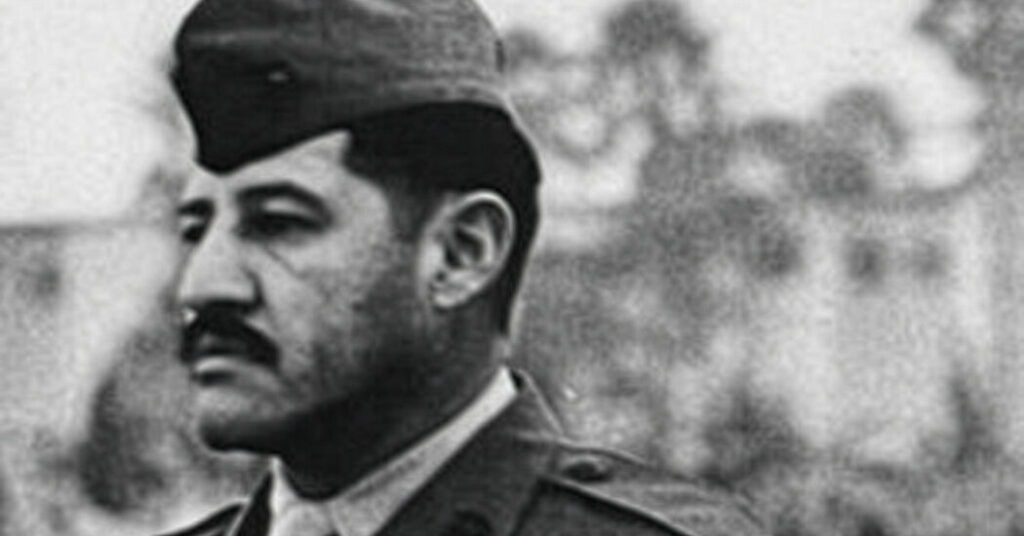
Juan Jose Valdez, the last American serviceman to leave Vietnam, who was lifted by helicopter from a U.S. Embassy rooftop in Saigon in April 1975 after assisting thousands of evacuees during the fall of that city, in the chaotic and, for Americans, humiliating final chapter of the Vietnam War, died on Feb. 15 at his home in Tucson, Ariz. He was 88.
The cause was pneumonia, said his son Anthony.
Master Gunnery Sgt. Valdez was the senior noncommissioned officer in a detail of Marine security guards at the American Embassy, a last outpost of U.S. power in what was then South Vietnam.
In March 1975, the Communists of North Vietnam broke a cease-fire negotiated two years earlier and launched a large-scale invasion of the South. Tens of thousands of Vietnamese who had fought alongside or aided the Americans sought to flee the country.
Many were evacuated from an air base outside Saigon, the South’s capital city, to a fleet of Navy ships. When the runways came under fire, the retreat continued by helicopter from within the city, a two-day airlift named Operation Frequent Wind.
Americans and at-risk Vietnamese were alerted to the start of the helicopter flights by a prearranged radio code: “The temperature in Saigon is 105 degrees and rising,” an announcer said, followed by a recording of “White Christmas.”
Sergeant Valdez and his fellow Marines maintained order as a procession of Sea Stallion and Sea Knight helicopters swooped in and lifted off from the embassy grounds and the rooftop of the chancery building within the embassy compound, as some 2,500 frantic people crowded inside the compound and others desperately tried to scale the walls.
(A famous photograph of a helicopter on a Saigon rooftop with civilians snaking up a staircase to board was not actually a scene from the embassy. It was at an apartment building where a top C.I.A. official lived.)
Before loading helicopters at the embassy, Marines searched evacuees for weapons and threw any they found into a swimming pool. At dawn on April 30, Ambassador Graham Martin, carrying the American flag that had been lowered in the compound, boarded one of the last flights out. Sergeant Valdez and a handful of Marines stayed behind to protect his departure.
Panicked civilians soon broke through the gates and surged up the stairways of the chancery. The Marines retreated to the rooftop, barricaded the access door and waited for their own ride out. They could see North Vietnamese troops converging in the street.
Maj. James Kean, the commanding officer of the Marine guards, recalled years later in an interview with CBS News, “There were 17 divisions of North Vietnamese coming across the bridges into Saigon and when the sun came up we saw them.”
When the last helicopter, a CH-46 Sea Knight, descended to the rooftop, Sergeant Valdez stood back as Major Kean and nine enlisted men got on board first. Sergeant Valdez was nearly left behind: He was thrown off balance and fell on the rear boarding ramp as the pilot lifted off.
“The ramp, you could see behind me it was starting to go up, and that helicopter wanted to get the hell out of there,” he recalled in a 2021 interview.
Staff Sgt. Mike Sullivan, one of the men already onboard, told The Los Angeles Times in 1990 what happened next.
“I looked at the back of the helicopter door, and I noticed two hands hanging there,” Sergeant Sullivan said.
Sergeant Valdez was grabbed and pulled aboard. It was approximately 8 a.m. on April 30, 1975. After a 30-minute flight, the chopper arrived at the U.S.S. Okinawa offshore.
By late morning, the flag of North Vietnam had been raised over Saigon, now Ho Chi Minh City, ending the Vietnam War two decades after it began and 10 years after the arrival of U.S. combat troops.
Juan Jose Valdez was born on Aug. 19, 1937, in San Antonio, to Salome and Antonia (Garza) Valdez. His father was a groundskeeper at a municipal golf course.
In 1955, at the age of 18, he enlisted in the Marines and served for 32 years. As a platoon sergeant from 1965 to 1967, he was in combat in Da Nang and Chu Lai in South Vietnam.
After retiring from the Marines in 1987, he worked as a civilian employee at Camp Pendleton, the Marine Corps base near Oceanside, Calif., where Mr. Valdez lived for many years.
Besides his son Anthony, he is survived by another son, Michael; his brother, Antonio Valdez; his sisters, Nancy and Chayo Valdez; a grandson; and three great-granddaughters.
Mr. Valdez’s memories of America’s last, humbling days in Vietnam symbolized for him what many other veterans eventually concluded: that the war, in which 58,000 Americans and at least three million Vietnamese died, was a tragic waste.
“A lot of good people got killed, and for what?” he told The Los Angeles Times in 1990. “And when we left, we left with our tail between our legs.”
Trip Gabriel is a Times reporter on the Obituaries desk.
The post Juan Jose Valdez, Last Marine Out of Saigon, Dies at 88 appeared first on New York Times.