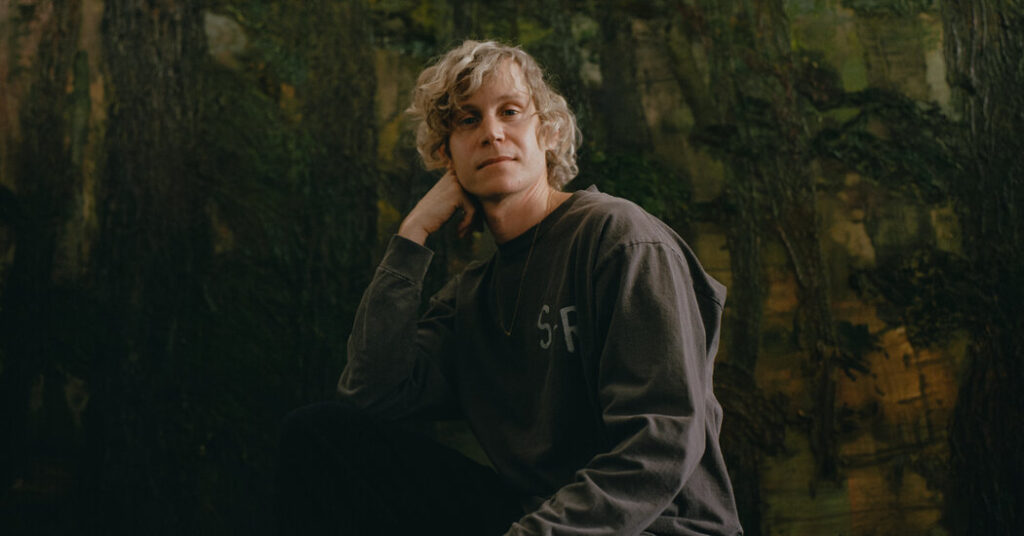
Doron Langberg was in the middle of the Bronica Forest in western Ukraine, communing with ghosts.
It was November 2024, and Langberg’s journey to the forest had been challenging from the start. With no commercial airlines operating in Ukraine amid the Russian invasion, the 40-year-old painter had to fly into eastern Poland and hire a driver to reach the checkpoint. There, Langberg paid two Polish women — who earn money carrying goods back and forth because men are barred from crossing the border during wartime — $20 each to help lug 14 canvases across and guide the artist into Ukraine on foot.
Before long, Langberg, who was born in Israel, was standing in front of an easel in the same place where thousands of people — including family members — had been killed during the Holocaust. In 1942, Nazis began transporting Jews from the nearby Drohobycz ghetto to Bronica Forest, where they were executed and buried in unmarked graves.
The haunting, melancholy paintings that came out of Langberg’s trip form part of their first solo New York gallery exhibition in seven years, opening at Jeffrey Deitch gallery on Friday.
The new work is a departure for one of the most famous and commercially successful Israeli artists working today, and it’s a personal reckoning. Over the past decade, Langberg has been known for a different kind of work: diaphanous, colorful paintings of lovers and friends having sex, dancing and lying on the grass. Along with Salman Toor and Louis Fratino, Langberg is part of a loose cohort of painters that some critics have called the “New Queer Intimists” because of their tender depictions of gay life.
For most of their career, Langberg felt that nationality and religious identity were incidental to their art. They grew up in Yokneam, Israel, a city southeast of Haifa in the shadow of the Menashe mountain range. Like most Israeli teenagers, they served in the army. (Originally assigned to work as an airplane mechanic, Langberg had an unofficial role as an in-house artist, making paintings for dormitories and offices.) Langberg cut their service short by two months to move to the United States to attend the Pennsylvania Academy of the Fine Arts and wasn’t particularly interested in reflecting on their relationship to their home country. But when the Israel-Hamas war broke out, everything changed.
As footage of the destruction in Gaza flooded social media, Langberg experienced a creative block. “ I just did not find the same meaning in what I was making anymore,” they said in a recent interview. So they decided to look away from intimate domestic scenes and toward landscape — a genre of painting that artists throughout history, including Vincent van Gogh and Edvard Munch, have used to explore difficult emotional terrain.
Over the next two years, Langberg traveled to three places heavy with personal and political significance: Yokneam; Drohobych, Ukraine, where their father was born and narrowly survived the Holocaust; and Fire Island, a queer haven outside New York City that has become a refuge for the artist. In the process, Langberg began to question everything they had been taught about their home and history.
The new body of work charts that process. After the Oct. 7 attacks by Hamas and the outbreak of the war, Langberg’s relationship to their family’s history, as well as their own Israeli and Jewish identities, began to shift as the artist examined what they now view as their complicity in a cycle of violence. “What does my home mean? What does my Jewishness mean?” Langberg recalled asking. “These became such urgent questions that I felt like I had to address them with my way of understanding the world, which is through painting.”
The show, innocuously titled “Landscapes,” features six monumental paintings 13 to 20 feet wide, made with layer upon layer of paint. Several of the tree trunks in the paintings are life size. Sometimes, the surfaces are so heavily rendered that the texture resembles scabs or gashes.
Langberg, typically a blur of bleach-blond curls and bubbly energy, was uncharacteristically reserved during a conversation at their studio in the Ridgewood neighborhood of Queens. Normally press-friendly, the painter said they would give only one interview about the show, then refer people to a 750-wordtext they wrote — and rewrote, and rewrote — about how the paintings reflect their views of the Israeli-Palestinian conflict. Although “paintings in their nature are open-ended,” Langberg said, they wanted there to be no confusion about their own political position. The statement concludes: “No matter the circumstances, Palestinians deserve justice and liberation. By choosing to look away from unspeakable horrors under the auspice of protecting Jewish life, we destroy ourselves and countless others.”
In addition to the monumental paintings, the show includes small canvases Langberg made outside while overlooking Emek Yizrael, an expanse of farmland and mountains near their hometown. The bottom of each composition is left blank, exposing the white canvas beneath.
The works are an expression of the cognitive dissonance the artist experienced traveling between New York — where the response to the war was “like a cacophony” — and Israel, where “you’re in the eye of a storm, and it’s so peaceful.” The partial view of the landscape and the emotional flatness of the palette represented what Langberg saw as many Israelis’ decision to look away from the devastation taking place just a few hours’ drive away.
Growing up, Langberg was taught that there was an inextricable link between the Holocaust, Israel and Jewish safety. Langberg’s father, Anatol Naftali Langberg, was under a year old when Germany invaded Poland. Anatol’s mother left him at a monastery to keep him safe. After the war, he and his mother reunited and immigrated to Israel. Anatol’s father and his mother’s many siblings had been killed; Anatol has not returned to Europe since. (“He’s like, ‘I’ve been,’” Langberg said dryly.)
As the Israel-Hamas war continued, Langberg sought to develop a more direct relationship to their family history. That’s how the artist ended up in the Bronica Forest in the dark of night. “I had so many conflicting feelings about what was happening, and it was almost a desire to not betray my family and that history,” Langberg said. Painting by flashlight, Langberg said they felt as if they were asking their ancestors: “‘Is this really what you meant when you were murdered? Is this what you wanted?’”
After returning to New York, Langberg made two of the show’s most wrenching paintings. One is of the same scene that Langberg rendered on small canvases back in Israel, but this version is no longer partial. In fact, it is so large that it feels as if it could swallow the viewer whole.
The foreground is covered in dark brown and blood red paint that Langberg applied to the surface by hand, as if slipping down a wall and desperately trying to hold on. Langberg cited as inspiration the Israeli artist Moshe Gershuni, an outspoken critic of Israel’s expulsion and mistreatment of Palestinians, who used a similar palette and technique. “He represented this conscience,” Langberg said. Referring to their picturesque hometown, Langberg added, “We can’t look at this place as beautiful and tranquil. It’s tranquil and beautiful because of all the violence.”
Another painting captures the Bronica Forest from the perspective of someone falling backward, as if into a grave. With paint smooshed and squeegeed across the surface, the trees look as if they are crashing in on one another. Toor, a friend of Langberg’s, likened the image to “a horrible scream.”
The final pieces in the show are the two Fire Island landscapes, including a light-dappled scene of an impromptu rave at the Meat Rack, a popular cruising spot. Langberg recognizes that a party scene is a dissonant addition to a show about intergenerational trauma. “ I kept asking myself, why paint Fire Island?”
But the artist could not ignore the role that their politically engaged community played in helping them find a new perspective on stories they had inherited. Langberg said that seeing their community’s reactions to the Israel-Hamas war was “really helpful.”
The artist spoke with a number of galleries in New York about showing the new body of work. At least one negotiation reached an advanced stage before falling apart, they said. Langberg could not say whether the subject matter was a factor. The dealer Jeffrey Deitch, an admirer of Langberg’s work, was delighted to step in. “My grandfather comes from Ukraine,” Deitch said. “Parts of the story resonate with me very deeply.”
Deitch noted that many artists of Langberg’s generation are grappling with the questions at the heart of the show, including: “How can art connect with all the disturbing things that are going on in the world today? Can you make art for sale in a commercial gallery and address these profound issues?” Langberg’s portraits and interior scenes have been sought-after at auction, selling for as much as $420,000. At Deitch, the small paintings start at $30,000; larger ones are between $160,000 and $240,000.
As the show approached, Langberg was less worried about blowback from collectors — other artists who are Jewish, including Nicole Eisenman and Nan Goldin, have faced pushback for their views on Palestinian liberation — than about how the work will be received by their own community of New York artists.
Is it inappropriate, the artist wondered, to “focus on Jewish pain in the time of so much Palestinian pain? Who wants to hear from an Israeli right now?” But Langberg found precedents in artists like Gershuni as well as the German artists Gerhard Richter and Anselm Kiefer, who confronted the brutality and legacy of the Holocaust from the side of the perpetrator. “Dehumanizing Palestinians is an Israeli problem,” Langberg said. “It made sense to look inward.”
The post Fusing the Personal and the Political, With Monumental Results appeared first on New York Times.