Not long ago, I was in my hometown in upstate New York with my family. Like a lot of poor rural areas, it’s been hit hard by the loss of industry, and the opioid epidemic has taken a heavy toll. In winter, it’s common to see people without adequate coats or shoes, and it’s common to see young mothers without much support.
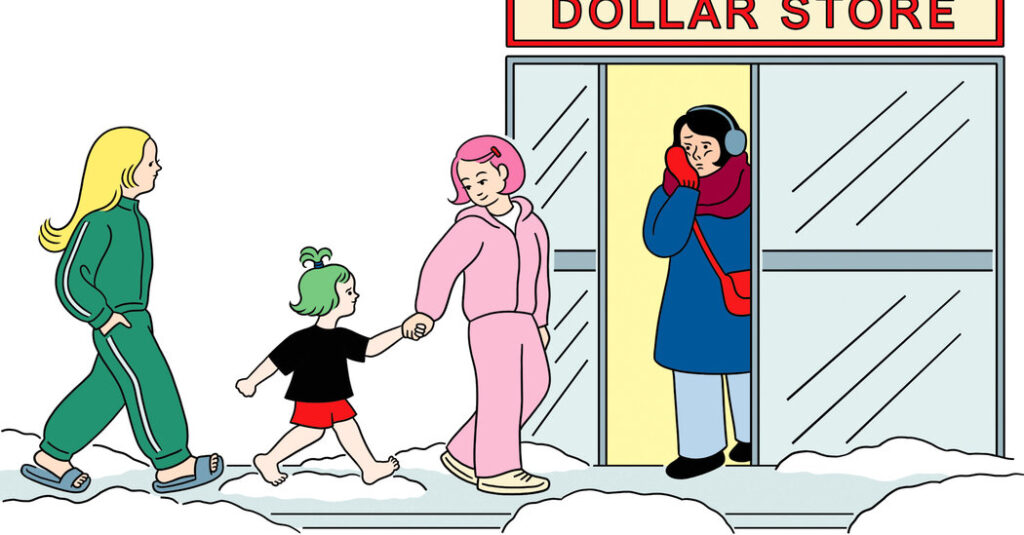
My mother and I stopped at a local dollar store on a bitterly cold day. Two young women came in with a small child, certainly under 5. I couldn’t tell whether they were babysitters or relatives, whether one was the child’s mother or a guardian. The child ran around the store with very little supervision.
At checkout, I noticed the child was wearing only shorts and a T-shirt, with no socks or shoes. The child also seemed extremely dirty, far beyond what I’d expect after a normal day of play. As a mother to a young child, I know that look. This seemed like a child who hadn’t been bathed in days.
A few other details made me look twice. The child’s hair was dyed neon green, and there was black nail polish on their hands and feet. It bothered me that someone had found time for the “fun” touches while basic care, like shoes on a freezing December day or attentive supervision in public, seemed to be missing.
When we walked out, I watched the child step barefoot into slush in a pothole-filled parking lot and climb into an older car. The driver was smoking a cigarette.
I understand that none of this necessarily adds up to illegality or abuse. Still I can’t shake the feeling that I may have seen a child who needed help and I simply walked away. At the same time, I worry that I’m piling assumptions onto a family I know nothing about, a family that might be doing its best. Maybe this was a one-off or a bad babysitter. I also know that calling Child Protective Services can create serious harm for families who don’t deserve it. What should I have done? — Name Withheld
From the Ethicist:
This probably wouldn’t be a hard call if we all trusted the ability of social services to intervene — and to refrain from intervening — thoughtfully and protectively. After all, child abuse and neglect take place on a distressing scale. In an ideal world, you could note the car’s plate number, report what you’d seen and be confident that you were more likely to help than harm. A widespread concern, though, is that C.P.S. can do a great deal of damage; indeed, some child-welfare experts have concluded that, on net, these programs do more harm than good.
A big problem is that C.P.S.’s most powerful instrument is family separation, which can be traumatic for both children and parents. Despite efforts to reduce reliance on it, a built-in asymmetry of blame can lead to overuse. Headlines and public outrage can ensue when a caseworker makes a judgment that leaves a child in a dangerous situation; there’s seldom much notice when a caseworker makes a judgment that unnecessarily separates a family. As one social-policy expert has put it, this imbalance of incentives means that those in the child-protection sector aren’t so much “risk averse” as “risk-to-self averse.”
When people talk as if all that matters is the “best interests of the child,” they turn an important idea into a simplifying rule. It isn’t as if we believe that billionaires are entitled to take the babies of low-income parents on the grounds that they can promise better life chances. The harm done to parents, along with the harm done to children by tearing their families apart, has to figure into any proper moral accounting.
All of that brings us back to your position in this episode. As you say, you don’t really know much about this situation, and your letter indicates a certain class distance that may add to your uncertainty. What you witnessed was worrisome, but you did not see someone shivering or sick. Nor do you live in the community. Others in the store, townspeople, saw the child, too. The child presumably has neighbors who see the preschooler’s everyday life, and any of them could have reported what they knew (and, for all you know, have done so). They may know the local record of C.P.S. and have a keener sense than you of both the risk to the child and the risk of calling in the state. So you shouldn’t reproach yourself for not reporting this child. That’s not because C.P.S. couldn’t possibly have helped. It’s because you didn’t know enough to decide what was needed and there were others better placed to do so.
Readers Respond
The previous question was from a reader who was debating whether to take away her aging mother’s car keys. She wrote:
About a year ago, my mother, who is in her late 80s, was diagnosed with mild cognitive impairment. Since then, she has been dealing with health challenges that have increased her frailty and memory issues. She has always been a very proud, strong woman, and until recently she had no trouble living independently. But her neurologist told her, in my and my sibling’s presence, that she should no longer be driving. … The D.M.V. has suspended her license, and my mother is irate, blaming us for instigating this. … Meanwhile, we are concerned that she is continuing to drive, despite the known consequences. … But we have not yet gone so far as to take away her keys or put a lock on the steering wheel. My hesitation stems from the fact that she’s basically said that her life would not be worth living if she couldn’t drive. … How do we know when it’s time to take a drastic step? — Name Withheld
In his response, the Ethicist noted:
Taking her keys or putting on a steering-wheel lock may be an effective stopgap measure. But even though your aim is to stop her from doing something illegal, these steps could put you in a legally ambiguous area yourself. And you’ll be treating your mother like a child when she already fears the loss of her grown-up autonomy. You’ll do better, I suspect, if you treat her as the adult she still is. … Offer practical suggestions for preserving her mobility. Perhaps she could sell the car, cancel her insurance and use the money to cover ride-hailing services. Perhaps you and your sibling could also volunteer to drive her for, say, weekly shopping excursions. … In other words, rather than focusing on what you don’t want her to do, come up with proposals that leave her with at least some of the freedom she dreads losing.
(Reread the full question and answer here.)
⬥
The alternatives to driving that the Ethicist suggests are all useful, but in my experience as a physician, the letter writer’s mother is unlikely to accept any. Yes, she is an adult, but more than one physician has judged that she should not be driving and has reported that to her D.M.V. Ethically (and possibly legally), her family is obliged to prevent her from driving. This is a matter of preventing serious injury to her and others. It will be very unpleasant to have to do this, but ethical decision-making often involves choosing between two bad alternatives. To me, it is clear which one is worse. — Allyn
⬥
When my wife had to take the keys from her father, she did so boldly. But she also offered to hire a driver so that he could get around to the many activities he enjoyed. He soon became friends with the young man we hired, and it enriched his life. With more car services available today, it may be easier, but for a senior whose mental faculties are diminished, it may be hard to navigate these ride-share apps. I would still recommend hiring a driver for a certain number of hours per week. — David
⬥
The way our infrastructure is developing, driving means much more than just independence. Losing the right to drive only deepens the social isolation we seniors are trying to avoid. This happened to my mother, who was told to stop driving by her occupational therapist and my siblings, even though she still had a license and passed tests. She resented it mightily, but succumbed to social pressure. Now that I’m retired, I’m seeking a community where I can remain independent if I should lose my ability to drive. They are not easy to find. — Mike
⬥
The decision to take away a person’s driving ability should not just be dependent on wishes of their adult children or the recommendation of the patient’s doctor. Most large cities have driver-assessment facilities, often associated with rehabilitation facilities. The mother should be taken to have a thorough assessment done, which includes written tests as well as a driving test. Many people think they are knowledgeable and safe drivers — until they fail the test. — Cynthia
⬥
I’m 96 and I live alone. My car is my lifeline to everything (other than sitting at home). Still, I made copies of the Ethicist’s advice to give to my children, adding only the words: “When it’s my time to quit, just do it!” — Christopher
The post I Saw a Child Who Seemed Neglected. Should I Have Done Something? appeared first on New York Times.