Less than a year after President Trump raised concerns about ties that Intel’s chief executive, Lip-Bu Tan, had to China, senators are questioning the company and its leader about reports that they may use technology from a blacklisted Chinese maker of semiconductor tools.
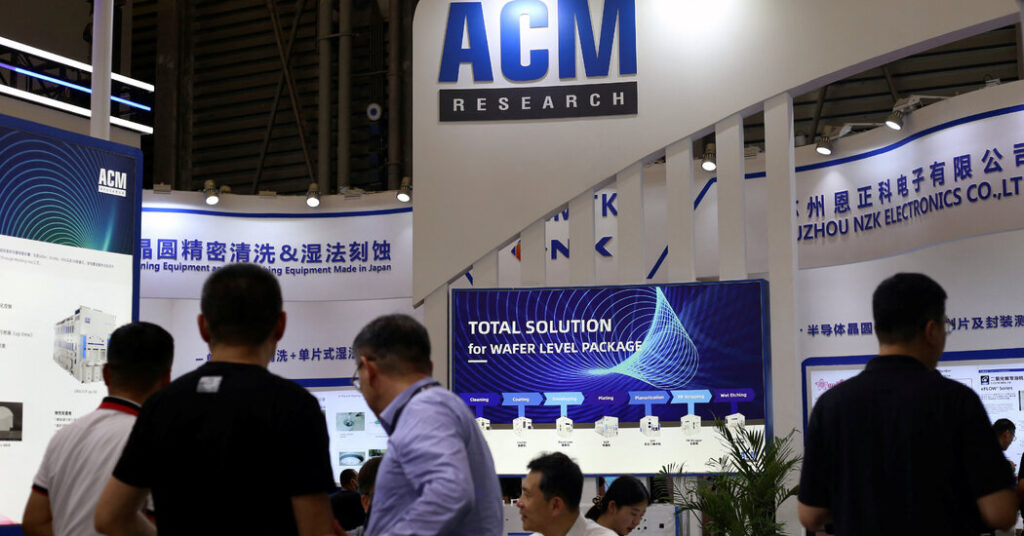
In a letter sent Wednesday to Mr. Tan, a half dozen Republican and Democratic lawmakers questioned whether using tools from the Chinese subsidiary of the company, ACM Research, would create national security risks and potentially allow China to gain access to Intel’s chip making processes.
The lawmakers said this was especially concerning since Intel is now partly owned by taxpayers, after the Trump administration acquired 10 percent of the company for $8.9 billion last year.
“Intel’s entanglements with blacklisted Chinese companies calls into question whether taxpayer dollars are subsidizing activities that could directly threaten U.S. national security and leadership in semiconductor manufacturing,” the senators wrote.
The letter illustrates the scrutiny that Intel is now under as the recipient of one of the largest public investments in a company since the 2008 financial crisis. It also adds to the list of challenges Mr. Tan faces as he tries to revive a business that was once an industry pioneer but has missed several waves of innovation.
Six senators signed the letter, including Elizabeth Warren, a Democrat from Massachusetts, and Tom Cotton, a Republican from Arkansas. They asked Intel to answer several questions by March 20, including: whether it has tested ACM tools, which are used to remove material from silicon wafers; what safeguards it has to protect chip making processes; and what mechanisms it has to make sure taxpayer money doesn’t inadvertently flow to China, which is considered a foreign adversary.
Intel said ACM tools aren’t used in its semiconductor manufacturing processes. ACM didn’t respond to requests for comment.
“All Intel activities fully comply with applicable U.S. laws and regulations, and we engage regularly with the U.S. government on security matters,” said Sophie Won Metzger, an Intel spokeswoman, in a statement. She added that Intel took national security responsibilities “extremely seriously” and had systems set up to “limit the information any individual tool can receive during the manufacturing process.”
The Senators sent the letter after a Reuters report last year that exposed Intel’s work with ACM.
ACM Research was started in Silicon Valley in 1998 by David H. Wang, who studied at Tsinghua University in China. In 2006, it formed a subsidiary in Shanghai. China became the hub for the company’s technology research, and its development and manufacturing, as it developed sophisticated semiconductor equipment. Eventually, the subsidiary was more valuable than the parent company in the United States.
In 2024, the U.S. government added ACM’s subsidiaries in China and Korea to its entity list, which restricts U.S. companies from doing business with it. The company said at the time that it was not notified of any specific wrongdoing.
The review of Intel’s ties to ACM is Mr. Tan’s latest brush with the U.S. government over China. Last year, he faced scrutiny after the U.S. government found the company he previously led, Cadence Design Systems, illegally sold chip technology to a Chinese university with military ties. The company pleaded guilty.
At the time, Mr. Cotton expressed concerns about Mr. Tan’s ties to China. Mr. Trump also criticized Mr. Tan and called for his immediate resignation.
Mr. Tan later visited the White House and struck a deal to sell the U.S. government a stake in Intel. He kept his job and won praise from Mr. Trump.
Tripp Mickle reports on some of the world’s biggest tech companies, including Nvidia, Google and Apple. He also writes about trends across the tech industry like layoffs and artificial intelligence.
The post Lawmakers Question Intel’s Use of Tools From Blacklisted Chinese Firm appeared first on New York Times.