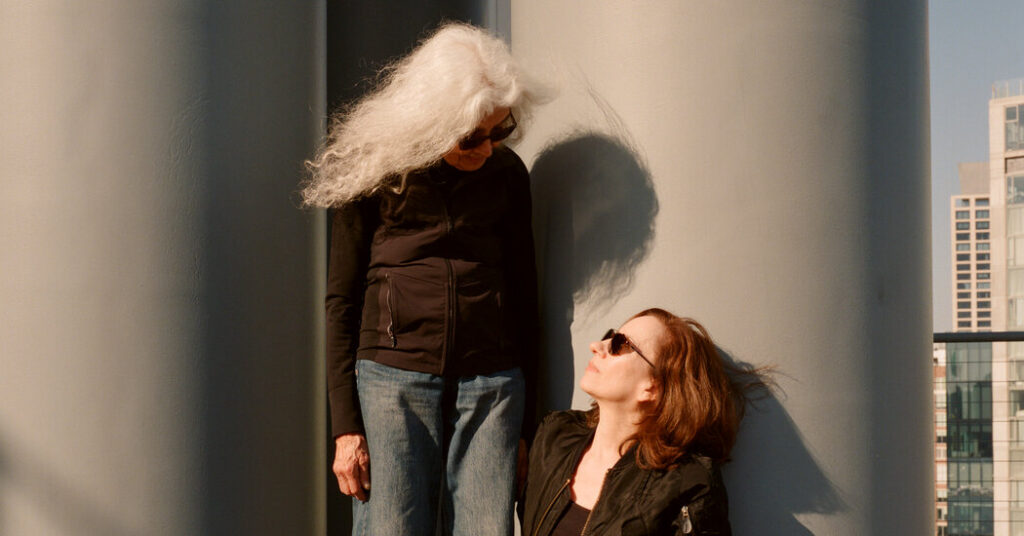
A few years after giving birth to her youngest daughter, the artist Carmen de Monteflores stopped painting, packed up the makeshift studio of her Berkeley, Calif., home and put her artistic career in a storage unit. Divorced, with five children, she had other priorities.
Years later, that daughter, Andrea Fraser, saw a piece her mother had created just after she was born. It was a photograph of a crying baby pasted behind chicken wire. Fraser, herself an artist known for her bold conceptual works, quickly arrived at her own interpretation.
“The chicken wire is a self-portrait,” she said during an interview, glancing at de Monteflores, who was listening as intently as possible to her daughter’s attempt at dissecting her past. “So that represents her feelings about motherhood in my infancy.”
“Not at all, not at all,” de Monteflores reassured her, as she has often done. She argued, a little halfheartedly, that the chicken wire merely represented the “vibration” she felt as a mother when her baby screamed; it was not a personal reaction to raising her daughter.
Yet Fraser is still trying to free herself from the chicken wire.
She has found great success as an artist, but, like her mother, she has complicated feelings about what it means to be a woman in the art world. Her performances have mocked the pompous tone of museums and questioned the motive of dealers who build a mystique around contemporary art in order to sell it for higher and higher prices. She has also sought to heal immense feelings of guilt and a belief that her career bloomed because her mother’s died.
The lock on those memories snapped open about three years ago as mother and daughter rolled back the wooden doors of the storage unit, which de Monteflores had continued to pay for. Now 92, De Monteflores, was reunited with mammoth canvases of nudes; orgiastic scenes of tangled bodies; and the collaged portrait of a crying infant in chicken wire.
Having spent her later years as a clinical psychologist, she looked at the dusty remains of her youth and recognized the irony. Standing before the artworks, she knew, “There was a lot here to unpack.”
Fraser was enthralled. She started plotting a course to revive her mother’s career and belatedly secure her position in art history. To do so, she would need to start engaging in the kind of commodification of art that she detested. That would mean restarting her relationship with a luxury art gallery and acting, in some ways, as a dealer for her own mother.
As she wondered whether she could make a case for an emerging artist who is nearly a centenarian, curators for the 2026 Whitney Biennial came calling, asking to include Fraser’s works in the exhibition. Fraser told them she was happy to participate: But would they like to meet her mother?
The museum decided to include both women. As the opening approached on March 8, three large paintings were exhumed from the storage unit and sent to the Whitney’s conservation department. De Monteflores prepared for the journey to New York, bracing herself for the first time she would ever see her artwork on a museum wall. Her daughter hoped the leading exhibition of contemporary American art would turn her mother into the star she might have been if she hadn’t put her work aside. De Monteflores was unsure if she was ready for the attention.
“The anxiety of rejection is relative to one’s hopes,” Fraser reminded her.
“Oh, that’s true,” de Monteflores acknowledged softly, “but I have tried to keep my distance.”
The Creativity of Estrangement
After de Monteflores reverted her studio to a garage in the late 1960s, she got on with living as a 30-something with a full house of children.
The epic, jigsaw-carved canvases of neon giantesses were replaced with child-care concerns and graduate school. She channeled her artistic skills into cartoons for young Andrea — whimsical sketches of giraffes, birds and a shaggy-haired woman, much like herself, hauling a wheelbarrow of dissertation pages. She painted a tropical fresco on the dining room walls to soothe the family’s caged squirrel monkey, named Sydney. And for a time in the 1970s, she even brought performance art to the Unitarian church where her husband ministered.
“One Sunday, I carried a bag full of dirt into the church,” de Monteflores recalled during an interview ahead of her museum debut.
“I was 7 or 8 at the time,” Fraser interrupted.
“Anyway, the bag of dirt. I poured it onto the table and made a neat pile. Then I started putting it back into the bag, little by little. And that’s it. I closed it up and walked out,” de Monteflores said. “The congregation already thought we were weird. We were hippies in the process of getting assimilated.”
By 1973, she was rejecting that process and her marriage was fracturing. De Monteflores was writing a dissertation for her doctorate in clinical psychology on lesbianism and had joined the gay liberation movement. Her husband asked for a divorce.
“He didn’t think you would say yes,” Fraser recalled.
In retrospect, her mother’s paintings held the subconscious blueprint of a sexual awakening. The erotic tangles of nude fantasy women — their bodies defined by sparse linework suggesting the curve of a breast or arc of a hip — were executed in colors that referenced the bright blues and pinks of Puerto Rico and her childhood. De Monteflores lacked a strong connection to the island while living in California and spent her evenings writing novels that tried to recapture her memories. Even the linework was a reference to the stained glass of the Catholic church she attended until she left the island at 16, when she moved to Wellesley College for art history classes, before learning to sculpt and paint at programs in Paris and New York.
“I had never heard you talk of stained glass as an influence,” Fraser interjected. “And you remember my art school portfolio was largely stained glass. I started doing that when I was 14.”
Fraser has rarely discussed her own artistic practice through the lens of their relationship, but she has begun to recognize a shared root, what she called “the creativity of estrangement.”
Fraser’s warm memories of her family seemed to vanish after the divorce. Her mother’s storage unit sat in the background of her life like an art graveyard, a silent warning that informed Fraser’s decision to become a conceptual artist who worked with ideas instead of physical objects.
As a student at the Whitney Museum’s Independent Study Program in 1984, Fraser became interested in appropriating images from popular culture, which eventually led her to think about making her own wall texts and exhibition brochures from museums. In 1989, for her performance piece “Museum Highlights: A Gallery Talk,” she posed as a snobbish docent at the Philadelphia Museum of Art who praised a water fountain for its “monumentality.” In 2003, in one of her most notorious projects, she videotaped herself having sex with a collector who prepaid for the video as an artwork and then participated in its production. For the collector, it was the ultimate act of possession of an artist, body and soul. For the artist, it was the most literal form of servitude to the art market.
And in 2008, she used recordings from her own therapy sessions in a piece where she performed as both the fictional psychoanalyst and patient. Called “Projection,” it helped Fraser confront her suspicion that her mother sacrificed her career to have children.
“The psychiatrist makes the interpretation: I believe that I have destroyed my mother’s creativity and that her lack of success as an artist was my fault,” Fraser said, failing to hold back tears. “It was my fault for being born.”
“I don’t know if she will ever totally believe me,” de Monteflores objected, pointing to other obstacles in her path: She lacked an artistic community in Berkeley to support her decision (she was unaware of developments across the bridge in San Francisco, where artists including Ruth Asawa joined creative networks with other mothers). De Monteflores also lacked support from curators or dealers who could have connected her with museums that might have exhibited her work. And, yes, there were entire years where she never touched a canvas because she was busy tending to her children.
Fraser knows — and she doesn’t know.
“If I hold this unconscious conviction that I destroyed my mother’s creativity,” she reasoned, “then this latest effort is about trying to repair things decades later.”
‘Why Did I Ever Stop?’
Walking through the Whitney last weekend for a special preview of the exhibition, de Monteflores leaned on her daughter’s shoulder.
She was not crying. She would not cry.
“The paintings were done so long ago, it’s almost like this is happening to somebody else,” the artist said, though she couldn’t deny something had psychologically changed for her after seeing the works hanging on a museum wall.
“That part of me that was no longer functioning,” de Monteflores said, “my identity is being restored as an artist.”
The artworks had spent the last month in the care of a museum conservator, Matthew Skopek, who removed layers of grime and smoothed abrasions caused by decades in damp storage.
“Everything suffers the injustices of time,” Skopek said, but the damage was entirely reversible, allowing the bright expressive colors of her acrylic paint to shine again.
That nearly-psychedelic outburst of color contrasted with Fraser’s contribution to the gallery: five life-size wax sculptures of babies shown on pedestals the size of cribs, from a series called “Untitled (Objects I-V).” Fraser had painstakingly molded the sculptures by hand, leaving indents and fingerprints across the babies’ bodies. The artworks had been presented in 2024 at Marian Goodman Gallery and marked Fraser’s return to the commercial art world after a decade-long hiatus.
Exhibition literature at the time suggested that the wax babies could be the offspring of Fraser’s sexual encounter with her collector. Infants born from the metaphor of selling art as a form of prostitution, they napped on podiums and waited for buyers.
Juxtaposed with de Monteflores’s paintings, Fraser’s sculptures completed a family portrait. Fraser was thinking about her mother’s five children when she made them; she was thinking about the effect of parenthood on a woman’s ability to lead a creative life. Perhaps by avoiding the creation of physical objects for her entire career, Fraser had avoided some of the anxious attachments that artists (like mothers) feel for their offspring.
Fraser has a “fear of rejection,” said Marcela Guerrero, who is curating the Biennial with Drew Sawyer. Although the babies were created as a series, Fraser has sold only one, meaning that the sculptures will be eventually separated. It’s all psychological for Fraser, Guerrero observed, noting how the artist was finally starting to confront her own fears of rejection while serving as her mother’s conduit in the art world.
“The best-case scenario here is that artists like Carmen are written about, they get solo shows and are acquired in museum collections,” Guerrero said.
But Fraser remains skeptical about what will happen after all the media attention. After all, it has become a trope in the contemporary art world that fame comes sudden and fast for women artists of an advanced age.
“Because of my critical relationship to the art world,” she told de Monteflores, “it isn’t really possible for me to think that exposing your work to that machinery is a good thing.”
Yet long after she stopped painting, de Monteflores kept her subscriptions to art magazines and collected articles that featured her daughter. She admitted to living vicariously through the reviews and essays written about Fraser’s career. Those records — not record prices — are what inspired her, she reminded her daughter.
“Your ambition wasn’t just to be famous, but to be a part of art history,” Fraser said.
“That hits the spot,” de Monteflores responded, wiping her eyes.
Looking at her mother’s artworks on the walls, Fraser’s gaze turned to a small text about her own work. She noted that curators had described her sculptures as shared in a “joint presentation” with her mother’s art. That kind of description would take some getting used to, she thought, after so many decades of standing independently as an artist.
The exhibition tour left de Monteflores energized. Everything felt new again, though a pang of regret started bubbling up to the surface once more.
“Why did I ever stop?” de Monteflores said. “This was the most important thing to me in my whole life. How could I stop?”
Cinematography by Gus Aronson.
Zachary Small is a Times reporter writing about the art world’s relationship to money, politics and technology.
The post Did This Artist’s Career Bloom Because Her Mother’s Career Died? appeared first on New York Times.