This article is part of our Design special section about buildings, objects and techniques that are fighting to stay alive.
Zipping along a two-way thoroughfare here, I gazed out at the parade of small apartment buildings, sporadic shops and single-family homes. The scene could have been Anywhere, Japan.
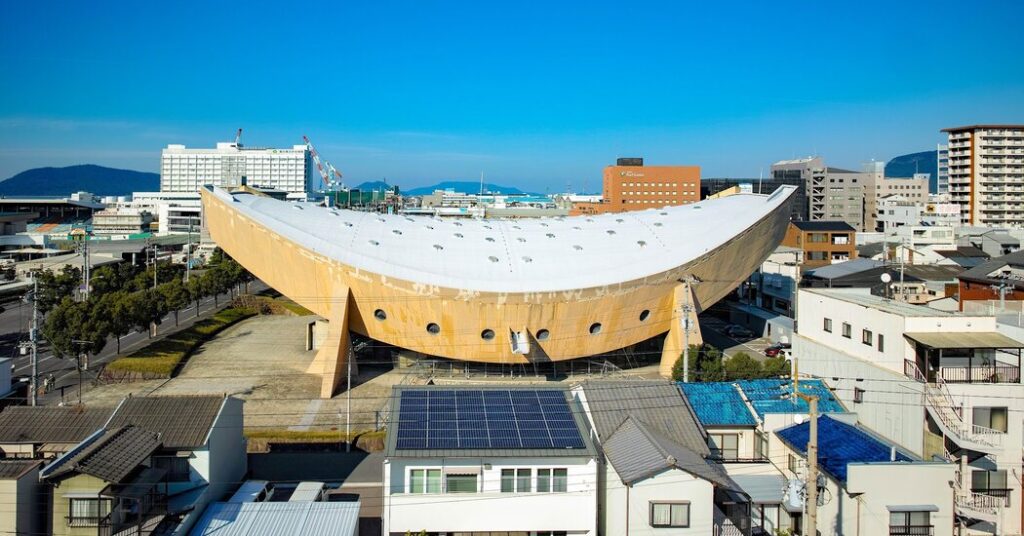
But then Kenzo Tange’s Kagawa Prefectural Gymnasium came into view. Set back from the street, this hulking concrete ark dry-docked on massive pylons was like nothing I had ever seen. Dynamic. Sculptural. Enigmatic. It was in a weight class of its own.
Because the gym has been shuttered since 2014, when the prefecture deemed its structure unsound, I couldn’t go inside. But where its coffered underbelly tilts up at either end, window walls revealed treadmills gathering dust, a wall clock with hands frozen in place and other traces of a past life. Given that the prefecture intends to raze this modern masterpiece from 1964, time for the so-called Boat Gym may be running out.
If the gym comes down, it will be the latest in a steady stream of Japan’s modern architecture casualties. Most of the lost works appeared in the decades following World War II, when the need to rebuild and modernize was urgent. A spate of new city halls, museums, schools and other large-scale cultural and commercial projects emerged, many by some of Japan’s leading architects, including Kunio Maekawa, Junzo Sakakura, Kiyonori Kikutake and, of course, Mr. Tange, who in 1987 was awarded architecture’s highest honor, the Pritzker Prize.
Despite vociferous outcry on both sides of the Pacific, the prefectural assembly approved the gym’s demolition, allocated public funds of 1 billion yen (about $6.5 million) and, in December, appointed a local contractor to do the deed. Formed last July, the Former Kagawa Prefectural Gymnasium Rebirth Committee countered with a plan to privately finance the gym’s renovation and turn it into a hotel — a big win for taxpayers and tourists alike.
This proposal, however, was ignored because officials in the prefectural government and politicians in the ruling party of the prefectural assembly remain committed to their original plan to pay a construction company to demolish the building.
“It’s a real loss for the country,” said Osamu Goto, an architectural historian and former official at the Agency of Cultural Affairs. “It is extremely unfortunate that the government is acting with a mind-set from 20 years ago.” Subsequently, the committee filed a lawsuit requesting further study of the building’s seismic condition and at least a temporary stay of execution.
Ironically, the Kagawa Prefecture positions itself as a locus for architecture and culture. Takamatsu is the departure point for ferries bound for Naoshima, the popular “art island.” In this city, Isamu Noguchi carved his sculptures, George Nakashima built his furniture and Mr. Tange designed the Kagawa Prefectural Government Office East Building.
That 1958 building, unlike the gym, has been beautifully refurbished and remains in use. “We have a responsibility to future generations to pass on this architecture, so we should reconsider the decision to demolish the gym,” said Maki Ueta, a Kagawa Prefectural Assembly member who opposes the government’s current plan.
Earthquakes are one obvious explanation for sacrificing vintage architecture. Crisscrossed by fault lines, Japan subjects its buildings to strict structural codes and routine seismic safety inspections. When they don’t pass muster, retrofitting is prescribed. But the expense of bolstering the old can rival the cost of creating the new. This is a frequent justification for tear downs.
Another reason is obsolescence. Buildings that no longer meet user needs become vulnerable. Take the once omnipresent “kaikan,” or community hall. After the war, when citizens had nowhere to go for concerts, lectures or even wedding parties, these public facilities popped up all over. But after towns and cities could afford specialized theaters and auditoriums, the all-purpose hall became the no-purpose hall. And then its days were numbered.
Even buildings as remarkable as Mr. Kikutake’s Miyakonojo Civic Center, with its segmented roof arched like a baby stroller, fell prey. Similarly, Japan’s shrinking population has stimulated the consolidation and elimination of redundant schools, hospitals and other public works.
The lives of commercial buildings are further cut short when real estate moguls strive for bigger profits. Since the 1950s, Japan’s construction technology has steadily improved and building codes have changed, enabling owners to replace their holdings with taller office towers and bigger shopping arcades.
Though hotly contested, neither the sublime Hotel Okura, designed in part by Yoshiro Taniguchi, nor Kisho Kurokawa’s eye-popping Nakagin Capsule Tower (one of its salvaged, boxy units now resides at New York’s Museum of Modern Art) survived property redevelopment.
Administered by the Agency for Cultural Affairs, various levels of historic preservation do exist. But midcentury buildings have yet to benefit in a big way. Treasured for their enduring beauty, cultural value and link to the past, traditional timber temples and teahouses or Meiji era (1868-1912) red brick edifices are regularly protected.
By contrast, buildings made of glass, steel and concrete seldom stick around long enough to acquire a comparable patina. In 1996, the government extended the scope of its preservation program to 50-year-old buildings. However, this coverage is neither ironclad nor irretractable. Buildings can still be altered or delisted and then torn down. And the expense of refurbishing and maintaining these properties is borne mostly by owners.
“Japan must create a system which allows the government to provide such support,” said Mr. Goto, the architectural historian. Combined public and private funding, for example, resuscitated Junzo Sakakura’s Iga City Hall in Mie Prefecture by turning the 1960s building into a boutique hotel designed by MARU.architecture that opened in July.
Another postwar preservation success story is Mr. Tange’s other gym: the Yoyogi National Stadium commissioned for the 1964 Tokyo Olympics. Topped with a spectacular swirling roof secured by massive steel cables, its brawny, muscular form wowed international sports enthusiasts and became a symbol of Japan’s spectacular recovery from World War II.
Referring to the Tokyo and Kagawa athletic facilities designed by Mr. Tange, the architect and Harvard professor Toshiko Mori explained, “At that time, Tange was searching for an architectural language that embraced new technology, Western methodologies and iconography unique to Japan.”
While the future of the Boat Gym hangs in the balance, the Yoyogi arena was designated by the government as an Important Cultural Property in 2021 and is under consideration as a UNESCO World Heritage site.
The significance of many other midcentury buildings in Japan goes unnoticed. The value of their artistic expression or technical experimentation is eclipsed by the promise of the latest earthquake safety and energy-efficiency measures inherent in new construction. Japan’s deep-seated appetite for the new, be it out of caution or personal preference, is an ongoing challenge for Modern architecture crusaders.
This tunnel vision even overrides the environmental impact of demolition. Though bits and pieces of buildings may be salvaged, mountains of detritus end up in landfills. But the idea of recycling entire buildings may be catching on. While shops and schools are reoccupied hermit-crab-style by artists’ studios and cafes, select public facilities are being spared the wrecking ball. A good precedent is Arata Isozaki’s Oita Prefectural Library, which the architect designed for his hometown in 1966 and then converted into the Oita Art Plaza in 1998.
Not even the most passionate partisan of Japanese modernist architecture believes that every building can or ought to be saved. When those hunks of concrete and tangles of rebar come down, however, they take with them a sense of place, a wealth of memories, a local landmark and a connection to history. Unless the government reverses its position, it may be too late to rescue the Kagawa Prefectural Gymnasium from this fate.
“I want to create a culture where even if a building is old, if the right steps are taken, it can be saved,” said Ms. Ueta, the prefectural assembly member.
Japan harbors a deep respect for its premodern architectural heritage, but she and many others are rushing to persuade the government that the country’s modernist legacy is an important part of that heritage too.
Naomi Pollock’s book “Vanishing Japan: Modern Architecture Gone but Not Forgotten” is coming out in September from Thames & Hudson.
The post To Many, These Buildings in Japan Are Magnificent. They’re Doomed Anyway. appeared first on New York Times.