LAKE EFFECT, by Cynthia D’Aprix Sweeney
In her review of Cynthia D’Aprix Sweeney’s debut, “The Nest,” for The Times in 2016, Janet Maslin placed it in “the Squabbling Sibling genre.” Ten years on, the author’s third book joins her first in an even more specific, burgeoning subgenre: the less mellifluous “Four Adult Siblings Reconvene to Rehash Their Privileged but Fraught Adolescence” novel.
If you knew America only through recent popular literary fiction, you might assume far more than 7 percent of its families include four children. You might also surmise that most of these families — well educated, liberal, white and insistently “dysfunctional,” but in a quirky way — contain one gay son, one sibling who’s made it big, one who’s circling the drain, one who’s going through a divorce. (These might be the same person.) One fails to fulfill his or her early potential. Only one has children, lest the cast of characters become too crowded. Often, in these novels, adult siblings reconvene after a long separation — because someone has died, or married, or reproduced; or perhaps the summer house must be saved. We nearly always get multiple viewpoints, combining past and present dramas.
The best four-sibling books feel less derivative and more like products of the collective unconscious. They might offer twists on the traditional family structure (Jean Hanff Korelitz’s “The Latecomer”), embrace comedy (Jonathan Tropper’s “This Is Where I Leave You”) or tragedy (Ann Napolitano’s “Hello Beautiful”), realism (Ann Packer’s “The Children’s Crusade”) or the speculative (Chloe Benjamin’s “The Immortalists”), all slaking readers’ thirst for juicy family sagas about the tension between our inner wounded adolescents and our adult attempts to move on.
Four siblings are few enough to track, but offer sufficient room to explore the various ways parents’ failures might reverberate. Add to this appeal our contemporary affinity for multiple narrators, and we get a plausible explanation for how American literature got bound to 100 years of ever-jollier iterations of “The Sound and the Fury.”
“The Nest” checked every box in this micro-genre, trafficking its tropes to pleasant, if not so revelatory, effect. Inheritance issues reunite the affluent, New York-adjacent, charmingly flawed Plumbs — one gay brother, one former superstar who’s now in crisis, one sister with troubled kids, another failing to live up to her early promise. We get all four points of view, including adolescent memories, and there’s even an imperiled summer cottage.
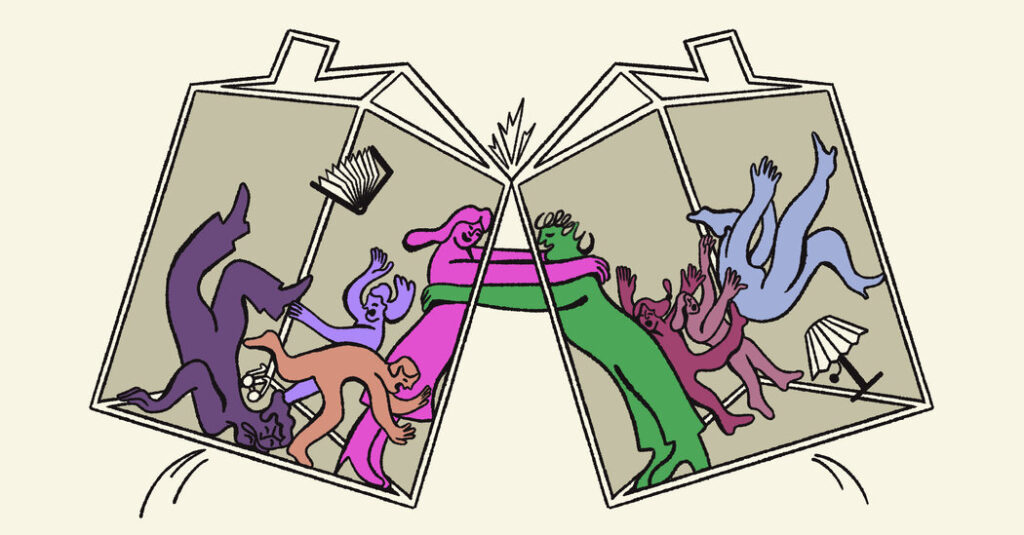
With “Lake Effect,” Sweeney presents another four-sibling novel, albeit with a less predictable family and plot. We meet Clara and Bridie Larkin and Dune and Fern Finnegan — soon to be step-siblings — as teenagers in upper-middle-class Rochester, N.Y., in 1977. The two families are merely neighbors until the Finnegans’ father, Finn, and the Larkins’ mother, Nina, turn their affair into an elopement. The seismic event rocks the small, uptight Catholic community, and the novel takes us through the scandal and its aftermath into the 1990s, when “all the unwilling players” are “summoned to the stage one more time” for another scandalous wedding (and then a birth, and then a death).
Sweeney brings significant psychological acuity to everything from midlife sexuality to adolescent cafeteria drama to postpartum depression. After the elopement legitimizes her relationship with Finn, Nina makes the “ridiculous” yet thoroughly human decision to trek to Buffalo to buy herself lingerie, because “she enjoyed performing deception now that they were safely husband and wife.”
In granting all the major characters a voice, Sweeney makes use of another, broader 21st-century trend: polyphonic sprawl, which favors pluralism over the subjectivism of the 20th century, or the trusting omniscience of the 19th. Rotating narration offers the repeated fun of learning new characters’ secrets — and conflicts seen from multiple sides are more richly engaging. We understand Clara’s heartbreak when Dune ends their teenage romance just as we understand his reasons, reeling from parental betrayal and the idea of Clara as his stepsister. We even sympathize when the adult Bridie finds falling in love with Dune “maybe the only easy thing in her life.”
But in this narrative juggling act, balls get dropped. Strange elisions mar the otherwise deft psychology: Clara defers her acceptance to Cornell to care for her sister in a now motherless home. Yet the following fall, when Bridie starts her freshman year there, Sweeney offers no good explanation for why Clara doesn’t also enroll, instead moving to Manhattan. In the 1980s, the girls’ father, Sam, moves to San Francisco and struggles to come out to his daughters until Clara warns him about AIDS, signaling that she already knows he is gay. While his perspective has been steadily mined in early chapters, here he barely reacts.
Similar lapses pepper the plot. In the prologue, Nina’s neighbor Bess purchases seven copies of “The Joy of Sex,” gives one away to the bashful store clerk and arrives at her book club with seven copies. Despite spending “weddings, funerals, church functions, holidays” in the same spaces and sharing parents, the two pairs of adult siblings know shockingly little about one another’s lives.
Characters we’ve invested in disappear from the text. After stealing the book’s first scenes, the divorced and outspoken Bess vanishes until we learn in passing, at the end, that she was the only one to stand by Nina after the elopement — something we never saw. And after that AIDS conversation, Sam returns to Rochester and, aside from a fleeting mention of him standing “slightly apart” at his daughter’s wedding, evaporates from the last 75 pages. He’s not even mentioned when his granddaughter is born, as if queerness were its own ending, rendering him irrelevant to family dynamics. He’s a particularly unfortunate victim of the narrative’s divided attentions; raising the specter of AIDS only to walk away feels uncomfortably parallel to society’s disregard for those affected by the epidemic.
Perhaps omissions of such weighty material help “Lake Effect” go down easier. Some readers will wish for more friction, or to follow wilder minor characters (Bess, or Finn’s wunderkind employee, or Clara’s drama teacher’s yogi girlfriend) onto stranger paths. But they’ll find what’s here quite palatable, in more ways than one. With multiple grocers, a food columnist and a food stylist among the main characters, the novel seems almost intentionally packed with food that book clubs can crib for themed menus. And 1970s and Rochester shibboleths — Weight Watchers and Jean Naté on one hand, half-moon cookies and the Xerox Corporation on the other — hit hard.
Why not indulge? Whatever strange part of the American psyche so yearns for a four-sibling détente might not be nourished, but it will be satisfied.
LAKE EFFECT | By Cynthia D’Aprix Sweeney | Ecco | 273 pp. | $30
The post This Big, Juicy Drama Gives ‘Blended Family’ a New Meaning appeared first on New York Times.