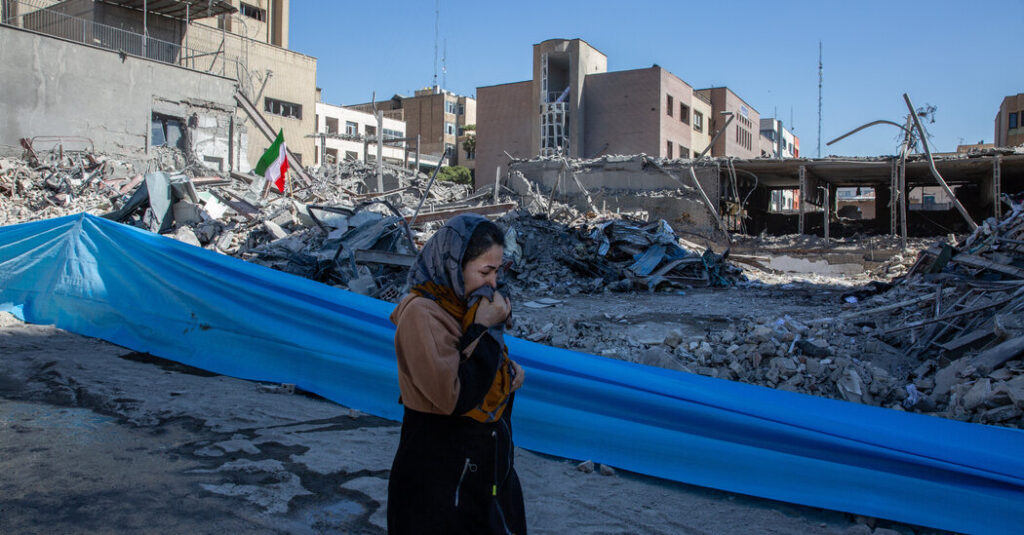
Just three days after the fourth anniversary of Russia’s invasion of Ukraine last week, America and Israel began dropping bombs on Iran. It was the start of another military conflict that threatens to undermine global stability, drive up energy prices and rattle financial markets around the world.
In places as far from the Middle East as Japan, Canada and Britain, the newest war is unnerving governments that were already reeling from economic turmoil over tariffs, wars in Ukraine, and Gaza, President Trump’s Greenland threats, and the American capture of Venezuela’s leader.
With Iran retaliating by launching missiles and drones at Gulf nations, Cyprus, Lebanon and beyond, the conflict is testing the ability of countries around the world to shape their own destinies — and prompting strikingly different political responses.
The head of Spain’s government condemned the attacks on Iran as “an escalation,” while Canada’s prime minister and Germany’s chancellor both explicitly backed Mr. Trump’s decision to go to war with Iran.
At a meeting with German Chancellor Friedrich Merz in the White House on Tuesday, Mr. Trump lashed out at Spanish Prime Minister Pedro Sánchez for denouncing the attacks.
“We’re going to cut off all trade with Spain,” the president told reporters. “We don’t want anything to do with Spain.”
The leaders of Britain, France and the European Union have sought to avoid clashes with the White House, issuing carefully worded statements denouncing Iran’s retaliation while not fully embracing the American-led offensive.
In the meeting with Mr. Trump, Mr. Merz also criticized Spain for not spending more on Europe’s defense, saying that other nations are “trying to convince them that this is part of our common security.” Mr. Merz also said the Iran strikes were “of course, damaging our economies,” adding “that’s the reason why we all hope that this war will come to an end as soon as possible.”
For years, those same leaders have called Russia’s aggression against Ukraine an assault on the global, rules-based order. Now, they are scrambling to understand how to maneuver in the wake of an American war with Iran that was launched while diplomatic talks were still underway and without congressional approval.
In a speech to Parliament on Monday, Prime Minister Keir Starmer of Britain tried to explain his refusal to join the United States and Israel in their attacks on Iran by vowing never to order British forces into war without clear legal authority to do so. But he also warned that there would be consequences regardless of Britain’s role in the conflict.
“I’ve spoken recently about the toll that global events are taking here at home, the compression into our lives with ever greater frequency, hitting our economy, driving up prices on the supermarket shelves or at the pump, dividing communities, bringing anxiety and fear,” he said.
He added that Britain had learned lessons from its full-throated support of America’s 2003 invasion of Iraq, which many people in the country later came to regret.
“Any U.K. actions must always have a lawful basis and a viable, thought-through plan,” Mr. Starmer said. “I say again, we were not involved in the initial strikes on Iran, and we will not join offensive action now.”
Similar calculations are taking place across the world, as leaders seek to navigate the tricky politics of the war, the risk of angering Mr. Trump and the devastating effects that another long-running conflict could have for their countries.
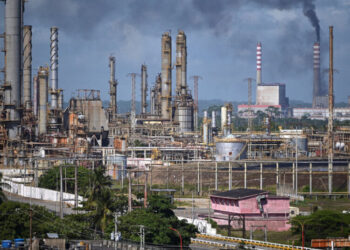
Prices for oil and natural gas have surged amid production halts and disruptions in the Strait of Hormuz. Hundreds of thousands of European vacationers and overseas employees remain in Middle East countries, trapped for the moment as much of the air travel through the region is suspended. The threat of terrorist acts as retaliation for the attack on Iran has increased, with investigators in the United States examining possible links to a deadly shooting in Texas. And experts have warned of a new wave of refugees from Iran and the broader region if the conflict is protracted.
“From energy to nuclear, from transport to migration to security, we must be prepared for the fallout from these recent events,” Ursula von der Leyen, the president of the European Commission, said on Monday.
The question for the world’s leaders is what — if anything — they can do to minimize the effects of the new war and Iran’s retaliation.
Iran has responded to the American and Israeli attacks with its own assault on American bases in several Gulf nations, attacks on oil and gas infrastructure in neighboring countries, and an effort to shut the Strait of Hormuz to shipping.
Michael B. Froman, the president of the Council on Foreign Relations, said countries around the world have been affected by the repercussions of Iran’s aggressive behavior since the Islamic revolution that brought the country’s theocratic government into power in 1979.
“They’ve all been subject to the impact of Iranian behavior and support for terrorism and conflict in the Middle East and around the world,” Mr. Froman said. “They all have concerns about a nuclear Iran.”
Many countries have long tried diplomacy to solve those problems. But now, he said, they are “largely bystanders, and have limited influence in the region, and probably limited influence with this administration.”
As middle powers, many countries in Europe, the Americas and Asia do not have the military might to exert much sway over the course of events in the region. They are also squeezed economically between the United States and China, diminishing their ability to make demands.
“The uncomfortable truth is that Europe now risks being perceived not as an underpowered actor, but as a marginal one,” Sharon Pardo, a professor of European studies and international relations at Ben-Gurion University of the Negev, wrote in the Jerusalem Post. “What is clear is that Europe’s long-cherished aspiration to act as a global player in the Middle East now faces its most severe test.”
The Middle East was already a polarizing topic around the world. Many countries have long and complicated histories with the region.
For France, which controlled parts of what is now Lebanon, Syria and Turkey as part of a secret 1916 pact with Britain known as the Sykes-Picot agreement, issues in the Middle East are almost always fraught. In his statement after the United States and Israel started the attack on Iran, President Emmanuel Macron of France was careful in his language.
“From the very first hours,” he wrote, “we took our responsibilities to protect our nationals and our interests, and to stand alongside the countries of the region, and we will continue to do so.”
In Britain, public anger over Prime Minister Tony Blair’s cooperation with President George W. Bush during the Iraq war led to a formal inquiry. In 2016, the panel, named after its chairman, John Chilcot, concluded that Britain, like the United States, had relied on flawed intelligence, had acted militarily before diplomatic options had been exhausted, and had failed to plan adequately for what would happen after the war.
“They are so traumatized by Britain’s military failures — Iraq, Afghanistan, Libya — and the Chilcot inquiry that they fail to see how the use of force could be successful for another state,” Ben Judah, a former senior adviser in the British foreign office, wrote in an opinion piece published Saturday. And he added a reference to the United States: “The superpower we have based our entire security around has become profoundly erratic.”
The question of how to manage Mr. Trump raises the stakes for traditional U.S. allies. Mr. Starmer has tried, with some success, to avoid antagonizing the president in hopes of negotiating better deals on trade and security. But his refusal to applaud the Iran strikes and his determination to carve out a different path is testing their relationship.
“I’m not happy with the U.K.,” Mr. Trump told reporters during the meeting in the Oval Office on Tuesday. “This is not Winston Churchill that we’re dealing with.”
Michael D. Shear is the chief U.K. correspondent for The New York Times, covering British politics and culture and diplomacy around the world.
The post Global Leaders Brace for the Fallout From a Fast Metastasizing War appeared first on New York Times.