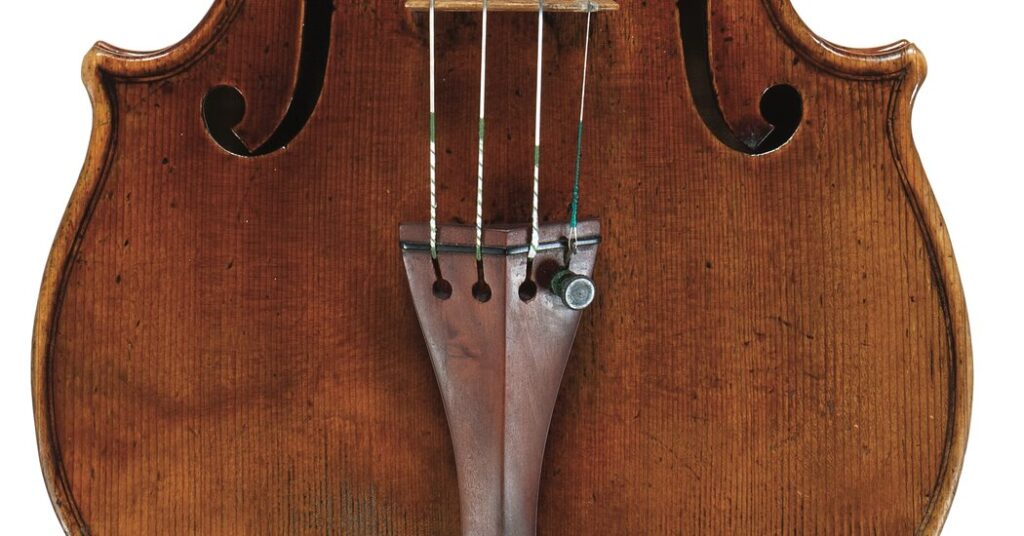
Everyone wants a piece of some of the world’s famous violins. Switzerland, France, Slovenia and other European countries have all claimed that the wood used in the celebrated stringed instruments of Antonio Stradivari came from their forests.
But now, a study of the tree rings in Stradivarius violins, published in January in the journal Dendrochronologia, has revealed the most likely origin of some of the craftsman’s violins: wood from trees growing at high elevation in northern Italy in the same valley that hosted part of the 2026 Winter Olympic Games.
Antonio Stradivari produced over 800 instruments in the 17th and 18th centuries, most of them violins but also cellos, guitars and a harp. A Stradivarius instrument is treasured for many reasons, but most notably its superior sound quality.
“It does everything better,” said Peter Beare, a director of Beare Violins Ltd. in England, a company that restores, sells and authenticates high-end violins.
The wood that goes into making a violin — particularly the front surface, known as the soundboard — is critical. Parameters such as wood density and stiffness all affect how a violin ultimately sounds. “The wood choice is very, very important,” Mr. Beare said.
Stradivari is known to have favored spruce, but where exactly he sourced his wood has long been steeped in mystery. That’s where the study of tree rings — dendrochronology — comes in.
Most trees produce a ring of growth each year, and the widths of those rings depend on environmental conditions. High levels of moisture tend to result in wider rings, for instance. So a sequence of tree rings is like a bar code that records the conditions experienced by a tree year after year.
Tree rings are easily measured on the soundboards of violins. That’s what dendrochronologist and violin maker John Topham did over the course of several decades. Before he died last year, Mr. Topham shared his meticulous measurements from 284 Stradivarius violins with Mauro Bernabei, a dendrochronologist at the Italian National Research Council in San Michele all’Adige. It’s a treasure trove of data, Dr. Bernabei said.
But those tree ring records don’t reveal anything about where Stradivari sourced his wood. To that end, Dr. Bernabei and his colleagues compared the patterns in the violins with tree ring records collected from over 6,000 sites around the world and recorded in the International Tree-Ring Data Bank.
“Each forest or mountain range is going to have a slightly unique pattern of wide and narrow rings over time,” said Chris Guiterman, a dendrochronologist at the University of Colorado who helps to manage the databank and was not involved in the research. “Those peculiarities of those locations help you match up trees from an unknown location.”
It was a challenge to find records stretching back to the time of Stradivari. “It’s not easy to find old wood,” Dr. Bernabei said. Some of the data that the team used came from measurements of wooden beams from castles and churches. There was uncertainty in that process, Dr. Bernabei conceded. “You don’t know if a castle is made from wood from the forest surrounding it.”
Dr. Bernabei and his colleagues grouped together violin records that exhibited similar tree-ring patterns and assembled an average tree-ring sequence for each group. When the team compared those averages with records from the International Tree-Ring Data Bank, they found that a little more than half of the violins in their sample didn’t yield a conclusive match. It’s nearly impossible to say anything about where the wood for those violins came from beyond saying it was probably Italy, Switzerland or Austria, Dr. Bernabei said.
But the average tree-ring sequence for a sizable fraction of the violins in their sample correlated well with tree rings from near Trentino in northern Italy, and specifically the high-altitude reaches of the Val di Fiemme. And interestingly, those violins tended to have been produced during Stradivari’s so-called “Golden Age” from roughly 1700 to 1725, a period noted for particularly high-quality Stradivarius instruments. Perhaps Stradivari produced his best work when he found a source of wood in the Val di Fiemme and stuck with it, Dr. Bernabei said.
That makes sense, said Mr. Beare, who was not involved in the study. But this discovery shouldn’t downplay the genius of Stradivari, he added. It was the craftsman’s skill, coupled with exceptional materials, that allowed Stradivari to produce some of his best pieces, he said. Wood by itself doesn’t guarantee success.
“You can have the best piece of wood, and you can completely mess it up,” Mr. Beare said.
The post Tree Rings Reveal Origins of Some of the World’s Best Violins appeared first on New York Times.