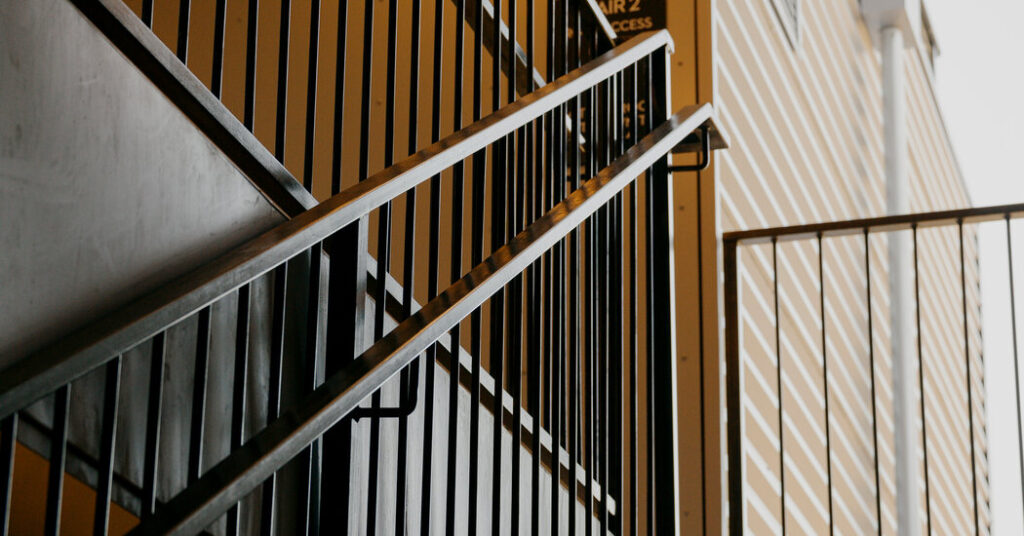
For roughly a century, most apartment buildings in the United States taller than three stories needed to have at least two staircases. It was considered a safety feature, giving people multiple ways out of a building, especially if there was an emergency like a fire.
But since 2024, a number of states have eliminated the requirement for small apartment buildings, a move that proponents say will go a long way to addressing the nation’s billowing housing crisis. Requiring only one staircase, they say, eliminates the need for a second, reduces the space needed for common areas like the hallways between staircases, which allows residential buildings to be on smaller lots, theoretically making them cheaper to develop.
“We’re seeing single-stair buildings on what were otherwise unbuildable small lots,” said Stephen Smith, the executive director of the Center for Building in North America, a research and advocacy group in New York. Allowing more cities to do this will help meet demand for housing, said Mr. Smith, who lives in Brooklyn in a building with one set of stairs.
In the past two years, Colorado, Connecticut, Maine, Montana, New Hampshire, Texas and Tennessee have approved code changes allowing just one stairway. In July, Washington State will join them. And California, Hawaii, New York, Minnesota, Oregon and Virginia are conducting studies exploring the code change.
Proposed building code changes are often met with significant pushback from developers and local residents who worry about everything from higher costs to how faster construction could affect the quality of new buildings and the character of a place. But tweaking the staircase code has prompted scrutiny of graver concerns: potential new safety risks during fires and emergencies.
There are “challenges in firefighter response to a single stair,” said Tom Pitschneider, the fire marshal in Shakopee, a rural town southwest of Minneapolis.
“As we’re going up the same way as the residents are trying to escape, we need working space,” he said. “With a single stair, everybody’s working the same space, so you don’t have a way to take people out.”
Few regulatory systems are as complex as the building codes that govern housing construction in U.S. cities.
These dense, highly prescriptive requirements, meant to improve safety, apply to every feature of new construction — wiring, plumbing, materials, windows, doors, framing, heating, cooling and much more. Architects and developers say the codes are a major factor in rising construction costs that push them to build high-end projects and contribute to the country’s shortage in affordable housing.
“Housing is the largest building sector in the U.S.,” wrote the authors of a report in 2023 by the Joint Center for Housing Studies of Harvard. “Yet it might well be the one that imposes the greatest constraints on design and innovation.”
But facing severe housing supply shortages and affordability challenges in their communities, cities and states across the country have begun to re-examine which rules they want to continue to impose.
Colorado now allows a single staircase in buildings up to five stories in Denver and 10 other cities with more than 100,000 residents. The state’s governor, Jared Polis, said the new building code would “reactivate the urban core.”
“We wanted lower costs, smaller footprints, more natural light,” he said in an interview. “It just allows for much more flexibility.”
In Washington State, single staircases will be allowed in buildings up to six stories. “Single stairway is one significant avenue to promote infill — that’s the motivation,” said State Senator Jesse Salomon, who led the legislative effort to approve single-staircase apartments beyond Seattle. (Seattle, New York and Honolulu are U.S. cities that have for years allowed single staircases on smaller multifamily buildings.)
U.S. codes mandating two staircases in apartments taller than three stories stem from big fires in New York and other cities more than a century ago that killed scores of people. Before that, single staircase apartments were common, especially in the tenement buildings that still exist by the thousands in New York City.
Design features like sprinklers and fireproof materials have made apartment buildings built after World War II safer, said Alex Horowitz, the director of housing policy at the Pew Charitable Trusts.
In a study last year, Pew examined 468 deaths between 2012 and 2024 at apartment buildings in New York City where fires had broken out. Three were in buildings with a single staircase, and the study found that those deaths were not due to fewer available staircases.
Another reason that led the study’s authors to conclude single-stairway buildings are as safe as those with more staircases is that the buildings can be only four to six floors tall, depending on each state’s requirement. The compact design means there are fewer apartments — and fewer people to evacuate in an emergency. And only four apartments are allowed on each floor, so residences in those buildings are closer to a staircase: 20 feet versus up to 250 feet in tall apartment buildings.
“A one-stair building has faster egress times because it has a smaller floor plate,” Mr. Horowitz said. “Everyone is closer to the stair. And there are so many fewer residents to evacuate.”
The safety concerns become more serious in rural areas where fire response times are longer — or in areas that don’t have the fire resources that a big city would have, Chief Pitschneider said.
“The model works in a St. Paul, where they’re running multiple engines and they’re putting 12, 15, 18 firefighters on scene in that first 10 minutes,” he said. “What we’re not comfortable with is that model going to our outstate, smaller cities that are bringing three, four firefighters in that first 10 minutes of the firefight.”
Michael Eliason, an architect and housing researcher, pointed to Seattle’s building code as an example of how complex things have gotten. In 1917, the city’s building code was 216 pages, he said, but “today, it is 990 pages long.”
Seattle was an early adopter of the single staircase, allowing small apartment buildings to have just one starting in 1977. Roughly 60 single-staircase apartment buildings have been built in Seattle since then. But it took nearly 50 years for the state to expand that beyond the city.
“The single stair is really vital to the survival of small developments in cities,” said Carey Moran, who designed a multifamily building in Seattle, called Fremont View, that opened in 2024 with one staircase.
The eight-story building was allowed because it stacked a five-story building on top of a three-story one — all on a tight 9,600-square-foot city lot. It was also approved because it has two exits — one at the front of the building and another at the rear. There are 29 well-lit apartments, from 430-square-foot studios to 923-square-foot two bedrooms, renting between $1,700 and $4,000 a month.
Mr. Eliason, who advocates allowing single-stair construction for small multifamily buildings as a solution to the housing crisis, said he learned how common the design was outside the United States while working in Germany in 2019.
After seeing an 11-story tower his firm at the time had designed, Mr. Eliason recalled, he turned to his boss and said: “Something is wrong here. Where’s your other stair?”
“He’s looking at me, and said: ‘What are you talking about? If there was another stair, there wouldn’t be any room for the homes.’”
The post To Cut Housing Costs, Some States Are Easing Fire Safety Rules appeared first on New York Times.