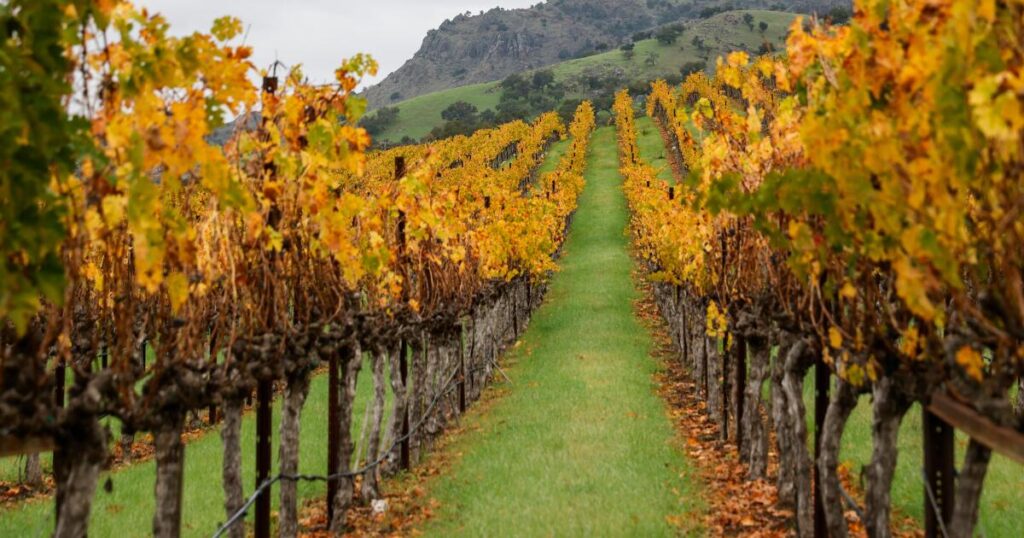
Winery owner Stuart Spencer estimates that he left about 50 tons of grapes to rot on vines in Lodi, Calif., last fall, as harvesting and processing them would cost more than they were worth.
“We’re doing our best to keep our head above water,” said Spencer, the owner of St. Amant Winery and executive director of the Lodi Winegrape Commission.
Spencer blames a mix of factors: weak demand, a worsening grape oversupply crisis and an influx of cheap bulk imports flooding the market and collapsing California bulk wine prices. Tariffs have increased the costs of labels, capsules and corks and triggered a backlash from the biggest international consumer of Californian wines, Canada.
Wineries of all sizes across California have started laying off workers and shutting down production facilities to cut costs.
“People [are] having to face their balance sheet,” said wine industry consultant Dale Stratton, who spent more than 30 years in leadership roles across Gallo Wines and Constellation Brands. The two companies — among the largest U.S. wine producers — have announced sweeping layoffs recently.
At the heart of the wine industry’s crisis is a basic supply and demand problem: too many grapes and not enough buyers.
Consumer demand is shrinking because boomers — the industry’s biggest fans — are aging out of the wine market. Younger generations drink less alcohol in general and are less likely to choose wine. The wine industry has lost drinkers to premium beers and spirits.
California wine giant Gallo, the maker of Barefoot wines and the largest supplier of wine in the U.S., notified the state last month that its plans to lay off 93 people and close a facility in St. Helena. The same day, Santa Rosa-based Jackson Family Wines, best known for its Kendall-Jackson Chardonnay, notified the state that it would close its Carneros Hills Winery in April and lay off 13 workers.
Alcoholic beverage behemoth Constellation Brands on Feb. 3 notified the state of plans to lay off 212 workers at its Mission Bell Winery in Madera. The publicly traded company, which owns Robert Mondavi wines and Modelo and Corona beers, has set a goal of $200 million in cost savings by 2028 and is shifting away from wine to focus more on its growing beer business, its financial filings show. Santa Rosa-headquartered Foley Family Wines & Spirits has also wound down operations at its Chalone Vineyard in Monterey and laid off the entire winemaking staff at Chalone, though it plans to keep producing the Chalone label wine enjoyed by Julia Child, the San Francisco Chronicle reported.
It’s harder to keep track of layoffs at small wineries. California law requires companies with more than 75 employees to give notice of impending layoffs. But small wineries are subject to the same economic pressures.
“We have had to let go more than a dozen people and removed hundreds of acres of vineyards,” one Paso Robles winery said in a new report on U.S. wine exports from the Wine Institute, a trade group. “What concerns us most is the uncertainty.”
Winemaking in California traces its roots to the days of the Spanish missions, when Father Junípero Serra cultivated European grapes for Communion and barter at Mission San Juan Capistrano.
As the mission system was dismantled in the 1830s, European immigrants purchased swaths of land across the state — starting in Southern California — and began producing wine commercially. The state’s wine business prospered during the Gold Rush, which brought an influx of drinking men.
In 1920, Prohibition imposed a nationwide ban on producing, transporting and selling alcoholic beverages and decimated the American wine industry. A few wineries, including San Antonio Winery in Los Angeles, survived Prohibition by producing sacramental wines for the Catholic Church.
California’s wine industry, which was rebuilt in the aftermath of World War II, shot to global prominence after the “Judgment of Paris” tasting in 1976, where French experts in a blind tasting ranked California wines above prestigious French bottles.
In the decades that followed, California wines saw tremendous growth due to the efforts of influential vintners such as Robert Mondavi, whose marketing savvy helped turn wine into a dinnertime staple across America.
Even as consumer demand began to plateau in 2017, wineries stayed in expansion mode, planting more vineyards and adding facilities. The pandemic played a role in warping the wine industry’s demand expectations, according to Danny Brager, a beverage alcohol industry expert and former senior vice president of market research firm Nielsen’s beverage alcohol practice.
With people staying home instead of spending on luxuries such as concerts and travel, alcohol sales went up for about two years, Brager said.
The uptick didn’t last.
Since last year, vintners that depend on exports, stuck in the middle of President Trump’s trade war, have found themselves the target of a Canadian boycott of American alcohol.
The boycott, a response to tariffs imposed on Canadian goods by Trump, has dealt a blow to California’s wine industry.
The Wine Institute, which represents California wineries, said in a recent report that U.S. wine exports totaled $805 million in 2025, down 35% from 2024.
Boycotts imposed by several Canadian provinces since last March have “erased” roughly $360 million in revenue that the U.S. wine industry would have otherwise earned, according to the report.
“Family wine companies are fighting to survive — this is not hyperbole,” one Lodi winery said in the report.
The Wine Institute has called on Canada to end the boycotts, contending that they have forced U.S. wine companies to lay off Canadian sales reps and other employees while depriving the Canadian government of millions in tax revenue.
“It’s time for all involved to make resolving this issue a priority before more businesses are permanently harmed,” Wine Institute Chief Executive Steve Gross said in the report.
Wineries have found a sympathetic ear in Rep. Mike Thompson (D-St. Helena), who in December introduced a bill that would use taxpayer dollars to reimburse American wine producers for the money they have lost because of tariffs. The Specialty Crop and Wine Producer Tariff Relief Act has bipartisan support but faces a steep climb.
“California’s agricultural and wine community are cornerstones of our local economies, from family farms to world-class producers,” Thompson said in a statement in December. “Ensuring they can weather sudden tariff hikes isn’t just an economic necessity, it’s a commitment to protecting the livelihoods that make our district and community special.”
One big contributor to the grape oversupply crisis is that large winemakers are increasingly opting to import cheaper foreign bulk wines from Chile and Australia and blend them with American wines. (Blends that contain up to 25% foreign wine can still be marketed as “American” wines.)
The practice has hurt small California wineries, which used to rely on bulk sales to move excess wine.
While Lodi winery owner Spencer has managed to avoid layoffs, many independent grape growers, including those in Lodi, haven’t been as fortunate, shedding farmworkers and managers.
“Everybody is being very cautious right now and under-processing with the expectation of not knowing where the market is going to be,” Spencer said.
That cautiousness was ultimately what led him to make a tough decision to harvest fewer wine grapes than usual. Last fall, he opted to leave tons of grapes to rot on the vine.
Not all wineries are feeling the crush evenly. In fact, some are thriving, said Andrew Jones, the founder of Field Recordings, a small winery in Paso Robles that registered strong growth in revenue last year.
“I like where we’re at in the market right now,” Jones said.
Jones believes its small size — 14 employees with an average age of 29 — has helped it stay nimble as big names in the wine industry try to weather the storm. His winery grows about 10% of the grapes it crushes and buys the remainder.
His main demographic is young professionals ages 21 to 50. Jones said his customers prefer acid-driven white wines and chillable, lower-alcohol red wines, perhaps because they grew up in the “sour candy generation,” unlike baby boomers and Gen Xers, who grew up eating chocolate and have a different palate.
Jones also sees an opportunity to sell more bag-in-box wines — cartons containing 3 liters of wine meant to be stored in the fridge once opened. Because they are lightweight, they end up being much cheaper to ship than glass bottles, he said.
“There’s a ton of opportunity out there,” Jones said. “There’s still a lot of younger wine drinkers out there that want to drink cool, younger, fresher wines.”
The post Why California’s wine industry is being crushed appeared first on Los Angeles Times.