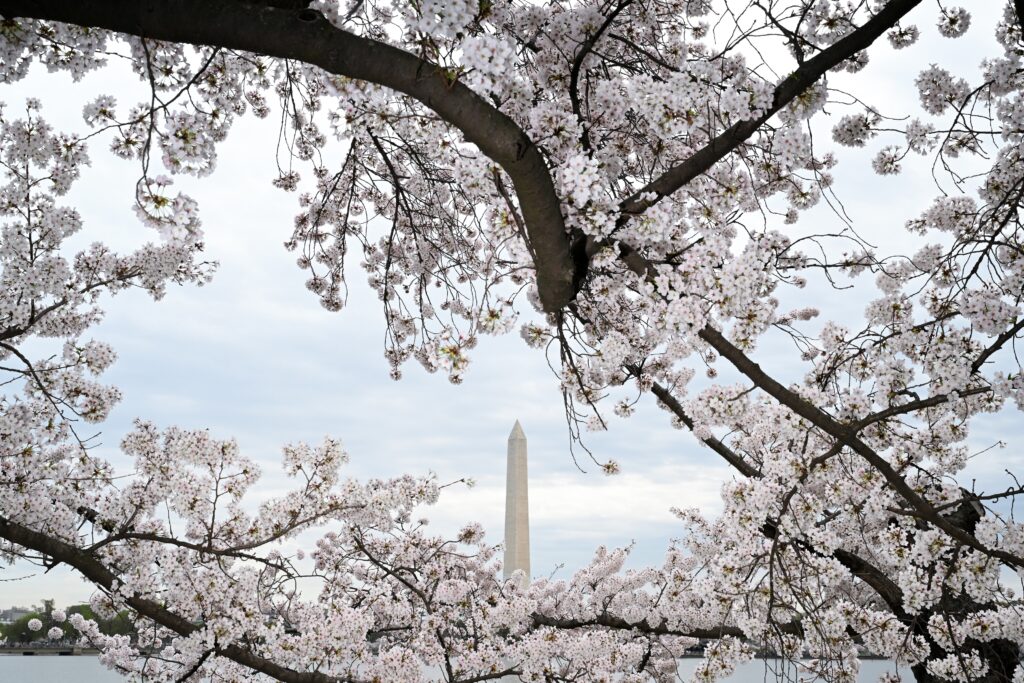
The famed cherry blossoms in D.C. are likely to take their time this year, following the chilliest winter in more than two decades. As March begins — after three-straight months that all ended colder than normal — the trees’ buds are only showing the slightest signs of emerging.
Abnormally warm weather in the coming week should jump-start development, with green buds beginning to pop. But cooler-than-expected conditions in mid-March may slow the cherry trees’ progression through the five bud stages before peak bloom.
We’re predicting a peak bloom date for the Tidal Basin’s Yoshino trees between April 3 and 7, which would be the latest since 2018 (April 5). If the trees peak even later, that could surpass 2015 (April 10).
Last year, the peak bloom occurred on March 28.
Over the past century, the blossoms’ average peak has shifted about a week earlier — from April 4 to March 29 — a change linked to human-caused climate warming. Each of the past six years has seen peak bloom occur before March 29.
Since records began in 1921, the earliest peak bloom was March 15 (1990), while the latest was April 18 (1958).
Our projected peak bloom window coincides with the National Cherry Blossom Festival, which runs from March 20 to April 12.
Forecast rationale
March temperatures are the biggest driver of our forecast for the peak bloom date, as they have historically been the best indicator. When it’s warmer than average in March, the blossoms tend to peak in late March; when it’s on the chilly side, they tend to flower in early April.
With unusually warm weather expected over the next week, we anticipate March will finish about 3 degrees above normal. In most years, that would suggest a late-March peak. But this year is different.
The notably cold winter delayed bud development and set the bloom process back. By this point in some years, trees would have reached the first stage — green buds. This year, only the indicator tree — which typically runs about seven to 10 days ahead of the others — shows even a hint of green at the tips, according to Leslie Frattaroli, a program manager at the National Park Service. That suggests development is running at least a week behind schedule.
The upcoming warmth should jump-start the process, but it may not accelerate it for long. A disruption of the polar vortex is expected to usher in a cooler pattern in mid-March that could persist into early April. While forecasting temperatures more than two weeks out carries uncertainty, there is little indication that the progression toward peak bloom will be rapid.
Average highs rise from the 50s into the 60s by early April — warm enough to advance bud development, even if temperatures run a bit below normal. Still, the most likely outcome is a slow and steady march toward bloom.
How the forecast could go wrong
If the cooler pattern expected by mid-March fails to materialize and the second half of the month turns much warmer than normal, peak bloom could occur in late March instead of early April.
Conversely, if next week’s conditions prove less warm than anticipated, and mid-month cooling is more pronounced or prolonged, peak bloom could slip into the second week of April.
Sunshine is another wild card. Cloudy days would slow the buds’ progression through their stages. But abundant sun — even with slightly cooler temperatures — can accelerate development, especially if nighttime lows do not dip too sharply.
Given the delayed start to the bloom process this year, if our forecast is off, it is more likely that peak bloom will occur later than our projected window rather than earlier.
Here are the odds of alternative peak bloom windows:
- Peak bloom before March 31: 10 percent.
- Peak bloom March 31 to April 3: 15 percent.
- Peak bloom April 8 to 12: 20 percent.
- Peak bloom after April 12: 10 percent.
How have our forecasts done historically?
Forecasting peak bloom is challenging, especially in springs with sharp temperature swings. Looking back at forecasts issued since 2012, Capital Weather Gang’s predicted 5-day window has, on average, come within about two days of the actual bloom date. The National Park Service, which also makes forecasts, has come within four to five days, on average.
Both groups have had exact calls in several years, and they’ve navigated unusually difficult seasons. Impressively, the Park Service forecast has hit the peak bloom window in two of the past three years.
The post It’s been so cold that cherry blossom peak may push to latest date in years appeared first on Washington Post.