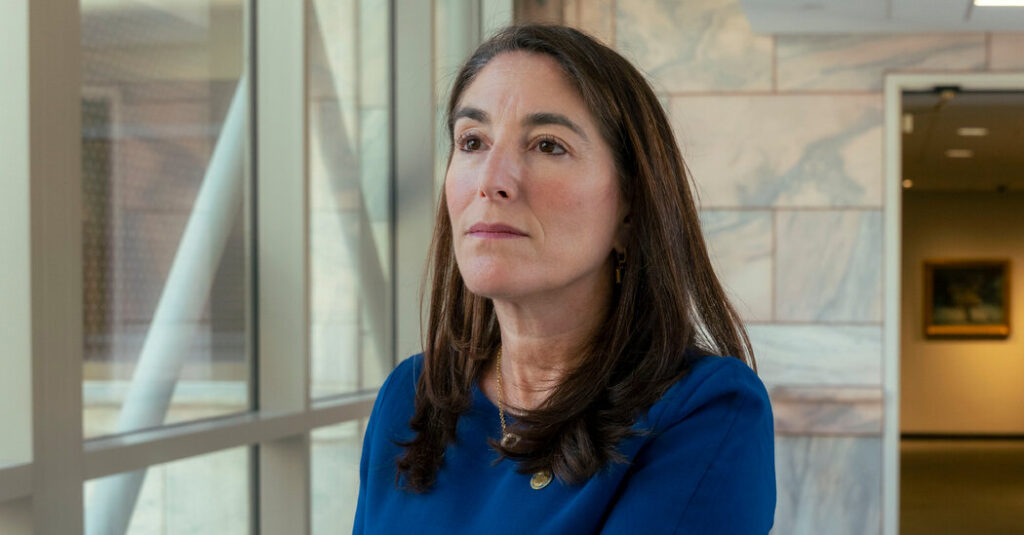
Long before the United States and Israel attacked Iran and energy prices soared, Beth M. Hammack, president of the Federal Reserve Bank of Cleveland, harbored concerns about inflation.
For roughly five years, the Fed has exceeded its 2 percent target for annual inflation. In the past 12 months, it has made little progress in closing the gap as President Trump’s sweeping tariffs reshuffled global trade.
And the labor market, once shaky, has shown signs of stabilizing, fortifying Ms. Hammack’s view that the Fed need not rush to lower rates again after three quarter-point reductions last year.
The escalating conflict in the Middle East represents a new inflationary risk that Ms. Hammack is watching closely, she said in an interview. Higher energy prices could translate to a more persistent inflation problem for the Fed, but at the same time dent consumer demand, although it is far too early to know what the overall economic impact will be, she said.
The Fed, which is widely expected to hold rates steady at its next meeting on March 17-18, has typically avoided responding to supply shocks for this reason. Raising rates to choke off a potentially temporary burst of inflation could lead the Fed to cause unintended economic damage. Even in the midst of acute supply disruptions caused by Mr. Trump’s tariffs, the central bank lowered rates three times in the latter half of last year to a range of 3.5 to 3.75 percent.
Ms. Hammack, who is a voting member of the Fed’s rate-setting committee this year, was skeptical of those cuts at the time, and she appears even more hesitant now to provide further relief to borrowers, suggesting she will remain a vocal detractor if aggressive reductions are pursued this year by Kevin M. Warsh, Mr. Trump’s pick to lead the central bank.
“We’re in a good spot from a policy perspective,” Ms. Hammack said. “I think we could be on hold for quite some time.”
Ms. Hammack considers the Fed’s policy settings to be at “neutral,” meaning rates are neither stoking consumer demand nor restraining it. With inflation too high and the labor market relatively steady, the central bank should keep its focus trained on stamping out price pressures, she said.
“It’s important to make sure that we’re maintaining policy at a level where we can drive inflation back down to target while balancing any potential softness in the labor market,” she said. That may include the Fed’s eventually entertaining rate increases, something that would no doubt anger Mr. Trump, who wants significantly lower interest rates.
“There are two-sided risk to rates,” Ms. Hammack said. “If we see more weakness emerging in the labor market, it could mean that we need to provide more accommodation. If we don’t see inflation moving toward target as I expect, it could mean that we need to put more restriction on the economy.”
Rate Cut Reluctance
Four months into her tenure as president of the Cleveland Fed, Ms. Hammack demonstrated that she would not be swayed into supporting a policy decision she fundamentally opposed.
She broke with the rest of the policy-setting committee and voted against its decision at the December 2024 meeting to lower rates by a quarter of a percentage point, citing economic resilience and worries about elevated inflation.
Dissents were fairly uncommon then, reflecting the ability of Jerome H. Powell, the Fed’s chair since 2018, to forge consensus even amid thorny of economic challenges.
Dissents have become much more frequent as officials have confronted seismic policy changes since Mr. Trump returned to the White House. Tariffs raised the prospects of higher inflation and slower growth, pitting the Fed’s two goals of low, stable consumer price growth and a healthy labor market against each other. That led to varying appetites among officials for rate cuts and more splintered votes.
The divisions could grow sharper, depending on the policies Mr. Warsh pursues when he takes over from Mr. Powell after his term as chair ends on May 15. Mr. Trump vowed to pick a chair who would support substantially lower rates. Mr. Warsh is likely to face pushback, however, if he accedes to those demands and the economic data does not call for that.
Mr. Warsh, if confirmed by the Senate, will be just one vote on the policy-setting committee, albeit with significant influence over the debate in the room. Rate decisions are voted on by all seven Fed governors, the president of the New York Fed and a rotating set of four regional presidents.
“That person will have to convince at least six other members of the committee to vote alongside them if they want to do something,” Ms. Hammack, 54, said.
One argument backed by Mr. Warsh is that the Fed has room to cut rates this year without worrying about stoking inflation because of productivity gains tied to artificial intelligence.
Ms. Hammack said it was too early to tell what A.I.’s economic impact would be and seemed wary about hinging rate decisions on forecasts. Instead, she stressed the importance of clear signs that inflation is retreating before supporting cuts.
“I want to see evidence that we are making progress on the inflation side of our mandate to have more confidence in my forecast,” Ms. Hammack said. She said she expected inflation to ease gradually over the summer but remain above target beyond the end of the year. “I take comfort from the fact that inflation expectations have not picked up materially, but I don’t take that for granted.”
In December, the Fed’s preferred inflation gauge, the Personal Consumption Expenditures price index, stood at 2.9 percent. Ms. Hammack described recent spending patterns as robust and said there was some room for the unemployment rate to fall from 4.3 percent currently. A strengthening labor market, however, would not prompt her to consider a rate increase. That would hinge on the trajectory for inflation, she said.
Shrinking the Balance Sheet
Mr. Warsh has also tied rate cuts to a plan to shrink the Fed’s footprint in financial markets and the size of its $6.5 trillion balance sheet. Ms. Hammack recommended proceeding with caution.
“We need to be very thoughtful. We need to be methodical. We need to signal to the public what it is that we’re doing, where we think we’re headed and why,” she said.
Before joining the Fed, Ms. Hammack spent three decades at Goldman Sachs working in financial markets that are intimately tied to the Fed’s policy actions. She served as the bank’s global treasurer, with authority over its roughly $1 trillion balance sheet.
Ms. Hammack attributed her interest in joining the Fed to a 2019 episode in which short-term funding markets seized up after the Fed accidentally caused a cash crunch by excessively shrinking the size of its balance sheet. The central bank responded by injecting billions of dollars back into the financial system.
The Fed’s balance sheet ballooned to almost $9 trillion during the pandemic as it bought up government bonds and other securities to stave off economic collapse. It began again shrinking the balance sheet in 2022 up until December, after another flare-up in short-term funding markets. In January, the Fed began buying short-dated government bonds, which mature in a year or less.
Shrinking the balance sheet significantly would take a “major change in the regulatory environment” to alter banks’ behavior and reduce the cash deposits they hold at the central bank, Ms. Hammack said. In what could be a first step, Scott Bessent, the Treasury secretary, and Michelle W. Bowman, the Fed’s vice chair for supervision, on Tuesday proposed changes to how much cash banks need to hold to fulfill liquidity requirements.
Mr. Warsh has called for closer coordination between Treasury and the Fed regarding the balance sheet, although he has spoken about the importance of the central bank’s maintaining its policy independence. Ms. Hammack, who led a top Treasury advisory board while working at Goldman Sachs, echoed that need, saying it was crucially important for the Fed to operate with that autonomy when there are “clear attempts to compromise Fed independence.”
The Justice Department initiated a criminal inquiry this year into Mr. Powell and his handling of costly renovations underway at the Fed’s headquarters in Washington. Mr. Powell confronted the president in an extraordinary video message for using a criminal investigate to coerce the Fed into cutting rates. Mr. Trump has also tried to remove Lisa D. Cook, a Fed governor, although several Supreme Court justices signaled unease at the move in recent oral arguments.
Ms. Hammack said this backdrop made it all the more important that the Fed maintains credibility with Americans, and warned that longer-term borrowing costs could spike if investors began to question the central bank’s motives.
“If we’re lowering rates into a world where there’s more persistent inflation, then inflation expectations are going to go up, investors are going to demand more compensation, and yields are going to go up in the back end of the curve,” she said.
Colby Smith covers the Federal Reserve and the U.S. economy for The Times.
The post Top Fed Official, Wary of Inflation, Calls for Extended Rate Pause appeared first on New York Times.