When Jonathan Anderson, the creative director of Dior, first announced that the inspiration for his fall show was the Tuileries, that elaborately manicured slice of garden in central Paris that stretches from the Louvre to the Place de la Concorde, my first thought was “Where is Miranda Priestley when you need her?”
I mean, Dior holds its ready-to-wear shows there twice a year. To paraphrase Ms. Priestley: the Tuileries for Dior? Groundbreaking.
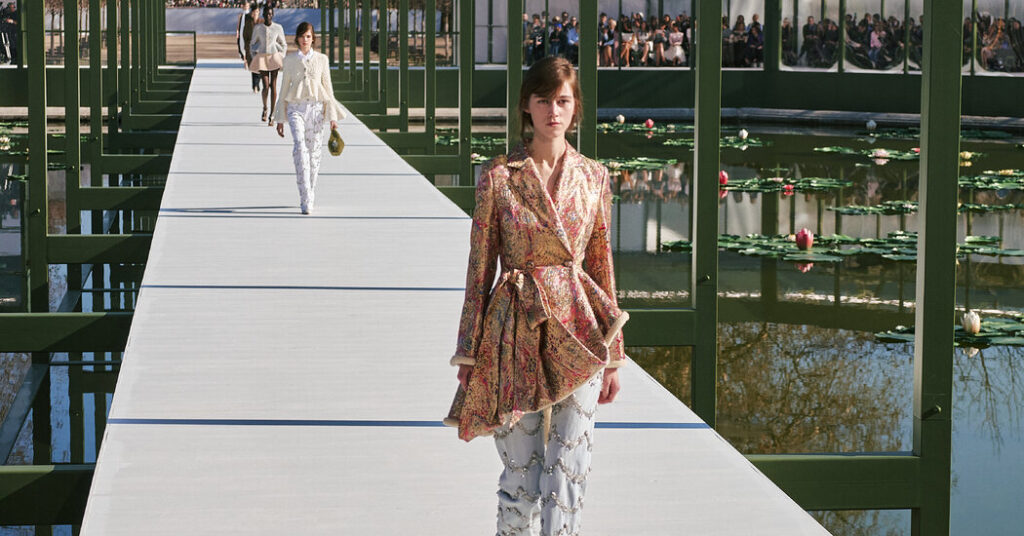
But it was. Not because of the flowers, though there were some (water lilies, which aren’t in the park at all except in the form of Monet’s “Water Lilies” in the Musée de l’Orangerie). But because what the park represents is also what, it turns out, Mr. Anderson is doing at Dior: taking a haven originally created as a private playground for the aristocracy and throwing it open to the public.
Or, in fashion terms, taking down the Bar.
In his hand that jacket, the staple piece of Dior New Look iconography, with its nipped-in waist and flaring hips, has been transformed: twisted, tweaked and otherwise subverted. The Bar — or Bar-ish — shape showed up as a stretchy pastel cardigan, with fluted sleeves and flippy peplum. It came shrunken and layered over its own embroidered mini-crinis, frothing out over the waist. It came as a frock coat, with ripples of fabric down the front. It came in baroque silks, and in soft knits with a pop of feathers on the sides.
And most of the time, it came over jeans. Sure they might have had bejeweled silvery embroidery, but they were jeans nonetheless. It set the tone of the collection, and continued in terrific coats that were hybrids of the bathrobe and the tuxedo and in trompe l’oeil Donegal tweeds that were actually airy jersey, draped into coatdresses that looked sort of like they had been tucked up on one side. A black knit halter dress dangling an array of knotted streamers was a little flapper, a little funky. Even the bags, in knits and shaved shearling, were soft.
In the past, Mr. Anderson has had a tendency to become enchanted by his own conceptualizing and overcomplicate his clothes. That’s partly why they haven’t worked very well on the red carpet thus far; they can look more like experiments in dresses than actual dresses.
There was some of that here, notably in the tutu-like minis with scalloped edges and a trailing squiggle of fabric at the back that were derivations of Christian Dior’s 1949 Junon dress but mostly made the women look like they had a vestigial tail. Or the lace dresses with giant ribbon candy peplums around the hips that seemed designed to double as very deep pockets. But five seasons in, thankfully, Mr. Anderson has stopped trying so hard.
Designers have talked a lot about lightening up this season — Louise Trotter spoke of it backstage at Bottega Veneta; Demna did at Gucci — but Mr. Anderson is the first to really understand that the idea has less to do with the weight of the fabric than the weight of the world.
By shrugging it off at a time when luxury and all its trappings seem less and less relevant to anyone outside the 1 percent, at a time when many runway brands seem increasingly intended only for an elite doing who knows what behind closed doors, he offered a viable proposition for how people might want to dress now. In that sense, it’s a whole lot easier to afford what he is selling (even if, like most, you can’t afford the clothes themselves).
It’s also why Anthony Vaccarello’s Saint Laurent seemed so stuck. Like Dior, Saint Laurent has a foundational jacket (or, to be exact, a suit): Le Smoking, or the tuxedo. This year is Le Smoking’s 60th anniversary, so Mr. Vaccarello was, understandably, celebrating it, in iteration after iteration — one-buttoned, two-buttoned, double-breasted, the lightest pinstripe — though always with a big, sloping shoulder and wide lapels, the jackets stretched to mid-thigh.
Amid the tuxedos came tiny transparent lace cocktail looks in fireside tones that had been coated in silicone for some slithery shine, as well as some enormous shearling jackets made to look like fox fur with rhinestone buckles at the thigh, and a pair of black lace ball gowns complete with panniers. So far, so drape-me-across-the-lounge-chairs-of-a-private-jet, baby. But somewhere along the way, the original spirit of Le Smoking was lost.
Once upon a time, it was both revolutionary and liberating. A woman in a man’s tux! Sacré bleu! Now it just looked — well, rich.
Mr. Vaccarello set his collection in a glass box with wood-paneled interior walls, a cognac-colored carpet and leather banquettes meant to represent a “modernist” residence, according to the show notes. Outside, the Eiffel Tower twinkled and crowds stood behind barricades, trying to peer in.
Vanessa Friedman has been the fashion director and chief fashion critic for The Times since 2014.
The post Finally, Clothes that Make Light of Luxury appeared first on New York Times.