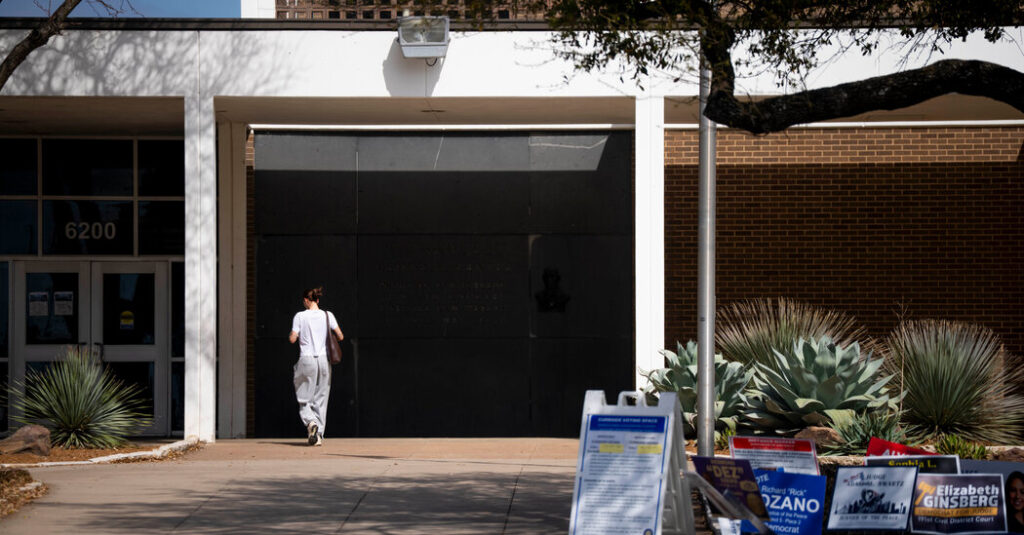
The process of tallying primary ballots in Texas’ second-most-populous county was thrown into uncertainty on Tuesday evening when the State Supreme Court temporarily blocked an earlier court ruling allowing voters more time to cast ballots.
Earlier in the day, a district judge had ordered Dallas County to keep its polling places open to Democrats for an additional two hours, until 9 p.m. local time, over concerns that a rule change about where to vote had caused “mass confusion” among voters weighing in on consequential House and Senate contests.
But the Texas Supreme Court, in a ruling just before 8:30 p.m. local time, said that “votes cast by voters who were not in line to vote at 7 p.m. should be separated.” Paul Adams, the Dallas County election administrator, confirmed that the votes would not be counted, and instead segregated the ballots pending further legal challenges.
He said that ballots from those who got in line after 7 p.m. were cast as provisional ballots. Election officials are trained to mark the last person in line at 7 p.m. in any election, Mr. Adams said, and typically an election worker goes out around that time to see where the line ends.
The challenge to the lower court’s ruling came from the office of Ken Paxton, the hard-line state attorney general who is running against Senator John Cornyn in a bitter Republican primary.
“We have a duty to make sure the law is followed in Texas,” said Brent Webster, the first assistant attorney general to Mr. Paxton, adding that it was his name rather than Mr. Paxton’s name on the filing “so that there’s no appearance of impropriety.”
At stake is a competitive Democratic primary in the race for Mr. Cornyn’s seat.
U.S. Representative Jasmine Crockett, battling James Talarico, a state representative, in the Democratic primary, told supporters at her watch party in Dallas that she had “no idea how it is that clerks are going to know who was in line by what time.”
“I can tell you now that people have been disenfranchised,” she added.
Ms. Crockett, who was counting on a strong showing in her base of Dallas as Mr. Talarico put up impressive numbers elsewhere in the state, added that she did not expect a winner to be declared on Tuesday because of the confusion.
“Unfortunately, this is what Republicans like to do, and so they specifically targeted Dallas County, and I think we all know why,” she said.
On the Republican side, Mr. Cornyn was forced into a runoff against Mr. Paxton that will be held on May 26.
The disarray began early in the day, when election officials said that “quite a few people” showed up at the wrong polling locations in Dallas County and had to be redirected. The confusion stemmed from a rule change in the county several weeks ago, after the local Republican Party opted out of an agreement dating to 2019 that had allowed voters to cast their ballots at any voting center in the county.
The change meant that voters had specific assigned precincts on Election Day, but some were not aware of the switch. A similar issue occurred in Williamson County, near Austin, according to election officials.
Both Ms. Crockett and Mr. Talarico complained, and the Dallas County Democratic Party petitioned for extra time for voters in the region.
On Tuesday night, Kardal Coleman, the local Democratic Party chair who had filed the lawsuit, said the party was “assessing all options and consulting counsel.”
Tim Balk contributed reporting.
Kellen Browning is a Times political reporter based in San Francisco.
The post Court Rulings Throw Dallas County Vote Tally Into Uncertainty appeared first on New York Times.