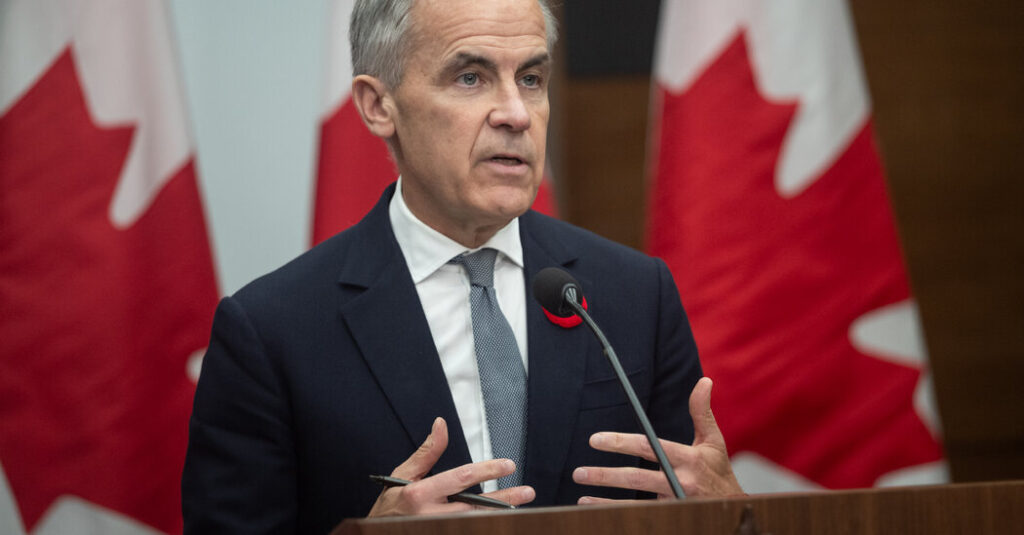
When Prime Minister Mark Carney of Canada met with reporters for the first time since the start of airstrikes against Iran, he swiftly qualified the statement of support he gave in the immediate aftermath and called for a de-escalation of the conflict.
He said that Canada’s support for the military action comes “with regret, because the current conflict is another example of the failure of the international order.”
Speaking on Wednesday in Sydney, where he is on an official visit, Mr. Carney said Iran had persisted in its nuclear ambitions in defiance of years of diplomatic efforts. But he also criticized the United States and Israel, which “have acted without engaging the United Nations or consulting with allies, including Canada.”
He also made the conflict another case for his call to “middle powers” to strike new alliances.
While Canada has long called for change in Iran and ended diplomatic relations with the country in 2012, Mr. Carney’s support for the attack was criticized by some Canadians as inconsistent with Canada’s support of international law and with Mr. Carney’s call during a speech in Davos, Switzerland, for “middle power” nations to no longer “go along to get along” with the United States.
A poll released on Tuesday in Canada found that nearly half of Canadians oppose the attacks on Iran.
On Wednesday, Mr. Carney emphasized that the Canadian government’s official support was based on the threat posed by Iran’s nuclear program and its human rights record, not on any desire to placate President Trump ahead of key talks about the free trade agreement between Canada, Mexico and the United States. Mr. Carney said Canada took its position without “asking for something” from the United States.
As for the position’s inconsistency with Canada’s support of international law, Mr. Carney offered a variation of another part of his Davos speech: “Canada is actively engaging in the world as it is, without passively waiting for the advent of a world as we want it to be.”
He stressed that Canada would not participate in the military action against Iran but would help with any efforts to find a negotiated settlement.
“Diplomatic engagement is essential to avoid a wider and deeper conflict,” he said adding that it needed to “involve broader parties than just the United States, Israel and Iran.”
Mr. Carney, citing security concerns, said that he could not discuss any intelligence Canada may or may not have received about the imminent threat posed by Iran that Mr. Trump cited when he launched the attack. Mr. Carney said he has not spoken with the president since the attack started.
He also declined to comment on a prediction that Mr. Trump’s made when he said the battle would end in weeks.
“I won’t speculate, Mr. Carney said. “Efforts should begin now to de-escalate the situation.”
Ian Austen reports on Canada for The Times. A Windsor, Ontario, native now based in Ottawa, he has reported on the country for two decades. He can be reached at [email protected].
The post Carney Says That Canada’s Support for Airstrikes Came ‘With Regret’ appeared first on New York Times.