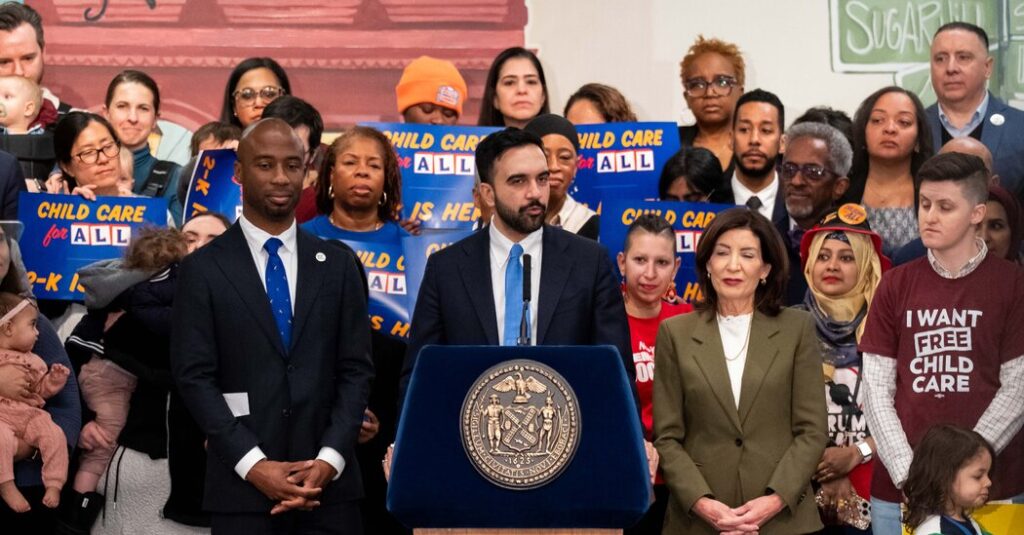
Mayor Zohran Mamdani has chosen four areas of New York City to kick-start his push to provide free child care for 2-year-olds — an early step in what is sure to be a long road to fulfilling his promise to create a universal child care system.
The first 2,000 seats in the program, known as 2-K, will be distributed across a diverse set of largely — but not exclusively — low-income parts of the city in four of the five boroughs and will be available this fall. Mr. Mamdani announced the plan at a news conference with Gov. Kathy Hochul, who is funding the expansion, in Upper Manhattan on Tuesday morning.
The city will work with existing child care providers in Canarsie, Brownsville and Ocean Hill in Brooklyn; Washington Heights and Inwood in Manhattan; Fordham and Kingsbridge in the Bronx and Ozone Park, Richmond Hill, Woodhaven and the Rockaways in Queens to provide the seats.
Children who live in five local school districts that include those neighborhoods — districts 6, 10, 18, 23 and 27 — will have access to the seats.
The spaces being offered this fall represent only a fraction of the seats the Mamdani administration hopes to create for 2-year-olds over the next four years, at which point it estimates the program will be universal. About 12,000 2-K seats will be available next fall, and advocates estimate that about 55,000 children will use the program once it is fully built out.
Despite a public victory lap from Mr. Mamdani and Ms. Hochul over their agreement that the state would put up $73 million for the first year of 2-K and about $425 million for the second, there is not yet a plan to fund the program after that. But on Tuesday, Ms. Hochul hinted that she was willing to put up more money for the program in future years.
“The state of New York is not walking away,” she said, “not now, not ever, you can count on that.”
Still, many questions remain about how the city will run what amounts to the most ambitious expansion of the social safety net in decades.
It will have to resolve longstanding issues over low pay for child care workers, which will require negotiations with several unions and could prove extremely expensive in the long run. And it will have to find and train scores of new employees to work in both existing child care programs and centers that are yet to be built.
The funding gap amplifies pressure on the mayor to ensure a successful debut, since he will need support from parents who can then lobby the governor and state legislators to extend funding for 2-K, or to raise taxes to pay for the program.
Mr. Mamdani projected optimism on Tuesday.
“We’re making what Wall Street would call a good investment,” he said, predicting that more families with young children would be able to stay in the city because of 2-K. “We will support and grow our work force, we will grow our tax revenue, and we will grow as a city,” he said.
Mr. Mamdani’s choice of neighborhoods that will get the first wave of 2-K seats — which could appear at first blush like a workaday bureaucratic decision — could help influence the political future of universal child care in New York, the most significant piece of the mayor’s promise to expand the city’s social safety net.
With his selection, he is trying to accomplish several goals at once. He is on the hook to respond to pleas from many of his voters in low-income neighborhoods to expand the availability of free child care. He also needs to project his administration’s seriousness about extending free services to all New Yorkers — including families who may be very eager for child care but are not living in poverty.
The four communities Mr. Mamdani has chosen include mostly low-income neighborhoods with increasingly gentrified pockets, whose residents include upwardly mobile parents who have the resources and connections to push for a greater expansion.
The popularity of former Mayor Bill de Blasio’s 3-K and pre-K programs with middle-class families was considered key to their political success. One of the architects of those programs, Emmy Liss, now runs Mr. Mamdani’s child care office.
The areas were selected in order to bolster a view that Ms. Liss and Mr. Mamdani share — that child care should be free for all families, not only low-income ones. In an interview, Ms. Liss said the selection of neighborhoods helped “underscore our commitment to universality” over the next few years.
She said the city intentionally chose “a diverse set of communities” so that it could learn about what families wanted from 2-K and what child care providers needed to offer the program.
Ms. Liss said part of the reason that exclusively low-income neighborhoods were not chosen for the initial rollout was that many of them did not have enough existing child care infrastructure to be ready to offer 2-K by September.
The largely Latino neighborhoods of Washington Heights and Inwood have in the last two decades attracted more middle-class white families, who are drawn to apartments on some of the last remaining affordable blocks in Manhattan. Among them is a subset of parents who have helped create a new advocacy movement that has successfully pushed local politicians to prioritize child care.
The early 2-K rollout also involves one of the most economically diverse sections of the Bronx, including the affluent, quasi-suburban neighborhood of Riverdale, along with Fordham, a lower-income neighborhood home to a large immigrant population.
Brooklyn’s first 2-K seats will be in Canarsie, Brownsville and Ocean Hill, three mainly Black neighborhoods that in recent years have seen small pockets of gentrification on their fringes.
And seats will open in a section of Queens that includes public housing projects in the Rockaways, predominantly white neighborhoods on the beach, the largely Latino neighborhood of Woodhaven and a growing South Asian community in Ozone Park and Richmond Hill.
Kamar Samuels, the city’s schools chancellor, said Tuesday that help was on the way soon — at least over the next four years — for parents in other school districts.
“This is a first phase,” he said, “and not a final answer.”
Eliza Shapiro reports on New York City for The Times.
The post Mamdani Announces First 2-K Seats in Universal Child Care Expansion appeared first on New York Times.