Over the past two weeks in a Georgia courtroom, prosecutors portrayed Colin Gray as ignoring obvious warning signs as his son, Colt careened toward catastrophe. The teenager had bursts of anger and nursed an obsession with school shooters. Instead of getting help, the father gave him an assault-style rifle as a Christmas gift and let him keep it in his room.
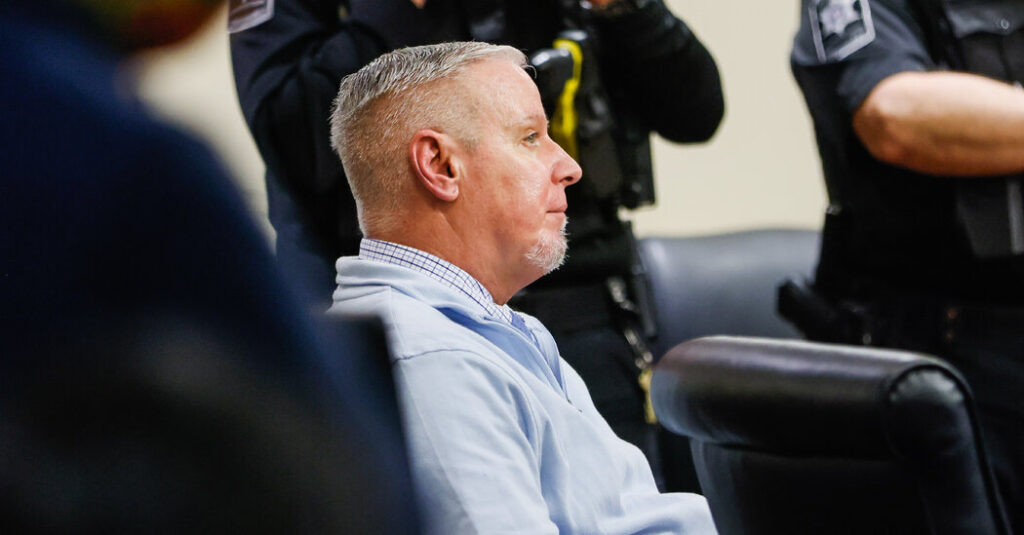
On Tuesday, a jury deliberated for less than two hours before finding the elder Mr. Gray guilty of murder and manslaughter. The son, now 16, has been charged with opening fire at Apalachee High School in Winder, Ga., in 2024, killing two students and two teachers. But before his trial has even been scheduled, jurors decided that the father bore criminal responsibility for the attack.
The prosecutors’ strategy — trying to hold parents accountable when their child is accused of a mass shooting — has gained traction across the country in recent years. But this time, the accountability for the father came before the son’s guilt had been determined. And the punishment may be far more severe than that in previous such cases: The father could be sentenced to spend the rest of his life in prison before his son’s trial is scheduled.
The elder Mr. Gray looked ahead blankly, pursing his lips, as the verdict was read on Tuesday. Afterward, the lead prosecutor in the case said the outcome not only secured a measure of justice for victims, but sent a powerful message to other parents about the consequences of failing to act decisively if they see their child struggling.
“This was multiple warnings over a lengthy period of time,” Brad Smith, the district attorney for Barrow County, Ga., told reporters outside the county courthouse. “You just had to do one thing, take that rifle away, and this would have been prevented.”
The first parents convicted in such a casewere those of Ethan Crumbley, a teenager sentenced to life in prison for fatally shooting four people at his Michigan high school in 2021. His father and mother were both found guilty of involuntary manslaughter and sentenced to 10 to 15 years in prison.
In Georgia, prosecutors sought to persuade jurors that the case was not as complicated as it might seem: They emphasized that the elder Mr. Gray had given his son the powerful rifle and that he did not take it away despite ample evidence of his son’s mental health problems.
But defense lawyers argued that it was unfair to say with the clarity of hindsight that the father should have been more cautious.
The elder Mr. Gray testified in his own defense, describing his struggles to connect with his son and help him as he struggled with panic attacks, intense anger and other behavioral issues. He had bought the gun to draw his son away from video games and the internet.
But he also said that despite his son’s emotional volatility, he had no reason to suspect that he was plotting a school shooting.
“There’s this whole other side of Colt I didn’t know existed,” he said.
Prosecutors showed jurors snippets of a text exchange between the father and his daughter after reports began to spread of a shooting at Apalachee High School, in which he asked if she had been in touch with her brother and she replied, “I think we’re thinking the same thing.”
When the police arrived at the family home, before officers could explain why they were there, Mr. Gray told them, “I knew it.”
During the trial, prosecutors tried to show that the son’s mounting struggles and capacity for violence were anything but hidden.
They painted a picture of a young man drowning in family chaos. His parents fought. His mother struggled with addiction. They moved constantly, forcing the younger Mr. Gray to switch schools repeatedly through elementary and middle school. Absences stacked up. He missed his eighth-grade year entirely.
By the time he enrolled at Apalachee High School for ninth grade, the boy was telling relatives about voices in his head. His grandmother testified that he had asked whether she would still love him if he did something terrible.
His parents discussed and researched possible psychological treatment, but never followed through. Instead, they gave him antidepressants prescribed to his mother, according to the prosecution.
In the years leading up to the attack, Colt Gray developed an obsession with gunmen in high-profile school shootings, particularly the teenager convicted of killing 17 people in Parkland, Fla., in 2018. He had photographs of the gunman and clippings of news coverage of the shooting on his wall. His father claimed to not recognize the person in the photos, at one point telling investigators he thought it might be a member of the rock band Green Day.
The shooting happened on Sept. 4, 2024, several weeks after the school year had began, but it was only the fifth day that the younger Mr. Gray, then 14, attended classes. He brought the gun to school in his backpack, using poster board to cover the portion that poked out.
In his first period class, he asked his teacher if the school had done active shooter drills; she said there had been one the previous week. The question unnerved her, prosecutors said, prompting her to email a counselor and a vice principal.
During the next period, he asked to go to the counselor’s office but instead locked himself in a bathroom stall for 26 minutes. Around that time, his mother called the school, apparently alarmed by a text message.
But school officers were delayed in intervening because they confused Colt Gray with another student whose name was almost identical and looked for that student instead. Colt Gray emerged from the bathroom and opened fire in a classroom and hallway before he was cornered by school resource officers.
In a search of his home, investigators found detailed plans for the attack.
Lawyers for the elder Mr. Gray argued during the trial that he had not broken the law by having the rifle and ammunition in his home. Jimmy Berry, a defense lawyer, told jurors that prosecutors needed to prove that the elder Mr. Gray “knew that Colt would, not could,” carry out the shooting, and that he did not believe they had done so.
He acknowledged the horror of the attack, but said that one person was responsible and it was not the father. “This is the person who should be punished,” Mr. Berry said, holding up a booking photograph of Colt Gray.
Alessandro Marazzi Sassoon contributed reporting from Winder, Ga.
Rick Rojas is the Atlanta bureau chief for The Times, leading coverage of the South.
The post Father’s Murder Conviction in School Attack Puts New Onus on Parents appeared first on New York Times.