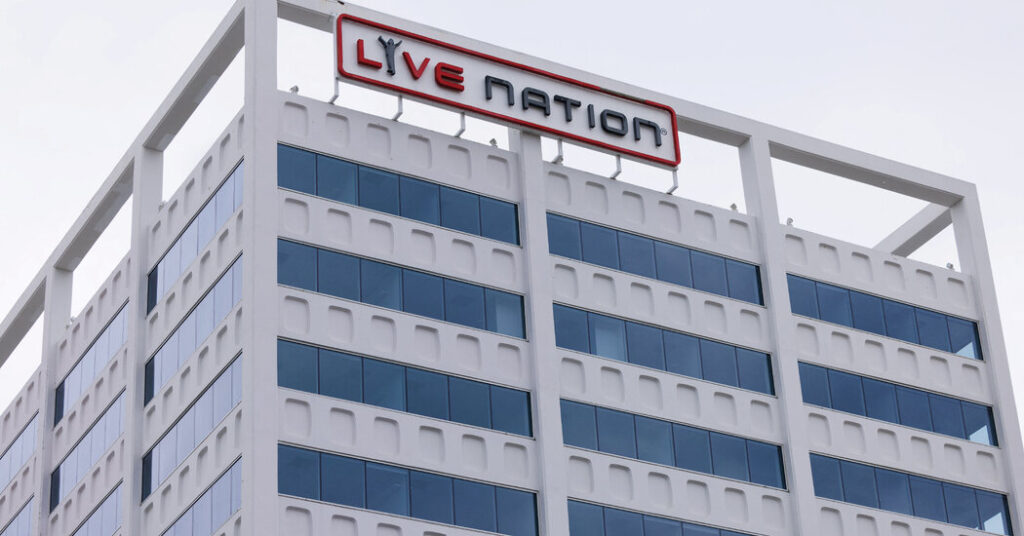
As it began its antitrust case against Live Nation on Tuesday, the Justice Department accused the giant concert company that owns Ticketmaster of deploying a far-reaching monopoly to stifle competition, dominate the ticketing market and extract money from fans through high ticket prices and surcharges.
“We are here because they misuse their market power,” David E. Dahlquist, a lawyer in the Justice Department’s antitrust division, said in an opening statement at the government’s long-awaited antitrust trial at Federal District Court in Manhattan. “They earn their profits through illegal action,” he added.
The government says Live Nation retains its grip on the music industry with strong-arm tactics like demanding that artists use its promotion services in order to perform in its amphitheaters. Major venues, the government says, are pressured into signing deals with Ticketmaster by the prospect of losing out on its popular tours the company controls.
As a remedy, the government is looking to break up the company — basically undoing the 2010 merger between Live Nation and Ticketmaster that it once approved and that it now blames for creating a colossus with no equal in the live entertainment world.
“This case is about power,” Mr. Dahlquist said, “the power of a monopolist to control competition.”
Live Nation argued to the jury that all of that is false.
Even though it is by far the biggest power in live music, David R. Marriott, a lawyer for Live Nation, said, the company is no monopoly. Instead, he argued, it has minimal profit margins, fights for every deal in a hypercompetitive business and does not make threats. The customers at the heart of the government’s case, he argued, are powerful and sophisticated counterparties: superstar artists and large venues owned by powerful entertainment companies.
“This marketplace,” Mr. Marriott said, “is more competitive than ever it has been before.”
In fact, he argued, the company is devoted to serving artists and delivering a product that fans enjoy — and doing so within the confines of the law.
“Live Nation and Ticketmaster are all about bringing joy to people’s lives,” Mr. Marriott said. “And doing it lawfully and doing it legitimately.”
The case, which the government brought almost two years ago, has the potential to reshape the lucrative touring industry. Since Live Nation merged with Ticketmaster in 2016, ticket prices — and artists’ touring grosses — have risen to record levels. But Live Nation and Ticketmaster have faced regular complaints from rival touring and ticketing companies who say the competitive landscape is unfair.
Even if the government prevails in the case, it is unclear whether a divestment that separates Live Nation’s touring division from Ticketmaster would occur.
In a ruling last month, the judge overseeing the trial, Arun Subramanian, narrowed the government’s case, dismissing some accusations about how Live Nation acts as monopolist, including how it sells tickets to the public and how it works with artists to put on tours in “major concert venues,” a segment of the market that the government defines as including arenas and large amphitheaters, but not stadiums. (The government is still targeting those venues when it comes ticketing deals.)
The government has said that Ticketmaster handles the ticketing for 86 percent of those “major” venues.
“This is not healthy competition,” Mr. Dahlquist said.
But Mr. Marriott, one of the lawyers representing Live Nation, disputed that market definition, saying the government was “cherry picking” venues to present the jury an arbitrary subset of venues that supported its statistic but does not reflect the reality of the business.
A more accurate view of the ticketing business, covering a wider group of large venues and events is “more in the neighborhood of 40 percent,” Mr. Marriott said.
Data and market definitions can play a critical part in an antitrust case where decisions can rest on whether a company has a dominant market share.
The government also sought to highlight Live Nation’s spotty record in serving members of the public through Ticketmaster. Mr. Dahlquist pointed to the botched ticket sale for Taylor Swift’s Eras Tour in 2022, when millions of fans were shut out — an incident that led to a combative Senate Judiciary hearing in early 2023, when lawmakers from both parties called Live Nation a monopoly.
Mr. Dahlquist said problems like those surrounding the Swift sale were signs that Live Nation, because of its monopoly power, did not need to have Ticketmaster operate efficiently. Rather than build the best ticketing technology, he said, Live Nation had underinvested in Ticketmaster because it does not face a major competitor.
“Their technology,” Mr. Dahlquist said, “is held together by duct tape.”
Mr. Marriott disputed that analysis, arguing that the Swift sale had been disrupted by a massive attack from online bots — and that rather than failing, Ticketmaster’s engineers had the system back up and running in a few hours.
The case is anticipated to last six weeks. A majority of the witnesses are expected to be top executives from throughout the music business, among them Michael Rapino, Live Nation’s longtime chief executive. One of the few top artists on the witness lists is Kid Rock, the outspoken rap-rock star who has emerged as a vocal critic of the industry’s status quo when it comes to ticketing.
On Wednesday, the first witness is expected to be the former chief executive of the company behind the Barclays Center, the basketball and music arena in Brooklyn. Barclays broke with Ticketmaster in 2021 in favor of SeatGeek — and, according to a the government, suffered a loss of Live Nation-promoted tours in retaliation, before returning to Ticketmaster less than two years later.
The Justice Department was joined in the case by the attorneys general of 39 states and the District of Columbia. In a brief statement to the jury, Jonathan Hatch, of the New York attorney general’s office, discussed potential damages in the case in terms of the impact on consumers who, according to the government’s case, paid higher fees that Live Nation and Ticketmaster were able to charge because of their monopoly power.
Mr. Hatch said fans paid $1.56 to $1.72 more for every ticket as a result of Live Nation’s “overcharge.”
“We are talking,” Mr. Hatch said, “about real money coming out of people’s wallets.”
Olivia Bensimon contributed reporting.
Ben Sisario, a reporter covering music and the music industry, has been writing for The Times for more than 20 years.
The post Live Nation Accused of Hurting Music Fans as Antitrust Trial Begins appeared first on New York Times.